Adding a second monitor is not as simple as choosing a splitter. Some models mirror one source across two screens, while others use USB-C, DisplayPort MST, or DisplayLink technology to create genuinely independent extended desktops.
This roundup compares 10 options for home offices, gaming setups, laptops, and multi-screen workstations, with attention to resolution, refresh rate, operating-system support, and connection type.
Best 10 Hdmi Splitters for Dual Displays Picks for 2026
Best for MacBook Expansion
OREI SplitExtend Dual-Monitor Adapter

- Extends to two HDMI monitors
- Up to 4K at 60Hz
- Supports Apple M1/M2/M3 Macs
Best For: Productivity users needing two external HDMI displays
Best for Mirrored Displays
avedio links 1x2 HDMI Splitter

- Mirrors one source to two displays
- Supports 4K at 30Hz
- Includes HDMI and USB power cables
Best For: Presentations, signage, and shared video feeds
Best for Dual 4K Extension

- Dual extended 4K at 60Hz
- USB-C and USB-A connectivity
- Supports newer Apple Silicon Macs
Best For: Productivity workstations needing two independent 4K screens
Simple HDMI Mirroring

- Mirrors one HDMI source on two displays
- Supports up to 4K at 30Hz
- Driver-free setup with synchronized audio
Best For: Mirrored presentations, videos, and console output
Extended Desktop Setup
OREI Dual-Monitor HDMI Adapter

- Supports mirrored or extended dual-monitor viewing
- Works with USB-A, USB-C, Thunderbolt, and USB4 devices
- Requires Silicon Motion driver installation
Best For: Compatible laptop users building a three-screen workstation
Best Overall
Dual 4K DisplayPort to HDMI Adapter
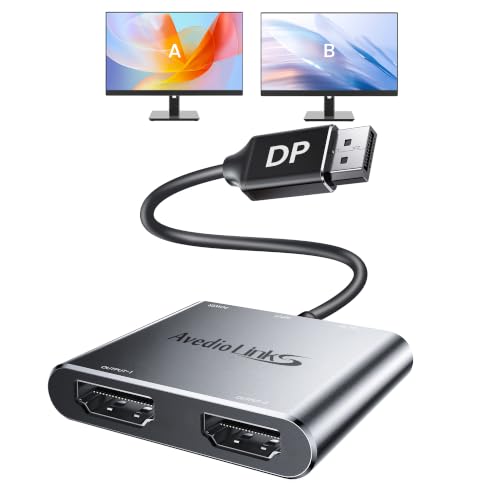
- Extends a Windows desktop across two HDMI monitors
- Supports dual 4K@60Hz with a DP 1.4a-or-higher source
- Automatically adapts to connected display resolutions
Best For: Windows multitasking setups with two HDMI monitors
Best for Desktop PCs

- Provides two HDMI outputs from one DisplayPort input
- Supports Windows extended and clone display modes
- Compact 28cm integrated cable helps reduce port strain
Best For: Desktop PCs and graphics cards with MST support
Best for MacBook Expansion – OREI SplitExtend Dual-Monitor Adapter
The OREI SplitExtend is one of the more flexible HDMI splitters for dual displays when you need to connect two HDMI monitors to a laptop or desktop. Its hybrid cable supports USB-C, USB-A 3.1, Thunderbolt 3/4, and USB4, while DisplayLink enables extended screens on supported Windows, macOS, ChromeOS, and Android devices. A driver is required for Windows and macOS.
Best For: Productivity users who want two external HDMI monitors plus their laptop display, including users with Apple M1, M2, or M3 MacBooks.
Pros:
- Supports extended display across two HDMI monitors.
- Offers up to 4K at 60Hz and 2K at 60Hz on the connected screens.
- Includes a versatile USB-C/USB-A connection cable and one-year warranty.
Cons:
- DisplayLink driver installation is required on Windows and macOS.
- Not recommended for gaming, graphics-intensive work, or design applications.
- Does not support HDCP-protected playback from services such as Netflix and Hulu.
This is a practical choice for office work, web browsing, and multitasking, especially if you need Mac extended-display support. Check your operating system and install the required DisplayLink software before use.
Best Plug-and-Play Pick – USB-C to Dual HDMI Adapter
This USB-C adapter is a straightforward option among HDMI splitters for dual displays, with two HDMI outputs and no driver installation required. It supports a single 4K display at 60Hz or dual 4K displays at 30Hz, provided the host device has a full-featured USB-C, USB4, or Thunderbolt port with video output.
Best For: Windows and ChromeOS users who want quick dual-monitor setup, plus macOS users who only need mirrored output.
Pros:
- Provides single 4K at 60Hz or dual 4K at 30Hz output.
- Plug-and-play operation requires no extra drivers or software.
- Works with USB-C, USB4, and Thunderbolt devices and includes a 24-month return or replacement guarantee.
Cons:
- macOS supports mirror mode only and cannot extend two distinct screens.
- Requires a USB-C port with DP Alt Mode or another supported video-output standard.
- Standard HDMI cables are required separately.
Its driver-free design makes setup simple, but compatibility is the key consideration. Confirm that your computer’s USB-C port supports video output; Mac users should choose it only if mirrored displays meet their needs.
Best for Mirrored Displays – avedio links 1×2 HDMI Splitter
The avedio links 1×2 is a conventional HDMI splitter for dual displays that duplicates one HDMI source on two screens. It is designed for simultaneous mirrored video and audio rather than an extended desktop, making it suitable for showing the same presentation, console feed, or media source on multiple displays.
Best For: Users who need one HDMI source mirrored to two monitors, TVs, projectors, or other HDMI displays.
Pros:
- Mirrors one HDMI input to two displays simultaneously.
- Supports up to 4K at 30Hz and lower resolutions including 1080p at 50/60Hz.
- Includes a 4-foot HDMI cable and USB power cable.
Cons:
- Cannot extend the desktop or show different content on each monitor.
- Requires a 5V power source; the power adapter is not included.
- Not compatible with HDCP 2.2.
This splitter is a good fit when duplication—not independent displays—is the goal. If you need two separate workspaces, choose a DisplayLink or USB-C adapter instead.
Best for Dual 4K Extension – WAVLINK DisplayLink Adapter
The WAVLINK adapter is a strong productivity-focused choice among HDMI splitters for dual displays, delivering two extended 4K screens at 60Hz from a compatible USB-C, USB-A 3.0, Thunderbolt, or USB4 port. It uses DisplayLink and supports recent Windows, macOS, and ChromeOS systems, but driver installation is required.
Best For: Mac and Windows productivity setups that need two independent 4K monitors from one compatible USB port.
Pros:
- Supports two simultaneous extended 4K displays at 60Hz.
- Hybrid cable connects to USB-C, USB-A, Thunderbolt 3/4, and USB4 ports.
- Supports Apple M1 through M5 Macs and includes warranty and technical support.
Cons:
- DisplayLink driver installation is required.
- Not recommended for gaming, graphics-intensive applications, or design work.
- Does not support HDCP-protected playback from services such as Netflix and Hulu.
For office multitasking, this adapter offers the most capable display setup in the group. Verify operating-system support and plan for the DisplayLink installation before connecting your monitors.
Simple HDMI Mirroring – 4K 1-in-2 HDMI Splitter
This compact option is a straightforward choice among HDMI splitters for dual displays when you want one HDMI source shown on two screens. It supports mirrored output, up to 4K at 30Hz, and synchronized audio without requiring drivers or a separate audio cable.
Best For: Users who need to display the same content from a laptop, PC, TV box, game console, or other HDMI source on two monitors, TVs, or projectors.
Pros:
- Splits one HDMI input to two HDMI displays.
- Supports up to 4K at 30Hz, plus 2K and 1080p at 60Hz.
- Easy driver-free setup with synchronized HDMI audio.
Cons:
- The two splitter outputs must show the same content; it does not provide independent extended desktops.
- Actual resolution depends on the connected devices and display settings.
This is a practical, lightweight splitter for presentations, video playback, and duplicate-screen monitoring. Choose it when simple mirrored output matters more than separate desktop expansion.
Extended Desktop Setup – OREI Dual-Monitor HDMI Adapter
For shoppers comparing HDMI splitters for dual displays, this OREI adapter is designed for both mirrored and extended viewing from one computer. It can support a laptop screen plus two external monitors, but it requires Silicon Motion driver installation and an Intel i5 processor or higher for optimal performance.
Best For: Windows, macOS, Chrome OS, or compatible Android users who want a two-monitor workstation and can install the required driver.
Pros:
- Supports mirrored or extended display across two external monitors.
- Can create a three-screen setup when used with a laptop display.
- Integrated USB-A and USB-C connectivity supports a range of compatible devices.
- Includes one-year manufacturer support.
Cons:
- Not plug-and-play; Silicon Motion driver installation is required.
- Not compatible with iOS, Linux, or Unix.
- Android output is limited to 1080p mirroring.
This is the more workstation-focused choice in the group, especially for compatible Windows laptops. Confirm operating-system support, processor requirements, and permission to install drivers before buying.
USB-C Productivity Hub – Fophmo Dual HDTV Adapter
This USB-C hub combines dual-display connectivity with charging and USB data, making it a versatile alternative among HDMI splitters for dual displays. It supports dual monitors up to 4K at 30Hz, while a single HDMI output can reach 4K at 60Hz, subject to host, cable, and monitor capabilities.
Best For: Windows laptop users with USB-C DisplayPort Alt Mode who want extended dual-monitor output alongside 100W Power Delivery and a USB-A port.
Pros:
- Supports extended displays on compatible Windows devices.
- Provides two HDMI outputs, USB-A data, and up to 100W Power Delivery.
- Offers dual 4K output at 30Hz or single 4K output at 60Hz.
- Plug-and-play design for compatible devices.
Cons:
- macOS supports mirror mode only rather than two separate extended screens.
- The host USB-C port must support DisplayPort Alt Mode.
- A charger is not included, and some listed laptop models are incompatible.
This adapter is a strong fit for a compact home-office setup, provided the laptop supports USB-C video output. Check the device list and look for DisplayPort Alt Mode support before purchasing.
Best Overall – Dual 4K DisplayPort to HDMI Adapter
If you need HDMI splitters for dual displays, this DisplayPort-to-dual-HDMI adapter is a flexible choice for Windows PCs and laptops. It supports extended desktop viewing across two monitors, automatic resolution adaptation, and dual 4K output when paired with a compatible DisplayPort 1.4a-or-higher source.
Best For: Windows users who want two HDMI monitors for multitasking, office work, presentations, or gaming.
Pros:
- Supports extended mode on Windows for viewing different content on two screens.
- Can deliver 4K at 60Hz to both HDMI monitors with a suitable DP 1.4a-or-higher source.
- Automatically adapts to connected monitor resolutions.
- May operate without external power when the DisplayPort source supplies enough power.
Cons:
- Requires USB power if the DisplayPort source does not provide sufficient power.
- macOS supports mirror mode only, not extended mode.
- Refresh rates require manual setting.
This is a strong all-around option when Windows extended display support and flexible power operation matter. Check your source’s DisplayPort version before expecting dual 4K at 60Hz.
Best for Desktop PCs – USB-C Powered DP MST Hub
For desktop users comparing HDMI splitters for dual displays, this compact DisplayPort MST hub provides two HDMI outputs from one DP port. It supports extended and clone modes, with dual 4K at 60Hz possible when the source uses DP 1.4 with DSC and the cables and monitors support it.
Best For: Desktop PCs and graphics cards used for stock trading, programming, video editing, presentations, and home offices.
Pros:
- Supports extended desktop and clone modes on Windows 10 and 11.
- Offers two HDMI outputs from a single DisplayPort connection.
- Compact design with an integrated 28cm cable helps reduce port strain.
- Works with AMD, NVIDIA, and Intel graphics cards supporting DP 1.2 or higher with MST.
Cons:
- Requires USB-C power at 5V/2A; the power adapter is not included.
- macOS supports clone mode only, not extended MST mode.
- Integrated graphics may have limited functionality.
This hub is especially practical for a desktop PC with HDMI monitors and a compatible DisplayPort graphics output. Confirm MST support and plan for a separate USB power source during setup.
Best Build – Braided Dual HDMI DisplayPort Adapter
This DisplayPort-to-dual-HDMI adapter is a durable option for shoppers seeking HDMI splitters for dual displays. It provides extended or mirrored output, uses an aluminum housing with gold-plated ports, and supports up to 4K at 30Hz when both HDMI outputs are active.
Best For: PC, mini PC, and graphics-card users who prioritize a reinforced design and straightforward dual-monitor setup.
Pros:
- Supports extended and mirrored display modes, with SST-only operation on macOS.
- Aluminum housing, gold-plated ports, and nylon-braided cable support repeated use.
- Supports resolutions up to 4K on HDMI outputs and is backward compatible with lower resolutions.
- Plug-and-play setup uses the included USB-C power cable.
Cons:
- Dual HDMI screens are limited to 4K at 30Hz according to the supplied notes.
- Requires USB-C power at a minimum of 5V/1A.
- Does not support hubs, docking stations, KVM switches, or adapters.
The reinforced construction makes this a sensible pick for a frequently used workstation. Its main tradeoff is the lower 4K refresh rate in dual-output mode, so verify your monitor requirements before buying.
How We Picked These Hdmi Splitters for Dual Displays
We grouped the selected products by the connection they require and the type of dual-screen output they provide. The list includes conventional HDMI 1-in-2-out splitters, USB-C adapters, DisplayPort-to-HDMI MST hubs, and DisplayLink-based solutions. We also considered stated support for 4K resolution, 60Hz refresh rates, extended versus mirrored desktops, power requirements, and compatibility with Windows and macOS.
Specifications can vary by computer, cable, monitor, and operating system. Treat “4K” as a resolution claim rather than a guarantee that every two-display configuration will run at 4K and 60Hz simultaneously.
Quick Comparison
| Type | Best For | Important Limitation |
|---|---|---|
| HDMI 1-in-2-out splitter | Mirroring one source on two screens | Usually cannot create an extended desktop |
| USB-C dual HDMI adapter | Laptops with compatible USB-C video output | Host port and operating-system support vary |
| DisplayPort MST hub | Extended displays from a compatible DP or USB-C source | Requires MST support and adequate bandwidth |
| DisplayLink adapter | Flexible multi-monitor laptop setups | Requires drivers and may not suit high-performance gaming |
Key Buying Factors for Hdmi Splitters for Dual Displays
Mirror Versus Extend
This is the most important distinction. A mirror-only splitter shows the same image on both monitors, which is useful for presentations, signage, teaching, or a duplicated preview. An extended-display adapter gives each monitor its own desktop area, which is better for multitasking. Check the product description carefully because “dual monitor” does not always mean independent screens.
Input and Output Compatibility
Match the splitter to your computer’s available port. Standard HDMI splitters need an HDMI source, while USB-C models require a USB-C port that supports DisplayPort Alt Mode unless they use DisplayLink. DisplayPort MST products need a compatible DisplayPort output, and some USB-C computers support MST while others do not. HDMI outputs also require suitable HDMI cables and monitors.
Resolution, Refresh Rate, and Bandwidth
For office work, 1080p or 1440p can be sufficient. Choose a model advertised for 4K at 60Hz if you need sharper text, smoother motion, or modern high-resolution monitors. Running two displays at once can reduce the maximum supported resolution or refresh rate, so verify the specifications for dual-output use rather than single-screen operation.
Power, Drivers, and MacOS Support
Bus-powered adapters are convenient, but demanding configurations may need USB-C power delivery or an external power source. DisplayLink devices generally require software and can behave differently across operating systems. macOS support deserves special attention: some adapters extend displays, some mirror only, and some require additional configuration.
Who Should Buy Which Hdmi Splitters for Dual Displays?
Choose a basic HDMI 1-in-2-out splitter when you only need identical images on two screens. Pick a USB-C dual HDMI adapter for a modern laptop with video-capable USB-C and a straightforward desk setup. A DisplayPort MST hub is usually the better choice for a desktop or workstation that supports native multi-monitor output. Consider DisplayLink when your laptop lacks enough native display outputs or you need a flexible dock-style solution, provided you are comfortable installing drivers. For gaming, prioritize native HDMI or DisplayPort bandwidth, confirmed refresh-rate support, and low-latency operation over generic splitter terminology.