Choosing among the best resin printers for prototypes means balancing fine detail, print speed, build volume, reliability, and operating cost. Resin printers can produce smooth surfaces and precise features that are useful for fit checks, display models, housings, and early design validation.
This roundup compares 10 current options across compact, mid-size, and large-format categories, so you can match printer capabilities to your prototype workflow instead of paying for features you will not use.
Best 10 Resin Printers for Prototypes Picks for 2026
Fast Detail Specialist
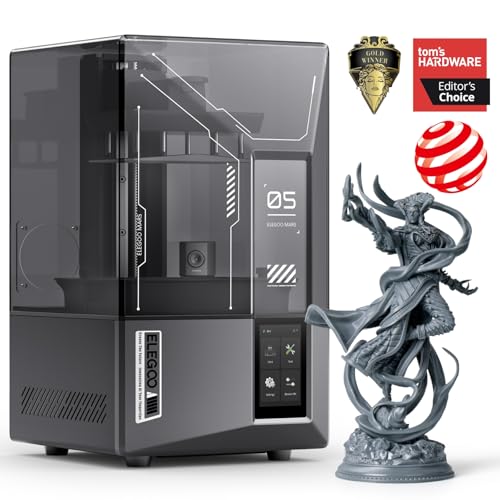
- 9K mono LCD with 18 μm XY resolution
- Up to 150 mm/h with tilt release
- AI monitoring and Wi-Fi cluster printing
Best For: Detailed prototypes and fast multi-printer workflows
Precision Production Platform
Reflex RS Turbo Resin 3D Printer

- High-contrast 566:1 amber screen
- Automated repair, supports, and leveling
- Force monitoring with diagnostic reports
Best For: Professional, repeatable prototype production
Large-Format Detail Leader

- 16K LCD with 14 × 19 μm pixels
- Larger 8.33 × 4.66 × 8.66-inch build area
- Heated resin tank and AI monitoring
Best For: Large, highly detailed prototypes
Easy Industrial-Resin Workhorse

- 14K LCD for crisp prototype details
- Automatic leveling and AI inspection
- Handles resins up to 8,000 cps
Best For: Advanced materials and low-calibration workflows
Best for High-Detail Prototyping
UniFormation GK3T 16K Resin Printer

- 16K resolution with 14×19μm pixels
- Factory pre-leveling and smart resin handling
- Heated resin system and remote monitoring
Best For: Detailed prototypes and automated workflows
Best Beginner-Friendly Value

- 7-inch 10K mono LCD
- 153.4 × 87 × 165 mm build volume
- Beginner-oriented four-point leveling
Best For: Small-to-medium prototypes and first-time users
Best Beginner Pick

- 9K LCD with 18μm XY resolution
- Pre-leveled platform for easier setup
- USB, WiFi, and Creality Cloud transfer
Best For: Beginners making detailed small prototypes
Best Balanced Option

- 10K LCD with 17μm XY pixel size
- Uniform LighTurbo matrix light source
- Power-loss resume and stable build platform
Best For: Detailed mid-size prototype iterations
Best for Production Runs

- Large 33 × 18.5 × 30 cm build plate
- Designed for high-volume batch printing
- 43μm detail with 15-inch 8K LCD
Best For: Professional studios producing prototype batches
Fast Detail Specialist – ELEGOO Mars 5 Ultra
The ELEGOO Mars 5 Ultra is a practical choice among resin printers for prototypes when you need fine detail, quick turnaround, and useful failure-monitoring features. Its 9K mono LCD delivers 18 μm XY resolution, while tilt release technology supports speeds up to 150 mm/h.
Best For: Prototype makers who want detailed prints, fast iteration, and remote control of multiple compatible printers.
Pros:
- 9K resolution and 18 μm XY resolution reproduce intricate details.
- Up to 150 mm/h printing with fast and slow modes.
- AI camera, residue detection, resin-shortage alerts, and leveling-failure alarms help reduce wasted prints.
- Wi-Fi cluster printing supports multi-printer workflows.
Cons:
- The AI detection results can vary with the environment, model, and resin type.
- Its listed build volume and screen size may be less suitable for especially large prototypes.
For detailed prototype work where speed and automated oversight matter, the Mars 5 Ultra offers a strong balance of precision and workflow efficiency.
Precision Production Platform – Reflex RS Turbo Resin 3D Printer
The Reflex RS Turbo targets demanding resin printers for prototypes with a high-contrast amber screen, automated preparation, and detailed motion monitoring. Its listed system is built around consistent dimensional accuracy, rapid curing, and process diagnostics.
Best For: Professional prototype workflows that prioritize repeatability, automated support generation, and advanced failure prevention.
Pros:
- High-contrast 566:1 amber screen is designed for sharper details and faster curing.
- One-click slicing repairs several model defects and generates supports automatically.
- Force sensors can detect fine residue, pause prints, and produce diagnostic reports.
- C5 ball-screw Z-axis offers ≤2 μm repeat positioning accuracy, with stated tolerances of ≤0.05 mm.
Cons:
- At 50.6 pounds, it is substantially heavier than the other listed options.
- Its advanced feature set may be more than casual prototype users need.
The RS Turbo is the most process-focused option in this group, making it appealing when prototype consistency and diagnostics are more important than simplicity.
Large-Format Detail Leader – ELEGOO Saturn 4 Ultra 16K
The ELEGOO Saturn 4 Ultra 16K is suited to resin printers for prototypes when larger models and extremely fine surface detail are priorities. It combines a 16K LCD, a comparatively spacious build area, heated resin management, and automatic monitoring.
Best For: Larger or highly detailed prototypes that benefit from temperature control, fast printing, and remote monitoring.
Pros:
- 16K resolution with 14 × 19 μm pixels supports intricate model detail.
- 8.33 × 4.66 × 8.66-inch printing size accommodates larger prototypes.
- Automatic resin heating activates below 25°C to help maintain printing conditions.
- Tilt release, AI monitoring, automatic leveling, power-resume, and Wi-Fi transfer support a streamlined workflow.
Cons:
- Its 35.4-pound weight and larger footprint require a sturdy, dedicated setup.
- The higher-resolution, larger-format feature set may be unnecessary for small, simple prototypes.
Choose the Saturn 4 Ultra 16K when prototype scale and detail both matter, especially if your workspace or resin conditions make automated monitoring valuable.
Easy Industrial-Resin Workhorse – ANYCUBIC Photon P1 14K
The ANYCUBIC Photon P1 is a strong option among resin printers for prototypes if you want automatic leveling, stable motion, and compatibility with very high-viscosity materials. Its 14K LCD is paired with release-force reduction and AI inspection features aimed at improving print reliability.
Best For: Advanced creators printing detailed prototypes with industrial or ultra-high-viscosity resins and minimal manual calibration.
Pros:
- 14K mono LCD provides 16.8 × 24.8 μm XY pixel size and supports fine details.
- Factory-calibrated Smart Leveling 3.0 performs self-checks and pressure feedback.
- Wave Release Technology reportedly reduces release force by 60%.
- Supports resins up to 8,000 cps, with preconfigured Anycubic resin settings.
Cons:
- Its 16.93 × 24.41 × 16.54-inch dimensions require considerable workspace.
- Advanced resin compatibility may be unnecessary for users working only with standard resins.
The Photon P1 stands out for material flexibility and hands-off setup, making it especially useful for prototype makers who work beyond standard resin formulations.
Best for High-Detail Prototyping – UniFormation GK3T 16K Resin Printer
For resin printers for prototypes, the UniFormation GK3T stands out with a 16K display, 14×19μm pixel size, and features designed to make repeat printing more manageable. Its heated resin system and factory pre-leveling are especially useful for users who want detailed output with less setup and seasonal variation.
Best For: Detailed prototypes, intricate models, and users seeking a more automated workflow.
Pros:
- 16K resolution and fine pixel size support sharp, smooth prototype surfaces.
- Factory pre-leveling, smart resin feeding, and a quick-release build plate simplify operation.
- Built-in heating supports resin fluidity in temperatures as low as 0°C/32°F.
- Remote monitoring, print controls, and timelapse photography add workflow convenience.
Cons:
- Its 52.8-pound weight and large footprint may require dedicated workspace.
- The advanced feature set may be more than needed for simple prototype work.
The GK3T is a strong choice when prototype detail and printing consistency matter more than compactness. Its temperature management and remote controls add practical value for longer or recurring print jobs.
Best Beginner-Friendly Value – ANYCUBIC Photon Mono 4
If you are comparing resin printers for prototypes and want a straightforward entry point, the ANYCUBIC Photon Mono 4 offers 10K resolution, a useful build volume, and a leveling process designed for beginners. Its uniform light source is intended to help produce detailed models with smoother surfaces.
Best For: First-time resin users, small-to-medium prototypes, and routine model printing.
Pros:
- 7-inch 10K screen with 17×17μm pixels supports detailed prints.
- 153.4 × 87 × 165 mm build volume accommodates a range of prototype sizes.
- LighTurbo matrix lighting helps reduce layer lines and rasterization.
- Four-point leveling only needs to be repeated after the initial setup, according to the supplied notes.
Cons:
- The Anycubic app is not supported for this model.
- Its build volume is smaller than the large-format option in this roundup.
The Photon Mono 4 is a practical pick for buyers who want high-resolution prototyping without moving into a large, heavy machine. The lack of app support is worth noting if phone-based control is important to your workflow.
Best for Large Prototype Runs – ELEGOO Jupiter 2 Large 16K Printer
Among resin printers for prototypes, the ELEGOO Jupiter 2 is built for scale. Its 302.4 × 161.98 × 300 mm build volume can handle larger parts or multiple smaller prototypes in one job, while 16K resolution and automated resin and temperature features support a more production-oriented workflow.
Best For: Large prototypes, batch printing, and users who need extensive build capacity.
Pros:
- Large build volume supports oversized parts or multiple models per print.
- 16K resolution and a fully enclosed light source are designed for detailed, uniform exposure.
- Auto leveling, smart tank heating, and automated resin management simplify longer jobs.
- Power-loss recovery, monitoring, alarms, and Wi-Fi cluster management add operational control.
Cons:
- The 63.8-pound printer requires substantial workspace.
- Its large format and extensive controls may be excessive for occasional small prints.
- Quick-swap film and other maintenance features still require routine upkeep.
The Jupiter 2 makes the most sense when throughput and part size are priorities. It is considerably less compact than the other options, but its capacity and automation are better suited to repeat prototype production.
Best Beginner Pick – Creality HALOT-X1 Neo
For makers comparing resin printers for prototypes, the Creality HALOT-X1 Neo emphasizes approachable setup and fine detail. Its pre-leveled platform, 9K LCD, and 18μm XY resolution make it suited to small, intricate prototype parts, miniatures, and concept models.
Best For: Beginners, desktop makers, and designers creating detailed small prototypes.
Pros:
- 9K resolution and 18μm XY pixel size capture fine details.
- Factory pre-leveled build platform supports a simpler start.
- Files can be transferred by USB, 2.4GHz WiFi, or Creality Cloud.
- Supports HALOT BOX, CHITUBOX, and Lychee Slicer workflows.
Cons:
- The 153.36 × 77.76 × 160 mm build volume is aimed at smaller projects.
- AI 2D-to-3D model generation can take up to 3.5 hours.
The HALOT-X1 Neo is a practical choice when ease of use and high-resolution detail matter more than oversized prototypes. Its compact build area fits desktop workflows, while multiple connectivity and slicing options leave room to refine your process.
Best Balanced Option – ANYCUBIC Photon Mono 4
The ANYCUBIC Photon Mono 4 is a balanced option among resin printers for prototypes, combining a 10K mono LCD with a moderate desktop footprint. Its 17μm XY pixel size, uniform LighTurbo lighting, and 153.4 × 87 × 165 mm build volume support detailed iteration work.
Best For: Prototype makers who want high detail, stable printing features, and a versatile mid-size build area.
Pros:
- 7-inch 10K LCD provides 17μm XY pixel resolution.
- LighTurbo matrix lighting is designed for balanced, uniform exposure.
- 1.5-second single-layer exposure times support efficient printing.
- Power-loss resume, pre-shipment testing, and a redesigned build platform support dependable operation.
Cons:
- The printer still requires first leveling after unpacking.
- Its build volume is not intended for large prototype batches or oversized parts.
Photon Mono 4 stands out for prototype users who want a straightforward machine with strong resolution and useful reliability features. The combination of a stable build platform and power-loss recovery can help reduce failed iterations and wasted resin.
Best for Production Runs – Phrozen Sonic Mega 8K S
For teams evaluating resin printers for prototypes at higher volume, the Phrozen Sonic Mega 8K S offers a substantially larger 33 × 18.5 × 30 cm build plate. Its 15-inch 8K mono LCD, 43μm XY resolution, and stated capacity for 80 1/32-scale miniatures in under 1.5 hours target production-oriented workflows.
Best For: Professional studios and commercial users producing large batches or larger detailed prototype models.
Pros:
- Large build plate supports high-volume batch production.
- 8K mono LCD delivers 43μm XY resolution across a large printing area.
- ACF film and TR300 resin are specified for speeds up to 10 times faster than standard mid-size printers.
- Built-in metal drip hanger helps recover excess resin and reduce workspace mess.
Cons:
- At 57.3 pounds, it is much less portable than desktop-size alternatives.
- The large footprint requires more workspace planning.
- Its speed claims are tied to the stated ACF and TR300 resin setup.
The Sonic Mega 8K S is the strongest fit when throughput and build capacity outweigh compactness. It is overkill for occasional small prototypes, but its large plate, production-focused speed setup, and resin-drip management make it compelling for repeat batches.
How We Picked These Resin Printers for Prototypes
We focused on specifications and features that matter during iterative product development: XY resolution, build volume, exposure consistency, leveling, print speed, workflow automation, connectivity, and ease of maintenance. We also considered whether each model is better suited to highly detailed small parts, repeated batches, larger enclosures, or general-purpose prototyping.
Resolution is only one part of the decision. A printer with a sharp LCD still needs dependable light uniformity, a stable build platform, compatible resin profiles, and software that makes repeat jobs easy to manage. Features such as auto-leveling, pre-leveled platforms, monitoring, and failure detection can reduce wasted material and setup time.
Quick Comparison
| Best For | What to Prioritize | Models to Consider |
|---|---|---|
| Small, highly detailed prototypes | High XY resolution and reliable exposure | ELEGOO Mars 5 Ultra, ANYCUBIC Photon Mono 4 |
| Large prototype parts | Build volume and sturdy motion components | ELEGOO Jupiter 2, Phrozen Sonic Mega 8K S |
| Fast design iteration | High-speed printing and automation | ELEGOO Saturn 4 Ultra, Reflex RS Turbo |
| Simple setup | Auto-leveling or a pre-leveled platform | ANYCUBIC Photon P1, Creality HALOT-X1 Neo |
| Stable production-oriented workflows | Consistency, monitoring, and repeatability | UniFormation GK3T, ELEGOO Saturn 4 Ultra |
Key Buying Factors for Resin Printers for Prototypes
Detail and Dimensional Accuracy
Fine XY resolution helps preserve small holes, text, edges, and mechanical features, but dimensional accuracy also depends on resin, exposure settings, orientation, supports, and post-processing. For tight-fit parts, plan to print calibration pieces before committing to a complete assembly.
Build Volume and Part Orientation
Choose a printer that can accommodate the largest prototype without excessive splitting. A larger platform can also improve batch production, while a compact machine may be more economical for individual components and consume less resin per job.
Speed, Reliability, and Automation
Fast exposure systems are useful when you are testing several design revisions, but reliable release from the build plate matters just as much. Auto-leveling, pre-leveled platforms, resin monitoring, remote connectivity, and failure-detection features can make frequent iteration less labor-intensive.
Resin, Ventilation, and Operating Costs
Budget for resin, replacement films, screens, build plates, cleaning supplies, gloves, and curing equipment. Standard resin is suitable for visual models, while tough, ABS-like, flexible, or engineering resins may be better for functional fit testing. Resin printing also requires appropriate ventilation and safe handling.
Who Should Buy Which Resin Printers for Prototypes?
Choose a compact high-resolution model if you mainly produce small housings, miniatures, connectors, or detailed form studies. A mid-size machine is the most versatile choice for designers who need a balance of detail, throughput, and manageable operating costs. Select a large-format printer when your prototypes are physically large or when batch output is more important than a small footprint.
For beginners or shared workspaces, prioritize simple leveling and dependable software over headline resolution. For experienced makers, engineers, and product teams, compare build volume, resin compatibility, repeatability, and serviceability first. The best Resin Printers for Prototypes are the ones that fit your part sizes and revision schedule while producing consistent results with a workflow your team can maintain.