Resin printing can produce exceptionally detailed miniatures, models, prototypes, and display pieces, but the right printer makes the learning curve much easier. The best resin printers for beginners combine reliable exposure, straightforward leveling, useful automation, and manageable maintenance.
We selected 10 models across compact, high-resolution, and larger-format categories so you can match your first resin printer to your workspace, project size, and comfort with post-processing.
Best 10 Resin Printers for Beginners Picks for 2026
Best Detail Value

- 7-inch 10K LCD with 17 × 17 μm XY pixels
- Beginner-friendly four-point leveling
- 153.4 × 87 × 165 mm build volume
Best For: Beginners prioritizing detailed prints and simple leveling
Best Fast Feature Set
- 9K mono LCD with 18 μm XY resolution
- Print speeds up to 150 mm/h
- AI camera and Wi-Fi cluster printing
Best For: Makers wanting speed and automated print monitoring
Best Plug-and-Play Choice

- Factory pre-leveled platform for easier setup
- 9K LCD with 18 μm XY resolution
- USB, Wi-Fi, and Creality Cloud transfer
Best For: First-time users making miniatures and intricate models
Best Simplified Setup
- One-click automatic leveling
- Self-check before each print
- 4K mono LCD with protective sensors
Best For: New users wanting guided setup and practical safeguards
Best for Hands-Off Precision

- 16K resolution with 14 × 19 μm pixels
- Factory pre-leveling and smart resin handling
- Heating and remote monitoring for easier printing
Best For: Beginners prioritizing detail and convenience
Best for Automated Reliability

- Factory-calibrated automatic leveling
- AI checks for common printing issues
- 14K detail and high-viscosity resin support
Best For: Beginners wanting guided setup and monitoring
Best for Fast High-Detail Printing

- 16K detail with an 8.33 × 4.66 × 8.66-inch build area
- Automatic resin heating and leveling
- 150 mm/h claimed speed with AI camera monitoring
Best For: Beginners wanting speed, automation, and detail
Best Beginner Detail Pick
- 7-inch 10K screen for fine detail
- Assembled and factory-calibrated
- Power-failure print recovery
Best For: Beginners who prioritize detailed models and easy setup
Best Automatic Setup
MALYAN S100 Mini Resin Printer

- Automatic calibration and leveling
- Compact 115 × 65 × 110 mm build area
- Removable magnetic build plate
Best For: First-time users printing small models in limited space
Best Larger-Volume Option

- 153.4 × 87 × 165 mm build volume
- 7-inch 10K mono LCD
- Assembled, calibrated, and tested
Best For: Beginners who want room for larger models and future projects
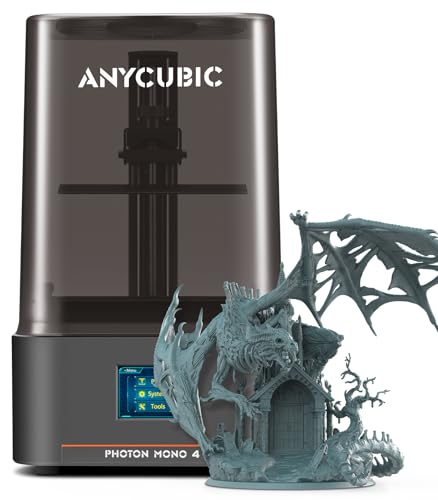
Best Detail Value – ANYCUBIC Photon Mono 4
For beginners comparing resin printers for beginners, the ANYCUBIC Photon Mono 4 combines a high-resolution 10K screen with a straightforward leveling process. Its moderate build volume suits everyday models while the laser-engraved platform is designed to support adhesion and easier model removal.
Best For: Beginners who want highly detailed prints and a relatively simple setup.
Pros:
- 7-inch 10K LCD delivers 17 × 17 μm XY pixel size and detailed models.
- Four-point leveling is intended to avoid repeated leveling after initial setup.
- Build volume measures 153.4 × 87 × 165 mm.
- Power-resume functionality can reduce wasted resin and print time after an outage.
Cons:
- Anycubic app service is not supported.
- It does not include the faster 9K or 10K workflow features found on some newer alternatives.
The Photon Mono 4 is a practical choice when print detail matters more than connected app control. Its beginner-oriented leveling approach and useful print volume make it approachable for first-time resin printing.
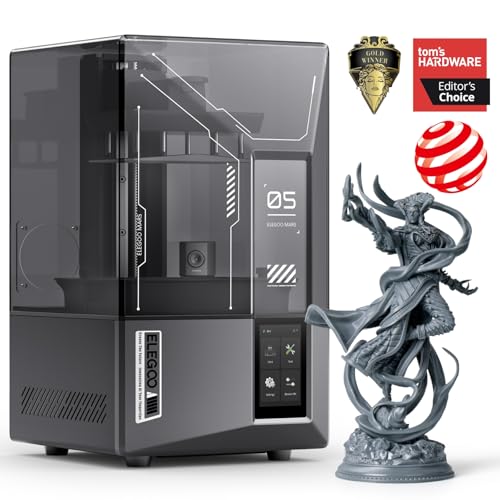
Best Fast Feature Set – ELEGOO Mars 5 Ultra
The ELEGOO Mars 5 Ultra stands out among resin printers for beginners who want speed without giving up fine detail. Its 9K display, tilt-release system, AI camera, and automatic warnings provide several tools intended to make printing more efficient and easier to monitor.
Best For: Beginners and makers who want fast printing, monitoring features, and wireless workflow options.
Pros:
- 9K mono LCD provides 18 μm XY resolution for detailed models.
- Up to 150 mm/h printing speed with fast and slow modes.
- AI camera can detect issues such as empty build plates and model warping.
- Supports Wi-Fi cluster printing for controlling multiple compatible printers.
Cons:
- AI detection results can vary with the environment, model, and resin type.
- Its larger listed footprint and 19.36-pound weight may require a sturdier workspace.
Choose the Mars 5 Ultra if speed and built-in oversight are priorities. It offers an advanced feature set for a beginner, although the camera’s alerts should be treated as assistance rather than a guarantee against failed prints.
Best Plug-and-Play Choice – Creality HALOT-X1 Neo
The Creality HALOT-X1 Neo is a compelling option for resin printers for beginners because its build platform arrives factory pre-leveled. It also combines 9K detail with USB, Wi-Fi, and Creality Cloud transfers, plus an AI 2D-to-3D feature for users who want help turning images into models.
Best For: First-time users, miniature creators, and tabletop makers seeking an out-of-box-friendly workflow.
Pros:
- Factory pre-leveled platform is designed for plug-and-play setup.
- 9K LCD and 18 μm XY resolution suit miniatures and intricate models.
- Files can be transferred through USB, 2.4GHz Wi-Fi, or Creality Cloud.
- AI 2D-to-3D generation can create models from images in as fast as 3.5 hours.
Cons:
- AI-generated model timing and results may not suit every project.
- The 153.36 × 77.76 × 160 mm build volume is focused on compact models rather than large prints.
The HALOT-X1 Neo emphasizes convenience without stepping down from high-resolution output. It is especially appealing if pre-leveling, flexible file transfer, and miniature-scale printing matter more than a larger build area.
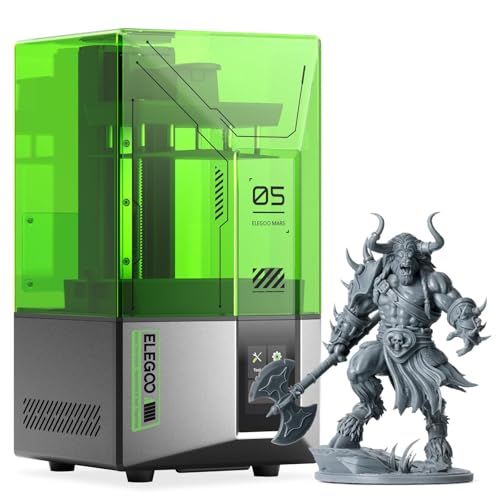
Best Simplified Setup – ELEGOO Mars 5
For beginners seeking resin printers for beginners with minimal calibration, the ELEGOO Mars 5 offers one-click automatic leveling and a built-in self-check before printing. Its 4K mono LCD is paired with sensors for residue, resin shortages, and leveling failures, making it focused on a guided and practical setup.
Best For: New resin users who value automatic leveling, checks, and basic safety protections.
Pros:
- One-click automatic leveling simplifies initial setup.
- One-click self-check verifies key components before a print.
- 4K mono LCD with COB light source supports detailed output.
- Residue detection, resin alerts, and overheat protection help reduce avoidable problems.
Cons:
- Its 4K display offers lower resolution than the 9K and 10K models in this roundup.
- The supplied notes do not specify its build volume or printing speed.
The Mars 5 is a sensible entry point when ease of setup matters most. It trades the sharper resolution and faster headline speeds of premium alternatives for automation, checks, and protective features that can make early use less intimidating.
Best for Hands-Off Precision – UniFormation GK3T
For beginners seeking resin printers for beginners, the UniFormation GK3T emphasizes easy setup, highly detailed output, and a streamlined workflow. Factory pre-leveling, smart resin feeding, resin heating, and remote monitoring reduce the amount of manual setup and supervision required.
Best For: Beginners who want maximum detail with convenient temperature control and app-based monitoring.
Pros:
- 16K resolution and 14 × 19 μm pixel size support highly detailed miniatures, figurines, and prototypes.
- Factory pre-leveling, a quick-release build plate, and side-mounted resin draining simplify operation.
- Built-in heating can maintain resin fluidity in temperatures as low as 0°C/32°F.
- Remote control, progress monitoring, and timelapse recording are available through the app or slicing software.
Cons:
- At 52.8 pounds, this is a relatively heavy printer to move.
- The printer requires compatible wash-and-cure equipment for the complete post-processing workflow.
The GK3T is a strong beginner-friendly choice when convenience and fine detail matter most. Its large, heavy design may be less suitable for users with limited workspace or who frequently need to relocate the printer.
Best for Automated Reliability – ANYCUBIC Photon P1
The ANYCUBIC Photon P1 is one of the more approachable resin printers for beginners because its factory-calibrated auto-leveling and automated checks reduce setup guesswork. Its stable motion system and release technology are designed to support consistent results while retaining 14K detail.
Best For: New users who want automatic leveling, print monitoring, and support for a broad range of resin viscosities.
Pros:
- Factory-calibrated Smart Leveling 3.0 performs self-checks and provides pressure feedback.
- AI monitoring checks build plate installation, bottom-layer separation, resin levels, and vat residue.
- Wave Release Technology reduces release force by 60%, potentially lowering failed prints.
- The 14K screen delivers 16.8 × 24.8 μm XY pixel size and supports fine details down to a 0.3 mm aperture.
Cons:
- Its large footprint—16.93 × 24.41 × 16.54 inches—requires substantial workspace.
- Advanced resin compatibility may be more than a beginner needs for basic projects.
The Photon P1 stands out for users who want assistance with leveling and error detection rather than a purely manual process. It offers strong detail and material flexibility, although its size should be considered before purchase.
Best for Fast High-Detail Printing – ELEGOO Saturn 4 Ultra
For shoppers comparing resin printers for beginners, the ELEGOO Saturn 4 Ultra combines 16K detail with automatic leveling, heated resin, and guided monitoring. Its claimed 150 mm/h print speed and one-click self-checks make it appealing to beginners who want a more automated, productive setup.
Best For: Beginners and growing hobbyists who want large, detailed models with speed, heating, and smart monitoring.
Pros:
- 16K resolution and a 14 × 19 μm XY resolution support intricate models.
- Automatic resin-tank heating activates below 25°C to help maintain printing temperature.
- AI camera, integrated lighting, and timelapse recording make print monitoring easier.
- Automatic leveling, power-on resume, Wi-Fi transfer, and one-click self-checks simplify operation.
Cons:
- The 150 mm/h speed claim is tied to the printer’s specified printing setup and may not apply to every resin or model.
- Its 8.33 × 4.66 × 8.66-inch build area and 35.4-pound weight call for dedicated space.
The Saturn 4 Ultra is a well-rounded option for beginners who expect to print frequently and value automation. It is especially compelling for detailed, larger models, provided you have enough room for its substantial enclosure and workflow.
Best Beginner Detail Pick – ANYCUBIC Photon Mono 4 10K
For beginners seeking resin printers for beginners with highly detailed results, the ANYCUBIC Photon Mono 4 combines a 7-inch 10K screen with a ready-to-use setup. It arrives assembled, tested, and factory-calibrated, so new users can complete a quick four-point leveling check and start printing in under five minutes.
Best For: Beginners who prioritize fine detail and a straightforward first setup.
Pros:
- 10K resolution and 17×17μm pixel precision support highly detailed models.
- LighTurbo matrix lighting provides stable curing and 1.5-second exposures.
- Upgraded laser-engraved build plate improves adhesion and helps reduce warping.
- Power-failure recovery can resume a print after downtime.
Cons:
- Its stated print dimensions are smaller than those of larger-format resin printers.
- The four-point leveling check still requires an initial setup step.
The Photon Mono 4 is a strong beginner-friendly choice when print detail matters most. Its preassembled design and recovery feature help reduce common early frustrations, while the 10K screen leaves room to grow into more demanding projects.
Best Automatic Setup – MALYAN S100 Mini Resin Printer
The MALYAN S100 Mini is one of the more approachable resin printers for beginners, thanks to automatic calibration and leveling at the start of a print. Its compact footprint and magnetic build plate also make it a practical option for users with limited workspace or those learning the basic resin-printing workflow.
Best For: First-time users who want automatic leveling in a compact printer.
Pros:
- Automatic calibration and leveling simplify printing out of the box.
- Magnetic build plate is easy to remove for cleaning and repeat jobs.
- 5.5-inch 2K LCD supports detailed models at an entry-level scale.
- Parallel LED lighting is designed to reduce layer and grid lines.
Cons:
- The 115 × 65 × 110 mm print area limits project size.
- Resin-specific printing parameters still need to be matched for best results.
Choose the S100 when ease of leveling and compact size are more important than a large build volume. It offers several beginner-focused conveniences, although its mini format is best suited to smaller models.
Best Larger-Volume Option – ANYCUBIC Photon Mono 4
For beginners who expect to print larger models, this ANYCUBIC Photon Mono 4 pairs a 6.04 × 3.42 × 6.49-inch build volume with a 7-inch 10K mono LCD. It is assembled, calibrated, and tested before shipping, giving new users a simpler starting point without giving up high-resolution output.
Best For: Beginners who need more build space for larger or multiple models.
Pros:
- Large 153.4 × 87 × 165 mm build volume supports bigger projects.
- 10K resolution and 17×17μm pixels deliver detailed prints.
- LighTurbo lighting and 1.5-second exposure times support smooth, efficient printing.
- Print-resume support helps reduce wasted resin after a power outage.
Cons:
- The printer is larger and heavier than the compact S100 Mini.
- Users still need to complete initial leveling before printing.
This Photon Mono 4 is a practical upgrade for beginners who may quickly outgrow a small resin printer. Its larger volume, high-resolution screen, and pre-shipment testing make it versatile for both early experiments and more demanding projects.
How We Picked the Best Resin Printers for Beginners
We focused on features that reduce setup friction without sacrificing print quality. Our selection considers screen resolution, build volume, leveling systems, print consistency, interface design, connectivity, ventilation needs, and the availability of practical beginner support. We also included a range of sizes and prices, from compact entry-level machines to larger printers suited to multiple models or bigger parts.
Resolution is only one part of the decision. A reliable platform, predictable exposure settings, simple file transfer, and an easy-to-clean vat can matter more to a first-time user than the highest advertised pixel count.
Quick Comparison
| What to Compare | Best For | Why It Matters |
|---|---|---|
| Compact build volume | Small workspaces and miniatures | Uses less space and resin, but limits model size |
| 10K to 14K resolution | Detailed figures and small parts | Can capture fine features when exposure and resin are well tuned |
| 16K resolution | Maximum detail and larger plates | Useful for demanding models, though files and settings still matter |
| Auto-leveling or pre-leveled platforms | First-time users | Can simplify initial setup and reduce one common source of failures |
| Wi-Fi or USB transfer | Convenient workflows | Makes moving sliced files easier, especially in a dedicated workspace |
Key Buying Factors for Resin Printers for Beginners
Build Volume and Workspace
Check the printer’s build dimensions against the objects you plan to make. A small machine is easier to place and cheaper to operate, while a larger model lets you print several miniatures or bigger components in one batch. Leave additional room for the cover, wash-and-cure equipment, gloves, tools, and ventilation.
Resolution, Speed, and Reliability
Higher LCD resolution can improve fine detail, but it does not guarantee better results by itself. Stable mechanics, suitable resin, correct exposure, and a well-supported model are equally important. Speed claims also vary by resin and layer height, so treat them as comparisons rather than guarantees.
Setup and Automation
Features such as auto-leveling, a pre-leveled platform, guided setup, resin monitoring, and wireless file transfer can make early prints less intimidating. They do not eliminate maintenance, but they can reduce avoidable mistakes.
Safety and Ongoing Costs
Resin printing requires uncured-resin handling, washing, curing, gloves, paper towels, replacement film, and good ventilation. Budget for a wash-and-cure solution and consumables, not just the printer. Keep resin away from skin, pets, food areas, and children, and follow the manufacturer’s safety instructions.
Who Should Buy Which Resin Printers for Beginners?
- Choose a compact model if you have limited space or mainly print miniatures, jewelry-scale designs, and small prototypes.
- Choose a 10K or 14K printer if you want a balanced first machine with strong detail and a moderate operating footprint.
- Choose a 16K model if fine surface detail and a larger build area justify the added cost and more involved workflow.
- Choose auto-leveling or pre-leveled hardware if setup confidence is your top priority.
- Choose a larger-format printer if you regularly print batches, cosplay components, or models that will not fit comfortably on a compact plate.
For most newcomers, the best choice is the model that fits the intended projects and workspace while leaving room in the budget for ventilation, cleaning supplies, and post-processing equipment.