The best hard drive enclosure with Thunderbolt 4 can turn an existing SATA drive or NVMe SSD into fast external storage for backups, media libraries, and demanding creative work.
We compare 10 high-speed enclosures, from compact single-drive NVMe cases to multi-bay RAID systems, so you can match capacity, performance, and expandability to your setup.
Best 10 Hard Drive Enclosure with Thunderbolt 4 Picks for 2026
Best Multi-Drive Array

- Four bays for 3.5-inch or 2.5-inch SATA drives
- RAID 0/1/4/5/10 support
- Up to 1527MB/s sustained performance
Best For: Desktop RAID storage and expandable multi-drive setups
Best Two-Bay Hard Drive Dock

- Two bays for 3.5-inch SATA drives
- USB-C connectivity compatible with Thunderbolt systems
- Tray-less design with quiet cooling fan
Best For: Simple two-drive desktop storage expansion
Best Four-SSD RAID Enclosure

- Four slots for 2230-2280 NVMe SSDs
- USB4 40Gb/s and Thunderbolt compatibility
- Up to 3200MB/s real-world performance
Best For: Fast expandable NVMe RAID storage
Best Multi-Drive NVMe Pick
TERRAMASTER D4 SSD 4-Bay Enclosure

- Four M.2 NVMe bays with up to 32TB capacity
- 40Gbps connectivity works with Thunderbolt 4
- Tool-free access with active cooling
Best For: High-capacity multi-drive NVMe storage
Best Hybrid RAID Option

- Combines two SATA and two NVMe drive bays
- Supports RAID 1, RAID 0, and large-capacity mode
- 40Gbps USB4 with Thunderbolt 4 compatibility
Best For: Mixed HDD, SSD, and RAID storage setups
Best Portable Single-Drive Pick
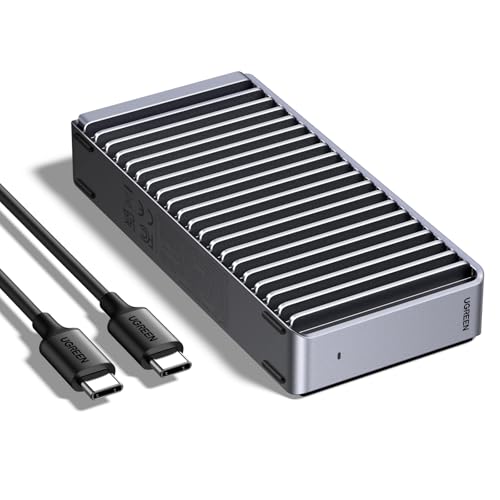
- Up to 3,600MB/s with Thunderbolt 4 equipment
- Supports four common M.2 NVMe sizes
- Compact, quiet, fanless aluminum cooling
Best For: Portable single-drive NVMe storage
Quiet Cooling Pick

- USB4 40Gbps with Thunderbolt 3/4 support
- Fanless aluminum body for silent passive cooling
- Tool-free support for four M.2 NVMe sizes
Best For: Quiet offices and users who swap NVMe drives
Fanless High-Capacity Pick
Qwiizlab ES40UR NVMe Enclosure

- 40Gbps USB4 with Thunderbolt 4/5 support
- Fanless aluminum chassis for quiet operation
- Supports M.2 NVMe SSDs up to 8TB
Best For: Quiet, high-capacity Mac or Windows portable storage
Best Multi-Drive Array – OWC ThunderBay 4
If you need a hard drive enclosure with thunderbolt 4-style USB-C connectivity but can work with Thunderbolt 3, the OWC ThunderBay 4 is a flexible four-bay option. It accepts up to four 3.5-inch or 2.5-inch SATA drives, supports software RAID configurations, and is designed for high sustained throughput.
Best For: Desktop users who need multi-drive storage, RAID flexibility, and support for both 3.5-inch and 2.5-inch SATA drives.
Pros:
- Four drive bays accept 3.5-inch or 2.5-inch SATA drives without an adapter.
- Supports RAID 0, 1, 4, 5, and 1+0 configurations.
- Up to 1527MB/s sustained performance with a heat-dissipating aluminum chassis.
Cons:
- Uses Thunderbolt 3 rather than Thunderbolt 4.
- Its four-bay desktop design is less portable than a single-drive enclosure.
The ThunderBay 4 is a strong choice when capacity, drive-count flexibility, and RAID options matter more than compact size. Its dual Thunderbolt 3 ports also support daisy-chaining and high-speed desktop workflows.
Best Portable NVMe Speed – Sabrent USB4 NVMe Enclosure
The Sabrent EC-U4TN is a compact hard drive enclosure with thunderbolt 4 compatibility for PCIe NVMe M.2 SSDs. Its USB4 interface can reach up to 3,900MB/s, while the tool-free design and integrated fan make it practical for fast portable storage.
Best For: Creators and mobile users who want high-speed external NVMe storage for Windows or macOS.
Pros:
- Supports USB4 and Thunderbolt 3/4 connections.
- Tool-free installation for 2230, 2242, 2260, and 2280 PCIe NVMe SSDs.
- Aluminum and ABS construction with active cooling for sustained transfers.
Cons:
- Does not support SATA M.2 SSDs.
- Maximum performance depends on a compatible USB4 or Thunderbolt host and NVMe drive.
This enclosure is a focused performance upgrade for users who already have, or plan to install, a PCIe NVMe SSD. It combines broad host compatibility with a small footprint, though it is not suitable for SATA-based M.2 drives.
Best Two-Bay Hard Drive Dock – Oyen Digital Mobius 2C
The Oyen Digital Mobius 2C is a two-bay hard drive enclosure with thunderbolt 4 compatibility through its USB-C connection. It holds two 3.5-inch SATA hard drives, uses tray-less insertion, and includes a USB-C hub for daisy-chaining or connecting additional devices.
Best For: Users who want a simple two-drive 3.5-inch SATA enclosure with USB-C connectivity and convenient expansion.
Pros:
- Supports two 3.5-inch SATA hard drives.
- Tray-less design makes drive insertion straightforward.
- Aluminum housing and a quiet fan help with heat dissipation.
- Includes a USB-C hub and cables for flexible connectivity.
Cons:
- Its 10Gbps data rate is slower than USB4 40Gbps enclosures.
- Supports 3.5-inch drives rather than compact M.2 SSDs.
The Mobius 2C is a practical middle ground for adding bulk storage without moving to a larger four-bay enclosure. Its two-drive capacity and hub are useful for desktop setups, while the 10Gbps interface keeps expectations below USB4-class performance.
Best Four-SSD RAID Enclosure – OWC Express 4M2
The OWC Express 4M2 is a high-capacity hard drive enclosure with thunderbolt 4 compatibility for four PCIe NVMe M.2 SSDs. Its USB4 40Gb/s connection, aluminum chassis, adaptive cooling, and RAID support make it suited to demanding storage and creative workflows.
Best For: Mac and Windows users building a fast four-SSD array with flexible RAID options.
Pros:
- Four slots support user-selected 2230, 2242, and 2280 NVMe M.2 SSDs.
- USB4 40Gb/s connectivity works with USB4, Thunderbolt, and USB-C systems.
- Supports RAID configurations through compatible software and operating-system tools.
- Adaptive fans and aircraft-grade aluminum help manage heat with quieter operation.
Cons:
- Requires separate NVMe SSDs.
- Four-drive setup and power adapter make it less portable than a single-drive enclosure.
The Express 4M2 is the most expandable option here for users who want NVMe performance and array-level flexibility. It can reach up to 3200MB/s real-world performance, but achieving that requires suitable SSDs and a compatible host connection.
Best Multi-Drive NVMe Pick – TERRAMASTER D4 SSD 4-Bay Enclosure
If you need a hard drive enclosure with Thunderbolt 4 for several NVMe drives, the TERRAMASTER D4 SSD provides four tool-free M.2 2280 bays and 40Gbps connectivity. It supports up to 32TB of combined storage and is designed for demanding transfers, video editing, and backup workflows.
Best For: Users who want four NVMe drives in one compact enclosure for high-speed storage expansion.
Pros:
- Supports Thunderbolt 4 and up to 40Gbps connectivity.
- Holds four M.2 NVMe 2280 SSDs, with up to 32TB total capacity.
- Active cooling, temperature sensors, tool-free installation, and hot-swapping.
Cons:
- It has no built-in RAID, so software RAID requires third-party tools.
- SSD storage is not included.
The D4 SSD is a strong choice when capacity and multi-drive flexibility matter more than a simple single-drive setup. Its cooling and broad Windows, Mac, and Linux compatibility also make it practical for sustained workloads.
Best Hybrid RAID Option – ACASIS 4-Bay USB4 Enclosure
The ACASIS is a versatile hard drive enclosure with Thunderbolt 4 support that combines two SATA bays with two NVMe bays. It can pair high-capacity 2.5- or 3.5-inch drives with faster M.2 SSDs, making it useful for backups, active projects, and large media libraries.
Best For: Users who want HDD capacity and NVMe speed in one enclosure with flexible storage modes.
Pros:
- Supports SATA HDDs or SSDs and M.2 NVMe drives in four total bays.
- Offers hardware RAID 1 for HDDs and software RAID 0 for NVMe storage.
- Includes active cooling, a 96W power supply, and 8K@60Hz video output.
Cons:
- Full 40Gbps performance requires RAID mode with compatible USB4 or Thunderbolt ports.
- Drive capacity and performance depend on the installed drives.
This ACASIS enclosure stands out for mixed-storage flexibility. It is a better fit than a dedicated NVMe box when you need economical HDD archiving alongside faster SSD space for editing or gaming.
Best Portable Single-Drive Pick – UGREEN 40Gbps NVMe Enclosure
For a compact hard drive enclosure with Thunderbolt 4, the UGREEN 40Gbps M.2 NVMe enclosure offers a portable single-drive solution. Its ASM2464PD chip can reach up to 3,600MB/s with a compatible Thunderbolt 4 cable and device, while the aluminum fin design provides fanless heat dissipation.
Best For: Travelers and single-drive users who need fast, quiet NVMe storage expansion.
Pros:
- Supports up to 40Gbps connectivity and speeds up to 3,600MB/s under the required setup.
- Works with M.2 sizes 2230, 2242, 2260, and 2280.
- Compact aluminum enclosure uses silent double-sided fin cooling.
Cons:
- It supports NVMe drives only, not SATA NGFF or mSATA SSDs.
- Only one drive bay is provided, and the SSD is not included.
- Some thicker SSDs may require thinner thermal pads for proper fit.
The UGREEN is the simplest and most travel-friendly option here. Choose it when you need one fast NVMe drive rather than multi-bay expansion, and verify your cable and host device support Thunderbolt 4 for maximum performance.
Fastest Active-Cooled Pick – Cable Matters 40Gbps NVMe Enclosure
For shoppers seeking a hard drive enclosure with Thunderbolt 4, the Cable Matters model combines USB4 40Gbps connectivity with PCIe Gen 4×4 support. It is designed for single-sided M.2 NVMe SSDs and includes active cooling for sustained transfers.
Best For: Professionals who prioritize high transfer speeds, portability, and temperature-controlled cooling.
Pros:
- Supports USB4 40Gbps and Thunderbolt 4 and 5 hosts.
- Tested speeds reach up to 3,800MB/s read and 3,600MB/s write with compatible hardware.
- Foldable, tool-free design supports M.2 sizes 2230, 2242, 2260, and 2280.
- Temperature-controlled fan helps maintain stable performance during heavy use.
Cons:
- Supports single-sided M.2 NVMe SSDs only.
- Maximum performance depends on the host, SSD, and operating system.
This is a strong choice when active cooling and top-end USB4 performance matter more than completely silent operation. The dual-color indicator also makes it easy to distinguish 40Gbps from lower-speed USB modes.
Quiet Cooling Pick – ICY BOX 40Gbps M.2 Enclosure
The ICY BOX is a practical hard drive enclosure with Thunderbolt 4 for users who want USB4-class speed without a mechanical fan. Its aluminum heatsink-style body and thermal pad help dissipate heat during demanding transfers.
Best For: Quiet workspaces, video editors, and users who frequently swap compatible M.2 NVMe SSDs.
Pros:
- USB4 performance up to 40Gbps with Thunderbolt 3 and 4 compatibility.
- Fanless aluminum construction provides quiet passive cooling.
- Tool-free installation supports M.2 sizes 2230, 2242, 2260, and 2280.
- Includes a USB-C cable, thermal pad, rubber fixation, and a two-year warranty.
Cons:
- Designed for M-Key NVMe SSDs rather than SATA drives.
- Actual transfer speeds vary by SSD and connected device.
With its silent fanless design and broad M.2 size support, the ICY BOX is well suited to desk setups where noise is distracting. It offers a straightforward upgrade path for users who regularly install or replace NVMe drives.
Fanless High-Capacity Pick – Qwiizlab ES40UR NVMe Enclosure
For a hard drive enclosure with Thunderbolt 4 that emphasizes quiet operation and capacity flexibility, the Qwiizlab ES40UR supports USB4 and Thunderbolt 3, 4, and 5 connections. It accommodates compatible M.2 NVMe SSDs up to 8TB, but the SSD must be purchased separately.
Best For: Mac and Windows users who want a rugged, fanless enclosure for a high-capacity NVMe SSD.
Pros:
- Supports USB4 and Thunderbolt 4/5 transfer rates up to 40Gbps.
- Compatible with M-Key and B-M Key M.2 NVMe SSDs in sizes 2230 through 2280.
- Fanless aluminum chassis provides quiet heat dissipation.
- Includes a 40Gbps USB-C cable, thermal pads, screws, screwdriver, and carrying bag.
Cons:
- SSD is not included.
- Not compatible with Thunderbolt 1 or Thunderbolt 2 ports.
- Performance depends on the installed SSD and host device.
The Qwiizlab stands out for combining silent cooling with support for drives up to 8TB. It is a sensible option for users building their own portable storage, provided their computer has a compatible USB4 or Thunderbolt connection.
How We Picked the Best Hard Drive Enclosure with Thunderbolt 4
We focused on enclosure designs that support Thunderbolt 4 directly or use USB4 hardware with broad Thunderbolt compatibility. The lineup covers single-drive NVMe enclosures, multi-slot M.2 units, and larger SATA or RAID storage systems. We compared interface speed, drive compatibility, cooling, construction, installation, RAID flexibility, and the practical trade-offs of each form factor.
Because advertised transfer rates depend on the installed drive, host computer, cable, and workload, theoretical bandwidth is only one part of the decision. A good enclosure should also manage heat, remain stable during sustained transfers, and fit the way you plan to use your storage.
Quick Comparison
Single-drive NVMe models are the simplest choice for upgrading a laptop, carrying a fast project drive, or reusing an M.2 SSD. Four-slot NVMe enclosures provide more capacity and can be better suited to scratch disks or organized media storage. SATA and RAID enclosures are preferable when you already own 2.5-inch or 3.5-inch drives, need large capacity at a lower cost, or want redundancy and multi-drive management.
USB4 enclosures can offer excellent performance through a Thunderbolt 4 port, but verify the exact compatibility, included cable, and host requirements before buying. Not every USB-C port supports the same speeds or features.
Key Buying Factors for a Hard Drive Enclosure with Thunderbolt 4
Drive Type and Capacity
Check whether the enclosure accepts M.2 NVMe, SATA SSDs, 2.5-inch hard drives, 3.5-inch hard drives, or several formats. NVMe is generally the fastest option, while SATA and mechanical drives can deliver more affordable capacity.
Interface and Real-World Speed
Thunderbolt 4 and USB4 provide high bandwidth, but sustained performance depends on the SSD and thermal design. Look for an enclosure with an appropriate controller, a quality cable, and sufficient cooling for long transfers.
Cooling and Noise
NVMe drives can throttle when hot. Fan-equipped models may maintain speed better under heavy workloads, while fanless aluminum designs are quieter and more portable. Choose based on whether you prioritize silence or sustained performance.
RAID, Expansion, and Power
Multi-bay products may support RAID, independent disks, or software-managed arrays. Confirm the available modes and whether the enclosure has its own power adapter. Bus-powered single-drive units are easier to travel with; larger arrays typically need wall power.
Who Should Buy Which Hard Drive Enclosure with Thunderbolt 4?
Choose a compact single-drive NVMe enclosure if you want a portable, fast external SSD or need to reuse one M.2 drive. Pick a four-slot NVMe model if you manage several SSDs or need high-speed local working storage. A SATA or RAID enclosure makes more sense for large libraries, existing hard drives, backups, and expandable desktop storage.
Before ordering, confirm your computer has a Thunderbolt 4 or compatible USB4 port, check the supported M.2 key and length when relevant, and verify whether drives, cables, and mounting hardware are included. The right enclosure is the one that balances speed with the capacity, portability, noise level, and future expansion your workflow actually requires.