Long SDI cable runs can introduce signal loss, timing problems, and format limitations—especially when working with 3G-SDI, 6G-SDI, or 12G-SDI video. The right converter or extender can help preserve a reliable signal while fitting your camera, display, production, or broadcast workflow.
This roundup compares fiber systems, reclocking distribution equipment, SDI-to-HDMI converters, bidirectional models, and purpose-built SDI cabling so you can choose the best solution for your distance, resolution, and connection requirements.
Best 10 Sdi Converters for Long Cable Runs Picks for 2026
Longest-Reach Fiber Kit

- Complete TX/RX kit with LC modules
- Up to 20 km over single-mode fiber
- SD, HD, and 3G-SDI support
Best For: Very long SDI runs in broadcast, studio, and industrial installations
HDMI-to-SDI Distance Pick
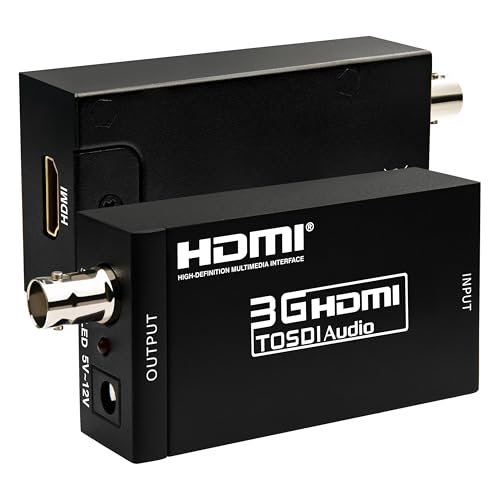
- Converts HDMI to SDI up to 1080p60
- Supports up to 100 m at 3G-SDI
- Carries up to eight audio channels
Best For: Live events and productions extending HDMI sources over SDI coax
Signal Distribution Choice
Reclocking SDI 1-to-2 Repeater

- Distributes one SDI input to two outputs
- Supports 3G, HD, and SD-SDI
- Reclocks and passes ancillary data
Best For: Fixed SDI systems needing signal conditioning and two outputs
Compact Format Bridge
Blackmagic 12G SDI/HDMI Converter

- Bidirectional SDI and HDMI conversion
- Compact micro-converter format
- Includes a two-year warranty
Best For: Cameras, monitors, and production rigs needing flexible format conversion
Precision 12G Cable
Superbat Belden 1694A SDI Cable
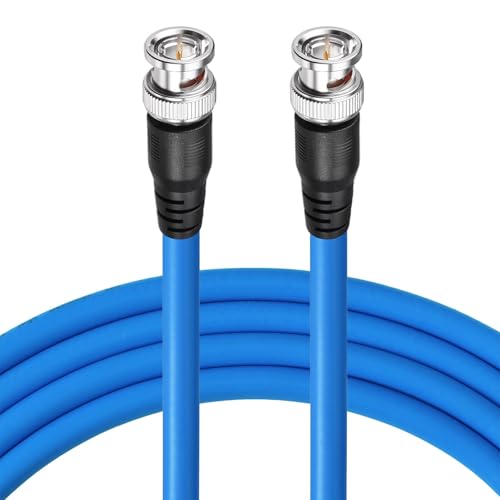
- Supports SD-SDI through 12G-SDI
- 75-ohm, 18 AWG Belden 1694A coax
- Shielded BNC cable for professional video
Best For: Professional SDI cabling and HDTV upgrades
Long-Run SDI Converter
Anber-Tech SDI to HDMI Converter
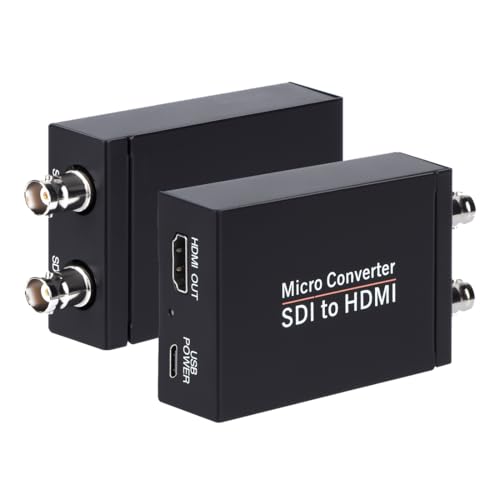
- Converts 3G, HD, and SD-SDI to HDMI
- Input distance ratings up to 1,000 feet for SD-SDI
- Includes SDI loopout and audio de-embedding
Best For: SDI cameras and sources connected to HDMI displays
12G Shielded Link

- 75-ohm BNC cable for 3G/6G/12G-SDI
- Supports 4K and 8K video applications
- Dual-shielded RG6 construction
Best For: Connecting SDI cameras, converters, monitors, and recorders
Best Fiber Reach
Mini HD-SDI Over Fiber Converter

- Up to 20 km over single-mode fiber
- Supports 1080p at 30 Hz and 8-channel audio
- Compact aluminum-alloy design
Best For: Long-distance 1080p camera and broadcast links
Best Simple Display Conversion

- Accepts SD-, HD-, and 3G-SDI input
- Outputs up to 1080p Full HD over HDMI
- Includes SDI loop-out and plug-and-play design
Best For: Sending an SDI source to an HDMI monitor or projector
Best Multi-Source Setup

- Four SDI inputs and four HDMI outputs
- Supports 1080p at 60 Hz
- Includes equalization and clock recovery
Best For: Multi-camera broadcast and control-room routing
Longest-Reach Fiber Kit – 3G-SDI Over Fiber Extender
For demanding sdi converters for long cable runs, this complete transmitter-and-receiver kit sends uncompressed SD-, HD-, or 3G-SDI video over fiber. Its included LC modules support distances up to 20 km on single-mode fiber, while USB-C power and compact housings simplify field or permanent installation.
Best For: Studio, broadcast, industrial, and event installations requiring very long SDI runs over fiber.
Pros:
- Includes both TX and RX units, LC SFP modules, USB-C supplies, and mounting hardware.
- Supports up to 20 km on single-mode fiber and 1 km on multimode fiber.
- Handles SD, HD, and 3G-SDI signals, including 1080p60 and DVB-ASI.
- Status LEDs show power, fiber link, and video status.
Cons:
- Requires compatible fiber cabling and a fiber-based installation.
- It is a one-channel kit rather than a multi-channel solution.
This is the most purpose-built option here for extreme cable distances. The compact design, dual mounting options, and 5V USB-C operation make it practical when both reach and installation flexibility matter.
HDMI-to-SDI Distance Pick – 3G-SDI Converter With Audio
This HDMI-to-SDI unit is a practical choice when a source device outputs HDMI but the destination is part of an SDI workflow. Among sdi converters for long cable runs, it supports coaxial transmission up to 100 m for 3G-SDI, 200 m for HD-SDI, and 300 m for SD-SDI, while also carrying up to eight embedded audio channels.
Best For: Live production, conferences, sports venues, and cameras feeding SDI monitors or broadcast equipment.
Pros:
- Converts HDMI to SDI at resolutions up to 1080p60.
- Supports long coaxial runs, with stated reach up to 100 m for 3G-SDI.
- De-embeds and transmits up to eight channels of 48 kHz audio.
- Compact metal housing requires no drivers or software.
Cons:
- It converts HDMI to SDI only, not bidirectionally.
- Maximum distance varies by SDI format, with the longest reach specified for SD-SDI.
Choose this model when HDMI compatibility and audio handling are as important as cable distance. It is especially useful for mobile setups that need a compact converter with straightforward plug-and-play operation.
Signal Distribution Choice – Reclocking SDI 1-to-2 Repeater
For SDI systems that need signal regeneration and two outputs, this broadcasting-grade repeater combines 1-to-2 distribution with reclocking. It is a useful supporting component for sdi converters for long cable runs, helping extend a compatible SDI signal through a properly designed coaxial chain.
Best For: Broadcast and fixed SDI installations that need reclocking plus two downstream SDI outputs.
Pros:
- Accepts 3G-SDI, HD-SDI, and SD-SDI signals.
- Provides two SDI outputs from one input.
- Reclocking helps regenerate the signal for distribution systems.
- Passes ancillary data and includes dual-color input-lock and rate indicators.
Cons:
- The supplied range specification is only 5 meters, so it is not a standalone long-distance extender.
- It uses BNC-to-BNC SDI connections and does not provide fiber conversion.
This is better viewed as a distribution and signal-conditioning tool than a complete long-run transport solution. It can complement longer SDI paths when you need two outputs and reclocking, but the listed range does not position it as the reach leader.
Compact Format Bridge – Blackmagic 12G SDI/HDMI Converter
The Blackmagic Design Micro Converter is a compact bidirectional bridge between SDI and HDMI equipment. While it is not specified with a maximum cable distance in the supplied details, its two-way format conversion can be useful alongside sdi converters for long cable runs when connecting cameras, monitors, and other SDI or HDMI devices.
Best For: Compact camera, monitoring, and production setups that need bidirectional SDI/HDMI conversion.
Pros:
- Supports bidirectional conversion between SDI and HDMI.
- Designed as a small micro converter for space-conscious setups.
- Offers a 12G SDI/HDMI format designation for compatible workflows.
- Includes a two-year warranty.
Cons:
- The supplied notes do not specify a maximum transmission distance.
- It is a single-channel converter rather than a multi-output distribution unit.
This model is a strong fit when flexibility and compactness matter more than a documented long-distance rating. Pair it with appropriate cabling or dedicated extenders when the installation requires a specifically verified cable-run distance.
Precision 12G Cable – Superbat Belden 1694A SDI Cable
For sdi converters for long cable runs, this 25-foot Superbat cable uses Belden 1694A coax with 75-ohm BNC male connectors. Its support for SD-SDI through 12G-SDI makes it a versatile interconnect for broadcast, studio, HDTV, and other professional video setups.
Best For: Professional SDI links that need a well-shielded 75-ohm cable with broad format support.
Pros:
- Supports SD-SDI, HD-SDI, 3G-SDI, 6G-SDI, and 12G-SDI.
- Uses Belden 1694A 18 AWG coax with low attenuation and a stated 4.5 GHz bandwidth.
- Features dual shielding, including tinned copper braid and foil shielding.
- Gold-plated BNC male connectors and compatibility with major professional video brands.
Cons:
- The supplied version is 25 feet, so it may not suit every installation length.
- Listed for indoor use.
This is a strong cable-focused option when signal integrity and format flexibility matter more than built-in conversion. Confirm the required length and connector path before ordering.
Long-Run SDI Converter – Anber-Tech SDI to HDMI Converter
This Anber-Tech unit is designed for sdi converters for long cable runs when an SDI source must feed an HDMI display. It automatically detects 3G-SDI, HD-SDI, and SD-SDI formats, while its loop output can continue the SDI signal to another device.
Best For: Cameras and SDI sources feeding an HDMI monitor, television, or projector over extended cable distances.
Pros:
- Accepts 3G-SDI, HD-SDI, and SD-SDI with automatic format detection.
- Specified input distances reach 300 feet for 3G-SDI, 500 feet for HD-SDI, and 1,000 feet for SD-SDI.
- Provides one HDMI output and one SDI loop output.
- De-embeds up to eight channels of 48 kHz digital audio.
Cons:
- It is not bi-directional and does not convert HDMI to SDI.
- The SDI loopout is specified for runs up to 300 feet.
- Requires the included power adapter.
Choose this converter when HDMI display compatibility is the priority and your source is SDI. Its published distance ratings vary by SDI format, so match the converter to the signal type and run length.
12G Shielded Link – XRDS-RF 25FT 12G SDI Cable
For sdi converters for long cable runs, this 25-foot XRDS-RF cable provides a direct BNC-to-BNC connection rather than an active conversion stage. The 75-ohm RG6 design supports 3G-, 6G-, and 12G-SDI, including 4K and 8K applications listed by the manufacturer.
Best For: Short-to-medium professional SDI connections between converters, cameras, monitors, matrix equipment, and recorders.
Pros:
- Supports 3G-SDI, 6G-SDI, 12G-SDI, HD-SDI, 4K, and 8K use cases.
- Uses 75-ohm BNC male-to-male connectors for digital video equipment.
- Dual RG6 shielding is designed to reduce attenuation and support 12G performance.
- Suitable for converters, surveillance cameras, matrix systems, monitors, and hard disk recorders.
Cons:
- At 25 feet, it may be too short for genuinely long installations.
- It is a cable, not an SDI-to-HDMI or HDMI-to-SDI converter.
- The supplied notes identify indoor and outdoor usage but do not specify a weatherproof rating.
This cable is a practical passive connection for high-bandwidth SDI systems. Its 12G capability gives it headroom for demanding video formats, but longer runs may require additional signal-management equipment.
Best Fiber Reach – Mini HD-SDI Over Fiber Converter
For sdi converters for long cable runs, this compact HD-SDI fiber transceiver is designed to extend 1080p video far beyond typical copper-cable distances. It supports embedded 8-channel audio, automatic reclocking, and transmission up to 20 km over single-mode fiber.
Best For: Broadcast, television, data-center, and camera installations requiring long-distance 1080p transmission over fiber.
Pros:
- Reaches up to 20 km over single-mode fiber and up to 550 m over multi-mode fiber.
- Supports 1080p at 30 Hz with embedded 8-channel audio.
- Very compact aluminum-alloy housing is easy to carry and designed for durability.
Cons:
- Limited to 1080p at 30 Hz rather than higher frame rates.
- Requires compatible fiber cabling and separate conversion units for a link.
This is the strongest option here when distance is the priority. Its fiber interface and 20 km single-mode rating suit professional long-run installations, while the mini enclosure helps in space-constrained setups.
Best Simple Display Conversion – SDI to HDMI Converter
Among sdi converters for long cable runs, this model is best viewed as a straightforward endpoint converter rather than a fiber extender. It accepts SD-SDI, HD-SDI, and 3G-SDI input and converts the signal to HDMI for a television, monitor, or projector.
Best For: Connecting an SDI camera or other SDI source to an HDMI display in broadcast, conference, control-room, and presentation setups.
Pros:
- Supports SD-SDI, HD-SDI, and 3G-SDI input formats.
- Provides up to 1080p Full HD output with synchronized audio and video.
- Metal housing, heat dissipation, and plug-and-play operation simplify installation.
Cons:
- Does not support 4K output.
- Converts SDI to HDMI only; it does not convert HDMI to SDI.
- Does not itself provide fiber-based long-distance extension.
This converter makes sense when your long run already terminates at an SDI connection and you need a practical HDMI display output. Confirm that your source uses SDI and that your cable has a BNC male connector before buying.
Best Multi-Source Setup – 4×4 SDI to HDMI Converter
For installations using several sources and displays, this 4×4 unit is one of the more capable sdi converters for long cable runs. It provides four SDI inputs and four HDMI outputs, with cable equalization and clock recovery intended to support reliable extended-distance signal transmission.
Best For: Professional video production, broadcasting, control rooms, and systems routing multiple SDI cameras to several HDMI displays.
Pros:
- Handles four HD-SDI or 3G-SDI inputs and four HDMI outputs.
- Supports video up to 1080p at 60 Hz.
- Automatic signal identification, cable equalization, and clock recovery support dependable operation.
Cons:
- Maximum stated resolution is 1080p at 60 Hz, not 4K.
- More equipment than needed for a single-source, single-display setup.
- Supplied power connection is USB Type-C, so a suitable power source is required.
This is the practical choice for a multi-camera or multi-display workflow. Its 4×4 format reduces the need for several small converters, while signal recovery features are useful when SDI sources must travel over longer cable paths.
How We Picked the Best Sdi Converters for Long Cable Runs
We focused on products that address the main challenges of extended SDI connections: transmission distance, signal integrity, format compatibility, conversion direction, and installation flexibility. The selection includes fiber-optic transmitter-and-receiver kits for very long links, copper SDI accessories for shorter runs, reclocking distribution hardware, and converters that bridge SDI with HDMI.
We also considered support for common standards such as SD-SDI, HD-SDI, 3G-SDI, 6G-SDI, and 12G-SDI, along with practical features including loop-through outputs, audio de-embedding, automatic format detection, multi-input switching, and bidirectional operation.
Quick Comparison
| Solution Type | Best For | Main Advantage | Important Limitation |
|---|---|---|---|
| SDI over fiber | Very long cable runs | Long reach and strong resistance to interference | Requires compatible transmitter and receiver units |
| Reclocking repeater | Extending or distributing copper SDI | Restores signal timing and can feed multiple devices | Still depends on suitable coaxial cable |
| SDI-to-HDMI converter | Connecting SDI sources to HDMI displays | Simple monitoring and display integration | Usually does not extend SDI by itself |
| Bidirectional converter | Flexible SDI/HDMI workflows | Can convert in either direction | Feature sets and supported formats vary |
| 12G-SDI cable | Shorter high-bandwidth connections | Simple, low-latency point-to-point setup | Distance is limited by cable quality and format |
Key Buying Factors for Sdi Converters for Long Cable Runs
Distance and Transmission Medium
For runs approaching or exceeding the practical limits of copper coax, choose an SDI-over-fiber system with a transmitter and receiver. Fiber is often the better choice for stadiums, venues, studios, and inter-building links because it supports long distances and avoids many electromagnetic interference concerns. For shorter installations, high-quality 75-ohm SDI coax and a reclocking repeater may be more economical.
Resolution, Frame Rate, and SDI Standard
Confirm that the converter supports the exact signal you use. A device limited to HD-SDI or 3G-SDI may not pass 4K signals carried over 6G-SDI or 12G-SDI. Check frame-rate support as well, since 1080p60 and higher-bandwidth 4K formats can exceed the capabilities of basic models.
Conversion Direction and Outputs
SDI-to-HDMI models suit monitoring, presentation, and consumer-display connections, while HDMI-to-SDI units are useful when an HDMI camera or source must enter an SDI infrastructure. Loop-through outputs help maintain the original SDI feed, and multi-output distribution units can send one source to several destinations.
Audio and Signal Management
If embedded audio matters, verify whether the device supports audio de-embedding, stereo output, or the required audio channels. Reclocking is also valuable on long copper runs because it regenerates timing and can improve stability between connected devices.
Who Should Buy Which Sdi Converters for Long Cable Runs?
Choose an SDI-over-fiber kit for the longest runs, electrically noisy environments, or permanent venue and broadcast installations. Choose a reclocking repeater when you need to extend or distribute SDI over existing coax. A compact SDI-to-HDMI converter is the practical choice for monitoring an SDI camera on an HDMI television, recorder, or computer display.
For flexible production kits, a bidirectional SDI/HDMI converter can reduce the number of adapters you carry. If your priority is straightforward high-bandwidth cabling rather than format conversion, use a properly rated 75-ohm 12G-SDI cable and keep the run within the manufacturer’s distance guidance. Always verify connector type, power requirements, supported formats, and the full end-to-end signal path before purchasing.