Building or upgrading a home theater often means combining newer HDMI equipment with older televisions, game consoles, amplifiers, and audio systems. The right converter can solve compatibility problems without replacing every component.
This roundup covers 10 HDMI converters for home theaters, including audio extractors, ARC adapters, RCA-to-HDMI converters, multi-input switchers, and HDMI-to-RF modulators. Use the guide below to match the converter type, ports, and signal support to your setup.
Best 10 Hdmi Converters for Home Theaters Picks for 2026
Best Audio Extraction Value

- Optical and 3.5mm audio outputs
- 2.0CH, 5.1CH, and pass-through modes
- Supports 4K at 30Hz
Best For: Adding separate audio output to HDMI source devices
Best Multi-Source Switcher

- Eight inputs across four video types
- One HDMI output for the display
- Coaxial and SPDIF audio outputs
Best For: Mixed legacy and HDMI home theater equipment
Best TV ARC Adapter
4K60Hz HDMI ARC Audio Extractor

- Designed for ARC-enabled TVs
- Simultaneous RCA and 3.5mm output
- Supports up to 192kHz sampling
Best For: Connecting an ARC TV to analog stereo equipment
Best Coaxial Distribution Option

- Outputs NTSC VHF on channel 3 or 4
- Supports resolutions up to 1080p
- Designed for coaxial and CATV distribution
Best For: Sending HDMI video through existing RF wiring
ARC Audio Hub

- HDMI ARC, optical, coaxial, RCA, and 3.5mm connections
- Simultaneous audio output across multiple ports
- Requires PCM/LPCM and an ARC/eARC TV port
Best For: Legacy stereo, headphone, and soundbar connections
Legacy Video Bridge
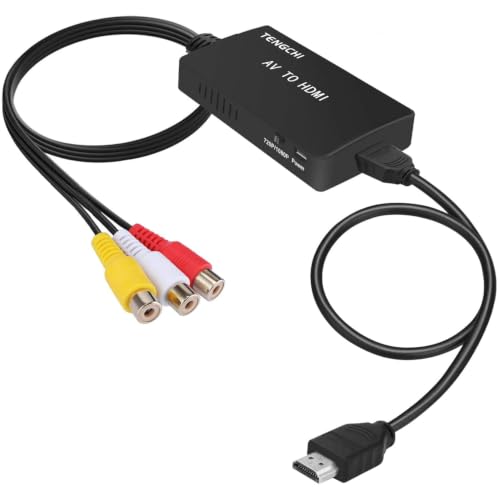
- Converts composite RCA to HDMI 1080p
- Supports several PAL, NTSC, and SECAM formats
- USB-powered; not compatible with 4K or 3D
Best For: Older consoles, VCRs, DVD players, and composite AV sources
High-Resolution ARC Switch

- Accepts HDMI ARC, optical, or coaxial input
- Outputs through RCA, optical, coaxial, and AUX
- Supports up to 192 kHz and remembers input mode
Best For: Mixed ARC, digital, and analog home theater systems
Best Legacy-Device Bridge
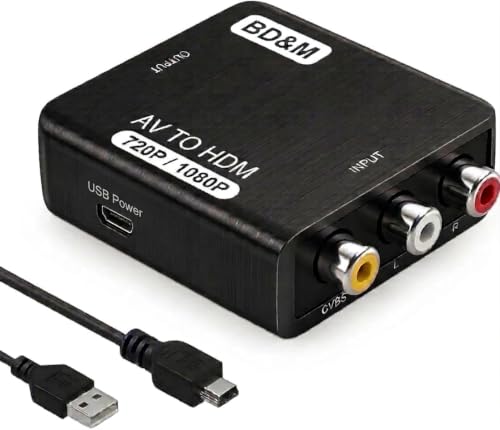
- Converts composite RCA to HDMI
- Supports 720P/1080P output
- Works with consoles, VHS, and DVD players
Best For: Connecting older AV devices to modern displays
Best Compact RCA Adapter
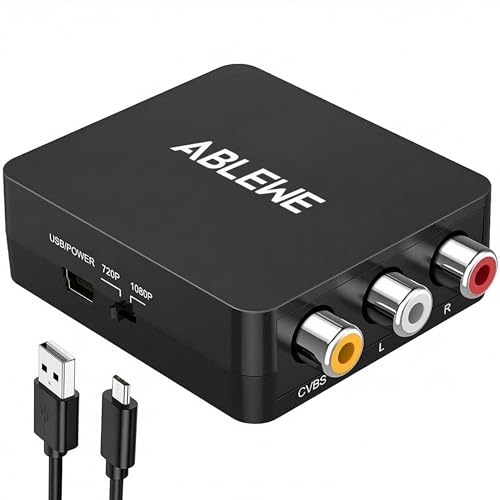
- Converts RCA composite to HDMI
- Supports 720P/1080P at 60 Hz
- Handles PAL, NTSC, and SECAM formats
Best For: Adding retro consoles and analog players to HDMI displays
Best Audio Extraction Value – 4K HDMI Audio Extractor
For shoppers comparing HDMI converters for home theaters, this compact extractor is designed to separate audio from an HDMI source and send it to an AV receiver, powered speakers, or headphones through optical or 3.5mm output. It supports 4K at 30Hz and includes selectable audio modes for different setups.
Best For: Home theater users who need optical or 3.5mm audio from HDMI sources such as Blu-ray players, game consoles, streaming devices, or PCs.
Pros:
- Offers optical and 3.5mm audio outputs.
- Includes 2.0CH, 5.1CH, and pass-through modes.
- Supports up to 4K at 30Hz with HDMI 1.4 and HDCP 1.4.
- Compact aluminum housing and USB-powered operation.
Cons:
- Does not support ARC or eARC, and a TV cannot be used as the input source.
- Does not support 7.1-channel audio.
- Listed source-device support is limited to 1080p for Fire TV, Apple TV, PS4, and PS5 rather than 4K.
This is a practical choice when your source lacks a dedicated audio output, but verify resolution and audio-format requirements before buying. Use 2.0CH for the 3.5mm output, 5.1CH for optical, or pass mode when needed.
Best Multi-Source Switcher – 8-Input HDMI Converter
Among HDMI converters for home theaters, this model stands out as a centralized connection hub for older and newer equipment. It accepts eight inputs across HDMI, VGA, AV, and component video, then sends the selected source to one HDMI display while providing coaxial and SPDIF audio outputs.
Best For: Home theater systems combining multiple HDMI, component, composite, and VGA devices with one HDMI television or display.
Pros:
- Provides eight total inputs: three HDMI, two component, two AV, and one VGA.
- Outputs video through a single HDMI connection.
- Includes coaxial and SPDIF audio outputs.
- EDID options support stereo, 5.1/6-channel, and 7.1/8-channel surround configurations.
Cons:
- Supports HDMI v1.3 and HDMI v1.4 3D rather than newer HDMI standards.
- The supplied notes do not specify 4K support.
- Its many legacy inputs may be unnecessary for simpler modern setups.
This converter is best suited to a large, mixed-device entertainment system where reducing cable swapping matters. Its broad input selection makes it especially useful for integrating legacy video sources with an HDMI display.
Best TV ARC Adapter – 4K60Hz HDMI ARC Audio Extractor
This ARC adapter addresses a specific home theater problem: sending audio from an ARC-enabled TV to a soundbar, amplifier, or powered speakers. It provides simultaneous left/right RCA and 3.5mm stereo output, making it one of the more focused HDMI converters for home theaters built around a compatible television.
Best For: TV-based stereo systems that need analog audio from an HDMI ARC port for a soundbar, amplifier, or speakers.
Pros:
- Extracts TV audio through an HDMI ARC connection.
- Provides simultaneous L/R RCA and 3.5mm stereo output.
- Supports sampling rates from 32kHz through 192kHz.
- Uses a compact aluminum enclosure and plug-and-play setup.
Cons:
- Works only with TVs and requires an ARC-labeled HDMI port.
- Requires PCM 2.0 output and does not decode DTS, DSD, 5.1, or 7.1-channel raw audio.
- Does not include CEC, so TV-remote volume control is unavailable through the adapter.
Choose this model when your TV has ARC but lacks a convenient audio output. Confirm ARC and CEC-related settings on the television, use a suitable HDMI cable, and set the TV audio format to PCM 2.0 for proper operation.
Best Coaxial Distribution Option – HDMI to RF Modulator
For home theaters or whole-home setups that still use coaxial television wiring, this HDMI-to-RF modulator converts an HDMI source into an NTSC VHF signal. It is intended for sending compatible video from consoles, computers, cameras, DVD players, or TV boxes to an RF-equipped television or CATV system.
Best For: Distributing an HDMI source through existing NTSC coaxial or CATV wiring to compatible televisions.
Pros:
- Converts HDMI input to NTSC RF output on channel 3 or 4.
- Supports resolutions including 1080p, 1080i, 720p, 576p, 576i, and 480p.
- Works with game consoles, PCs, cameras, DVD players, CCTV systems, and DVRs.
- Plug-and-play design with HDMI 1.4 and HDCP 1.4 support.
Cons:
- NTSC output and VHF channel operation may not suit non-NTSC systems.
- RF distribution is lower-bandwidth than a direct HDMI connection.
- Requires 5V DC power and does not include a power plug according to the supplied details.
This is a specialized converter rather than a standard HDMI switch or audio extractor. It makes the most sense when the installation already depends on coaxial distribution and the connected displays support the specified NTSC channel format.
ARC Audio Hub – PCM DAC Extractor
If you need HDMI converters for home theaters and want to route TV audio to legacy equipment, this ARC extractor offers HDMI ARC, optical, coaxial, RCA, and 3.5mm connections. It is designed for PCM/LPCM signals and requires a TV with an HDMI port labeled ARC or eARC.
Best For: TV-to-soundbar, amplifier, headphone, or stereo-speaker setups that use PCM audio and multiple output types.
Pros:
- Provides simultaneous optical, coaxial, RCA, and 3.5mm outputs.
- Includes an HDMI cable, optical cable, RCA-to-3.5mm cable, and power adapter.
- Compact aluminum housing supports flexible home audio installations.
Cons:
- Requires a TV with HDMI ARC or eARC for ARC operation.
- PCM/LPCM input is required; Dolby and DTS decoding are not supported.
- TV audio settings and the converter switch may require troubleshooting.
This is a practical choice for connecting ARC-equipped TVs to a mix of analog and digital audio gear, provided your system uses compatible PCM audio.
Legacy Video Bridge – RCA to HDMI Adapter
This RCA-to-HDMI converter is a straightforward option among HDMI converters for home theaters when you need to connect composite-video equipment to a modern HD display. It converts yellow, white, and red RCA input to HDMI 1080p output for compatible televisions and monitors.
Best For: Older game consoles, VHS or VCR players, DVD players, and other composite AV sources connected to an HD TV or monitor.
Pros:
- Converts composite RCA input to HDMI 1080p output.
- Supports PAL, NTSC, SECAM, and related listed TV formats.
- Includes an HDMI cable, USB power cable, and one-year warranty.
Cons:
- Does not support 3D or 4K output.
- Requires external USB power and does not include a power supply.
- Works from RCA to HDMI only, not HDMI to AV.
Choose this adapter when your source device has standard composite outputs and your display accepts HDMI. It is best suited to basic 1080p viewing rather than high-resolution or bidirectional conversion.
High-Resolution ARC Switch – 3-in-1 Audio Converter
For flexible HDMI converters for home theaters, this 3-in-1 audio converter accepts HDMI ARC, optical, or coaxial input and offers RCA, optical, coaxial, and 3.5mm AUX outputs. It supports sampling rates up to 192 kHz and lets you select the active input with a switch.
Best For: Home theater systems that combine ARC-equipped TVs, digital audio sources, soundbars, amplifiers, and legacy analog equipment.
Pros:
- Offers three selectable inputs and four audio output types.
- Supports sampling rates from 32 to 192 kHz and 24-bit SPDIF input.
- Includes input-mode memory and overvoltage protection.
Cons:
- Only one input source can be selected at a time.
- HDMI ARC operation requires an ARC-compatible TV and an HDMI 1.4 cable.
- It lacks CEC, so TV remote volume control is unavailable directly through the converter.
This model is the more versatile pick for mixed digital and analog systems. Its broad interface selection is useful for upgrades, but check your TV’s ARC capability and audio-format settings before installation.
Best Legacy-Device Bridge – RCA to HDMI Converter
For shoppers comparing hdmi converters for home theaters, the BD&M RCA to HDMI Converter is a straightforward option for connecting composite-equipped devices to a modern HDTV, monitor, or projector. It accepts standard red, white, and yellow RCA connections and outputs up to 1080P over HDMI.
Best For: VHS players, DVD players, older game consoles, camcorders, and other composite AV devices.
Pros:
- Converts analog RCA/composite signals to HDMI output.
- Supports 720P and 1080P HDMI output with PAL/NTSC compatibility.
- Plug-and-play setup requires no drivers or software.
- Compact design suits home entertainment setups and retro gaming.
Cons:
- Requires the included USB power cable and a 5V power source.
- Designed for RCA/composite sources rather than newer digital inputs.
This converter is a practical fit when your home theater includes legacy hardware. Its simple installation and broad device compatibility make it useful for preserving access to older media and consoles.
Best TV Audio Upgrade – HDMI ARC/eARC Audio Extractor
Among hdmi converters for home theaters, the VPFET HDMI ARC/eARC Audio Extractor focuses on routing audio from a compatible TV to external equipment. It converts audio from the television’s HDMI ARC/eARC port to simultaneous Toslink optical and coaxial outputs, supporting up to 24-bit/192 kHz sampling.
Best For: TVs with HDMI ARC/eARC that need digital audio connections to soundbars, amplifiers, DACs, headphone amplifiers, or older home theater systems.
Pros:
- Provides both optical and coaxial digital audio outputs.
- Supports HDMI ARC/eARC and up to 24-bit/192 kHz sampling.
- Includes an HDMI ARC cable, optical cable, USB-C power cable, and manual.
- Compact aluminum design is easy to integrate into an existing setup.
Cons:
- Works only with a TV’s HDMI ARC/eARC port, not a standard HDMI input.
- Some TVs require eARC activation and TV-speaker settings changes.
- ARC volume control may not work on some TVs.
This is an audio-focused converter rather than a video adapter. Verify that your television has ARC or eARC before buying, then use it to connect digital-output audio gear without relying on the TV’s built-in speakers.
Best Compact RCA Adapter – 1080P AV to HDMI Converter
The ABLEWE RCA to HDMI Converter is a compact choice for home theaters that still use composite sources. It accepts yellow, white, and red RCA inputs and converts PAL, NTSC, SECAM, and related formats to 720P or 1080P HDMI output at 60 Hz for a compatible TV or monitor.
Best For: Retro consoles, VHS and VCR players, DVD players, set-top boxes, and other devices with standard composite AV output.
Pros:
- Supports 720P/1080P HDMI output at 60 Hz.
- Compatible with multiple PAL, NTSC, and SECAM source formats.
- Plug-and-play operation requires no additional drivers.
- Small, lightweight design is easy to place behind a display.
Cons:
- USB power is required, and the package does not include a power adapter.
- Only converts composite RCA input; it does not accept modern digital source connections.
Choose this model when size and broad legacy-format support matter. It offers a simple way to bring older entertainment equipment into an HDMI-based setup, provided you have a suitable 5V USB power source.
How We Picked the Best Hdmi Converters for Home Theaters
We organized these models by the connection problem they solve rather than treating every converter as interchangeable. The selection includes HDMI audio extractors for optical, coaxial, RCA, or 3.5mm output; ARC and eARC adapters for TVs and sound systems; analog RCA-to-HDMI converters for legacy equipment; multi-input converters; and an HDMI-to-RF modulator.
We also considered stated video resolution, audio-format support, connector variety, ARC compatibility, PAL/NTSC support, and common use cases such as game consoles, Blu-ray players, VCRs, soundbars, and older receivers. Always confirm the product’s input and output direction before buying, since an HDMI-to-audio extractor is not the same as an RCA-to-HDMI upscaler.
Quick Comparison
- Need separate sound from HDMI? Choose an HDMI audio extractor with optical, coaxial, RCA, or 3.5mm output.
- Connecting a TV to a soundbar or amplifier? Look for an ARC or eARC audio adapter and verify your TV’s ARC port.
- Using a VCR, DVD player, PS2, or older console? Select an RCA-to-HDMI converter with the correct PAL/NTSC support.
- Combining several legacy sources? A multi-functional converter with multiple inputs may reduce cable swapping.
- Distributing HDMI through coaxial television wiring? An HDMI-to-RF modulator is the specialized option, but it is not a standard HDMI switch.
Key Buying Factors for Hdmi Converters for Home Theaters
Signal Direction and Ports
Check which device sends the signal and which receives it. HDMI-to-RCA, HDMI-to-optical, and RCA-to-HDMI products perform different jobs. Match every connector—HDMI, RCA, optical Toslink, coaxial, AUX, or RF—to the ports on your equipment.
Resolution and Video Standards
For current sources, look for the resolution and refresh rate your display actually uses, such as 4K at 60Hz. Older analog equipment typically outputs lower-resolution video, so a converter may upscale the image but cannot create genuine HD detail. PAL/NTSC compatibility matters when using imported or older devices.
Audio Compatibility
Confirm whether the converter supports stereo PCM, Dolby or DTS pass-through, ARC, or eARC as needed. Optical and coaxial outputs may have limitations with multichannel formats, while basic RCA and 3.5mm outputs generally target analog stereo equipment.
HDCP, Power, and Control Features
HDCP support can determine whether protected streaming or disc content works correctly. Also check whether the unit requires USB power, includes the necessary cable, offers volume control, or needs a remote. These details affect placement and day-to-day convenience.
Who Should Buy Which Hdmi Converters for Home Theaters?
Choose an HDMI audio extractor if your television, streaming device, or console sends HDMI video but your receiver or headphones use optical, coaxial, RCA, or 3.5mm audio. Choose an ARC/eARC extractor when the TV must send audio back to a soundbar or amplifier through its ARC/eARC connection.
Choose an RCA-to-HDMI converter for a VCR, DVD player, PS2, older Xbox, or composite camera connected to a modern HDMI television. Choose the multi-input model if you have several legacy video sources and want one HDMI output. Finally, choose an HDMI-to-RF modulator only when you specifically need to send HDMI content over a coaxial TV distribution system.