SDI converters for home theaters make it easier to connect professional cameras, monitors, switchers, and consumer HDMI equipment in one dependable video system. The right model can translate signals, preserve resolution, add audio flexibility, or distribute one source to multiple displays.
This roundup covers 10 practical options, from compact bidirectional adapters to dedicated SDI distribution and scaling converters. Use the guide below to match features, formats, cabling, and installation needs to your theater or media room.
Best 10 Sdi Converters for Home Theaters Picks for 2026
Compact Conversion Pick
Blackmagic Micro BiDirectional SDI/HDMI

- Bidirectional SDI and HDMI conversion
- Supports SD, HD, and 3G-SDI
- Universal 5V power supply included
Best For: Compact home theater SDI/HDMI connections
Scaling and Audio Pick
AVMATRIX SC2030 SDI/HDMI Converter
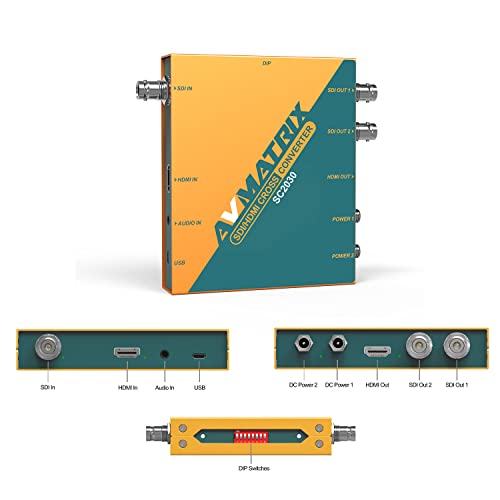
- Bidirectional SDI/HDMI conversion
- 1080p scaling with automatic signal detection
- 3.5mm external audio embedding
Best For: Flexible home theater signal conversion
Signal Distribution Pick
Blackmagic Mini SDI Distribution

- Provides eight re-clocked SDI outputs
- Supports SD, HD, and 3G-SDI
- Handles embedded audio and ancillary data
Best For: Splitting one SDI source across multiple devices
Flexible Routing Pick
Decimator MD-LX Bidirectional Converter

- Converts HDMI and SDI in both directions
- Supports several input/output routing modes
- Handles 3G Level A and B conversion
Best For: Mixed HDMI and SDI home theater systems
Simple Dual-Display Link

- Converts HDMI to two SDI outputs
- Supports up to 1080p60 input
- Long rated SDI cable distances
Best For: HDMI sources feeding two SDI displays
Flexible Signal Hub
Bidirectional SDI/HDMI Converter Scaler

- Converts SDI and HDMI in either direction
- Scales and converts frame rates up to 1080p60
- Adds audio routing and optional fiber support
Best For: Mixed-format systems needing conversion and scaling
SDI Display Bridge
3G/HD/SD-SDI to HDMI Converter

- Converts SDI to HDMI up to 1080p
- Includes SDI loop output
- Metal housing and plug-and-play setup
Best For: SDI sources connected to HDMI displays
Best SDI-to-HDMI Pick
Long-Run Home Theater Converter
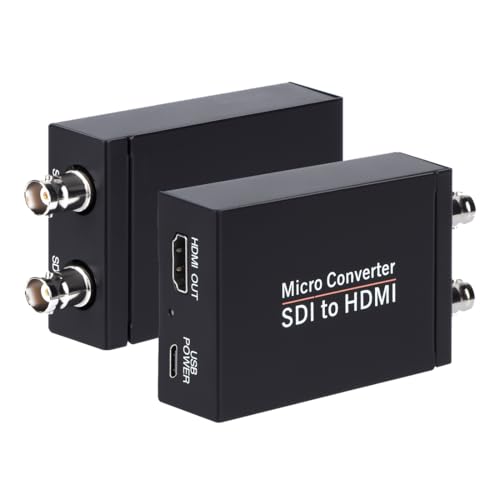
- Converts 3G-, HD-, and SD-SDI to HDMI
- Includes SDI loopout and audio de-embedding
- Supports extended SDI cable distances
Best For: SDI sources feeding HDMI displays over longer cable runs
Best HDMI-to-SDI Pick

- Accepts HDMI from 480i through 1080p/60
- Outputs SD-, HD-, and 3G-SDI
- Supports long SDI output distances
Best For: Sending HDMI sources to SDI monitors or professional video equipment
Best Two-Way Pick
Bidirectional HDMI/SDI Converter

- Converts in either HDMI-to-SDI direction
- Supports adaptive 1080p input and audio de-embedding
- Uses FPGA processing and a metal housing
Best For: Mixed systems that regularly switch between HDMI and SDI sources
Compact Conversion Pick – Blackmagic Micro BiDirectional SDI/HDMI
For home theaters that need a compact way to connect SDI and HDMI equipment, the Blackmagic Design Micro Converter provides bidirectional SDI/HDMI conversion in a portable metal housing. It supports SD, HD, and 3G-SDI and includes a universal 5V power supply with international socket adapters.
Best For: Home theater setups connecting projectors or other HDMI and SDI devices.
Pros:
- Supports bidirectional SDI-to-HDMI and HDMI-to-SDI conversion.
- Handles SD, HD, and 3G-SDI formats.
- Includes a universal power supply and international adapters.
Cons:
- Offers one SDI and one HDMI input/output path.
- Requires a 5V DC power supply.
This is a straightforward choice when you want a small, portable converter rather than a distribution solution or a unit with scaling and external audio features.
Scaling and Audio Pick – AVMATRIX SC2030 SDI/HDMI Converter
The AVMATRIX SC2030 is one of the more flexible sdi converters for home theaters, with SDI-to-HDMI and HDMI-to-SDI conversion plus 1080p scaling. DIP switches enable quick input selection, while USB software control, automatic signal detection, and 3.5mm audio embedding add setup flexibility.
Best For: Home theater systems that need conversion, format handling, and external analog audio embedding.
Pros:
- Converts between SDI and HDMI in either direction.
- Supports SD, HD, and Full HD signals with multi-frame-rate up/down scaling.
- Embeds external analog audio through a 3.5mm input.
- Includes a stated three-year guarantee and technical support.
Cons:
- Uses a 12V input and does not include a power plug according to the supplied details.
- Configuration can involve DIP switches or USB software.
Choose this model when your setup benefits from scaling and audio integration; it is more feature-oriented than a basic point-to-point converter.
Signal Distribution Pick – Blackmagic Mini SDI Distribution
For a home theater rack that needs to send one SDI source to several destinations, the Blackmagic Design Mini Converter SDI Distribution provides eight re-clocked outputs. Its auto-switching SD, HD, and 3G-SDI input also supports embedded audio, ancillary data, and ASI.
Best For: Multi-display or multi-device home theater systems sharing one SDI signal.
Pros:
- Distributes one SDI input to eight re-clocked SDI outputs.
- Supports SD, HD, and 3G-SDI with automatic format switching.
- Preserves embedded audio and ancillary data.
- Includes a redundant SDI input for critical applications.
Cons:
- Designed for SDI distribution rather than SDI-to-HDMI conversion.
- Requires a 12V power supply.
This is the best fit when the main challenge is signal splitting across multiple SDI devices. It is not the right choice if your system primarily needs HDMI connectivity.
Flexible Routing Pick – Decimator MD-LX Bidirectional Converter
The Decimator MD-LX is a practical option for sdi converters for home theaters where routing flexibility matters. It can convert HDMI to SDI or SDI to HDMI, and its auto-select behavior can send an active input to all outputs when both inputs are present.
Best For: Home theater or media setups that switch between HDMI and SDI sources and destinations.
Pros:
- Supports HDMI-to-SDI and SDI-to-HDMI conversion.
- Offers multiple input/output routing combinations.
- Supports 3G Level A and Level B, including conversion between them.
Cons:
- The supplied details list no warranty.
- It is intended for HDMI/SDI devices and does not add scaling or audio features.
Its routing modes make it useful for mixed-interface systems, especially when you want more connection flexibility than a simple one-direction converter provides.
Simple Dual-Display Link – HDMI to 3G-SDI Converter
For home theaters that need to route an HDMI source to SDI displays, this HDMI-to-SDI converter offers a straightforward, plug-and-play setup. It supports HDMI inputs through 1080p60 and provides two SDI outputs, making it a practical choice for extending or duplicating an HD signal.
Best For: Home theater users converting one HDMI source to two SDI displays.
Pros:
- Converts HDMI to two SDI outputs for dual-display setups.
- Supports input resolutions from 480i through 1080p60.
- Offers rated transmission distances up to 100 meters for 3G-SDI, 200 meters for HD-SDI, and 300 meters for SD-SDI.
- Metal housing, heat dissipation, and plug-and-play operation simplify installation.
Cons:
- One-way conversion only; it does not convert SDI to HDMI.
- Designed for HD and SD formats rather than 4K.
This is a focused option among SDI converters for home theaters when your signal path starts with HDMI and ends at one or two SDI destinations. Verify that your source and displays match the supported formats before buying.
Flexible Signal Hub – Bidirectional SDI/HDMI Converter Scaler
For more complex home theater or media-room installations, the AVMATRIX SC2040 combines bidirectional SDI/HDMI conversion, scaling, frame-rate conversion, and audio routing. It supports formats up to 1080p60 and can adapt different source and display standards without requiring separate conversion and scaling hardware.
Best For: Advanced home theater systems with mixed SDI and HDMI equipment, audio routing, or long-distance fiber requirements.
Pros:
- Converts in either direction between SDI and HDMI.
- Includes up/down scaling and frame-rate conversion up to 1080p60.
- Provides audio embedding and de-embedding through 3.5 mm stereo connections.
- Offers dual SDI outputs, HDMI loop functionality, test patterns, and optional fiber transmission up to 20 km with a compatible SFP module.
Cons:
- The SFP fiber module is not included.
- Its broader feature set may be more than a basic home theater setup needs.
- Maximum supported video format is 1080p60, not 4K.
The SC2040 is the most versatile of these SDI converters for home theaters, especially where sources, displays, and audio devices use different connections or formats. Its dual power options and rugged metal enclosure also suit installations that may need field or rack flexibility.
SDI Display Bridge – 3G/HD/SD-SDI to HDMI Converter
If your home theater receives video from an SDI camera or another SDI source but uses an HDMI television, monitor, or projector, this converter provides a direct connection. It supports 3G-, HD-, and SD-SDI formats up to 1080p and includes an SDI loop output for passing the signal onward.
Best For: Connecting an SDI source to an HDMI HDTV, monitor, or projector in a Full HD setup.
Pros:
- Converts 3G/HD/SD-SDI to HDMI with synchronized audio and video.
- Supports Full HD resolution up to 1920×1080.
- Includes an SDI loop output for onward signal distribution.
- Plug-and-play design and metal housing support simple, durable installation.
Cons:
- One-way conversion only; it does not convert HDMI to SDI.
- Does not support 4K.
- Requires a coaxial cable with a BNC male connector and does not support RF, CVBS, AHD, TVI, or CVI signals.
This is a sensible choice when the source is definitely SDI and the display is HDMI. Its loop output adds flexibility, but confirm the connector and signal type first because it is not a general-purpose video converter.
Best SDI-to-HDMI Pick – Long-Run Home Theater Converter
For home theaters using an SDI camera, monitor, or projector, this Anber-Tech converter changes 3G-SDI, HD-SDI, or SD-SDI input into HDMI output. Automatic format detection and an SDI loopout make it a practical choice for connecting professional video sources to consumer displays.
Best For: Home theaters that need SDI-to-HDMI conversion with long cable runs and an additional SDI output.
Pros:
- Supports 3G-SDI, HD-SDI, and SD-SDI formats with automatic detection.
- Provides one HDMI output and one SDI loopout.
- Supports cable runs up to 300 feet for 3G-SDI, 500 feet for HD-SDI, and 1,000 feet for SD-SDI.
- Supports eight channels of 48 kHz digital audio and stereo audio de-embedding.
Cons:
- It is not bidirectional and cannot convert HDMI to SDI.
- Its supported 3G-SDI formats are limited to the listed 1080p frame rates.
This is a strong fit when your system is built around an SDI source and HDMI display. Choose another model if you need two-way conversion.
Best HDMI-to-SDI Pick – 1080p Home Theater Adapter
This Groza converter is designed for home theaters and monitoring setups that need to send an HDMI source to an SDI display or professional video device. It supports common 480i through 1080p formats and outputs SDI at rates ranging from SD-SDI to 3G-SDI.
Best For: Home theater systems that need HDMI-to-SDI conversion for cameras, monitors, or other SDI equipment.
Pros:
- Supports HDMI input resolutions from 480i and 576i through 1080p at up to 60 Hz.
- Handles SD-SDI, HD-SDI, and 3G-SDI output bitrates.
- Supports SDI output distances up to 100 meters for 3G-SDI, 200 meters for HD-SDI, and 300 meters for SD-SDI.
- Includes a 5V/1A power adapter and one-year warranty.
Cons:
- It converts HDMI to SDI only, rather than operating in both directions.
- Requires 75-ohm coaxial cable with BNC connectors for the SDI connection.
Consider this model when HDMI is your source and SDI is required at the destination. Its broad 1080p support and stated output distances suit many dedicated video installations.
Best Two-Way Pick – Bidirectional HDMI/SDI Converter
For flexible home theater and video setups, this Qonakism converter supports both SDI-to-HDMI and HDMI-to-SDI operation. Its adaptive input resolution, 1080p support, audio de-embedding, and compact metal housing make it useful when the direction of conversion may change between installations.
Best For: Home theaters and mixed HDMI/SDI systems that need one converter for either signal direction.
Pros:
- Provides bidirectional HDMI-to-SDI and SDI-to-HDMI conversion.
- Supports adaptive input resolution up to 1920×1080 and uncompressed 1080p video.
- Includes FPGA processing, clock recovery, ESD protection, and a metal housing for heat dissipation.
- Supports SDI distances up to 80 meters for 3G-SDI, 100 meters for HD-SDI, and 120 meters for SD-SDI.
Cons:
- Its warranty is listed as three months.
- It is limited to resolutions up to 1920×1080.
This is the most versatile option of the three when your equipment changes between HDMI and SDI. It is especially appealing for users who want bidirectional operation without buying separate converters.
How We Picked These Sdi Converters for Home Theaters
We focused on converters that address common home-theater and small-production requirements: SDI-to-HDMI conversion, HDMI-to-SDI conversion, bidirectional operation, signal distribution, scaling, audio embedding or de-embedding, and support for widely used SD, HD-SDI, and 3G-SDI formats. Compact construction, straightforward connectivity, loop outputs, dual outputs, and automatic format handling were also considered where listed.
Because compatibility can vary by resolution, frame rate, cable length, and audio format, confirm the specifications for your exact equipment before buying. A converter is only useful when its inputs, outputs, and supported standards match the entire signal chain.
Quick Comparison
| Need | Best converter type | What to look for |
|---|---|---|
| Connect an SDI source to an HDTV or projector | SDI-to-HDMI converter | 3G/HD/SD-SDI support, HDMI output, audio handling |
| Send HDMI into professional SDI equipment | HDMI-to-SDI converter | SDI output level, supported HDMI formats, embedded audio |
| Switch between both standards | Bidirectional converter | Selectable direction, status indicators, reliable power |
| Feed multiple SDI devices | Distribution converter | One SDI input and multiple reclocked outputs |
| Match incompatible resolutions | Scaling converter | Input/output scaling range and frame-rate compatibility |
Key Buying Factors for Sdi Converters for Home Theaters
Signal Format and Resolution
Check whether your equipment uses SD-SDI, HD-SDI, or 3G-SDI, then verify the exact 1080p, 1080i, or other supported formats. A converter labeled “1080p” may not support every frame rate or timing standard.
Conversion Direction
A one-way unit is often simpler and less expensive when you only need to connect an SDI source to an HDMI display. Choose bidirectional hardware if your setup changes frequently or must handle both professional and consumer equipment.
Scaling and Signal Management
Scaling is valuable when source and display resolutions do not match. For longer cable runs or several downstream devices, look for reclocking, loop-through, distribution outputs, and clear signal-status indicators.
Audio Support and Installation
If audio travels through the video chain, confirm whether the converter embeds, de-embeds, or simply passes audio. Also check power requirements, connector placement, included supplies, chassis durability, and whether the unit is suitable for permanent or portable use.
Who Should Buy Which Sdi Converters for Home Theaters?
Choose a compact bidirectional converter for a flexible media room that alternates between HDMI sources and SDI equipment. Choose an SDI-to-HDMI model when the primary goal is displaying a camera, switcher, or professional source on a television or projector. Choose an HDMI-to-SDI model for feeding consumer media players, cameras, or computers into SDI monitors and production hardware.
Choose a scaling converter when mismatched resolutions are a recurring problem, especially with older displays or mixed-format systems. Choose an SDI distribution converter when one source must reach several SDI destinations. For audio-sensitive installations, prioritize models with clearly specified embedding, de-embedding, or stereo support rather than assuming every converter carries sound automatically.