The best voice recorders for lectures make it easier to revisit explanations, capture key details, and study without trying to write everything down. The right model should balance clear audio, reliable battery life, simple controls, and enough storage for your schedule.
We selected 10 recorders with useful combinations of voice activation, playback, noise reduction, USB connectivity, large memory, and AI transcription or summarization features. Use the guide below to match the recorder to your classroom, study, or note-taking needs.
Best 10 Voice Recorders for Lectures Picks for 2026
Best All-Rounder
EVISTR L357 64GB Voice Recorder

- 1536kbps recording with adjustable gain and noise reduction
- 64GB storage and up to 32 hours of continuous recording
- Voice activation, A-B repeat, and variable-speed playback
Best For: Students and professionals recording lectures, meetings, and interviews
Best for AI Notes
EVISTR L359 AI Transcribing Recorder

- Transcribes in 113 languages through the companion app
- Creates summaries, mind maps, and speaker identification
- 128GB storage with up to 33 hours of recording
Best For: Lecture recording followed by AI transcription and organized notes
Best for Long Recording Sessions

- Up to 9,800 hours of storage at 32Kbps
- Claims up to 100 hours of continuous recording
- Includes microphone, headphones, OTG adapters, and USB-C cable
Best For: Frequent lecture recording with minimal charging and storage concerns
Best Compact Budget Option
Cappsu V02 32GB Voice Recorder

- One-click recording with voice activation
- Compact 1.6-ounce design and built-in 32GB storage
- Includes external microphone and two-year warranty
Best For: Simple, portable lecture recording and everyday note-taking
Best High-Capacity Option
Tonfarb 136GB Digital Voice Recorder

- 136GB stated total storage
- Up to 68 hours of continuous recording
- PCM audio, noise reduction, and USB-C
Best For: Frequent users recording long lectures and multiple sessions
Best Simple Value Pick
Sunlan 16GB Lecture Voice Recorder
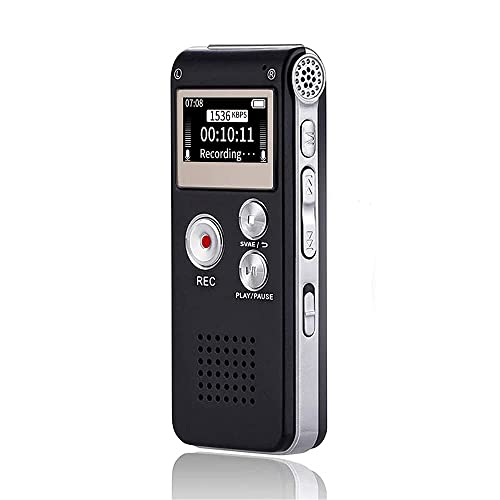
- Lightweight 35-gram design
- One-button recording and voice activation
- Up to 30 hours of continuous recording
Best For: Students who prioritize simple controls and portability
Best with Extra Features

- 64GB storage for extended recording archives
- Up to 48 hours of stated continuous recording
- PCM audio, voice activation, and password protection
Best For: Students and professionals needing substantial lecture-recording storage
Best Simple-Operation Pick

- Three-button controls for quick recording
- Voice activation and noise-reduction functions
- A-B repeat and variable playback speed for studying
Best For: Students wanting a compact recorder with easy controls
Best Maximum-Storage Pick
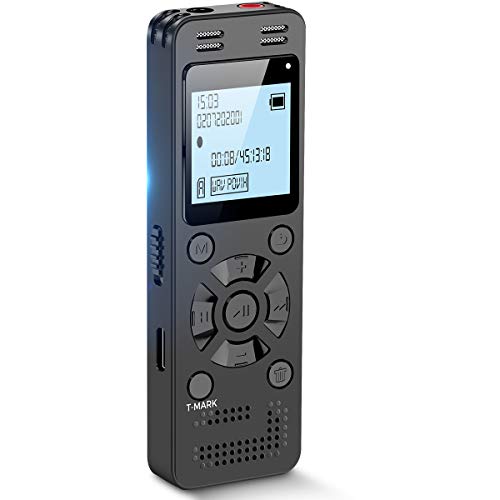
- 128GB storage with up to 9,296 stated hours
- Up to 54 hours of continuous recording
- Voice activation, folders, bookmarks, and password protection
Best For: Users building a large, organized archive of lectures
Best All-Rounder – EVISTR L357 64GB Voice Recorder
The EVISTR L357 is a practical choice if you need voice recorders for lectures with clear audio, generous storage, and straightforward controls. Its adjustable recording gain, noise-reduction technology, and voice activation make it suitable for capturing classroom discussions while limiting silent sections.
Best For: Students and professionals who want a versatile recorder for lectures, meetings, and interviews.
Pros:
- Records up to 1536kbps with adjustable gain and noise-reduction processing.
- 64GB storage can hold up to 4,660 hours at 32Kbps.
- Voice activation, variable-speed playback, A-B repeat, and scheduled recording add flexibility.
- Offers up to 32 hours of continuous recording and transfers files through USB-C.
Cons:
- The many playback and scheduling features may be more than casual users need.
- Voice activation depends on selecting an appropriate sensitivity level for the room.
Choose this model when you want a balanced combination of recording quality, storage, playback tools, and simple file transfer in a compact metal body.
Best for AI Notes – EVISTR L359 AI Transcribing Recorder
The EVISTR L359 adds an AI-assisted workflow to the usual lecture recorder. It can record up to 3072Kbps, transfer files to a phone through the included wired OTG connection, and use the AI DVR Link app for transcription, summaries, mind maps, speaker identification, and related insights.
Best For: Students and professionals who want to turn recorded lectures into searchable notes and summaries.
Pros:
- Supports transcription in 113 languages through the AI DVR Link app.
- Offers smart summaries, mind maps, speaker identification, and Ask AI features.
- 128GB storage provides substantial capacity, with up to 33 hours of continuous recording.
- One-button recording, voice activation, password encryption, and a HOLD switch support convenient use.
Cons:
- AI processing requires the AI DVR Link app and a wired OTG connection.
- The listed continuous recording time is shorter than some high-capacity alternatives.
This is the strongest fit for buyers who value post-recording organization as much as the recording itself, particularly when multilingual transcription and automated summaries are useful.
Best for Long Recording Sessions – Elasound 132GB Voice Recorder
The Elasound recorder is built for users who need voice recorders for lectures that can remain ready for extended sessions. Its large storage capacity, claimed 100-hour battery life, one-touch operation, and AI-assisted triple noise reduction make it suited to frequent recording of classes, meetings, and interviews.
Best For: Heavy users who prioritize storage capacity and long battery life.
Pros:
- Offers up to 9,800 hours of storage at 32Kbps with its included 128GB TF card.
- Claims up to 100 hours of continuous recording and headphone playback.
- AI DSP 4.0 and triple noise reduction are designed to improve vocal clarity.
- Includes a clip-on microphone, headphones, OTG adapters, and a USB-C cable.
Cons:
- Its larger storage setup may be unnecessary for occasional lecture recording.
- The product details specify MP3 recording rather than multiple recording formats.
Consider this model when charging and file capacity are your main concerns. The included accessories also make it a more complete package for recording in different situations.
Best Compact Budget Option – Cappsu V02 32GB Voice Recorder
The Cappsu V02 keeps lecture recording simple with one-click operation, voice activation, and built-in 32GB storage. Its lightweight design and included external microphone make it a convenient everyday option for students who want a small recorder without relying on a TF card.
Best For: Casual lecture recording, note-taking, and buyers who prefer uncomplicated controls.
Pros:
- Records at up to 1536Kbps and includes voice-activated recording.
- Built-in 32GB memory avoids the need for a separate TF card.
- Weighs 1.6 ounces and measures 4.16 × 1.46 × 0.47 inches.
- Includes an external microphone, earphone, USB-C cable, two-year warranty, and lifetime technical support.
Cons:
- Its 20-hour continuous recording time is lower than the longer-lasting models here.
- Storage capacity is more limited than the 64GB, 128GB, and 132GB options.
This recorder is a sensible pick for straightforward, portable use. Choose it when ease of operation and a compact design matter more than maximum storage or advanced transcription tools.
Best Compact Classroom Recorder – HoTiyan 8GB Digital Voice Recorder
For shoppers comparing voice recorders for lectures, this HoTiyan model offers a compact design, stereo recording, voice activation, and straightforward three-button operation. Its 8GB storage and rechargeable battery make it practical for regular classroom use, while A-B repeat and variable playback speed support review after class.
Best For: Students who want a small, simple recorder for lectures, meetings, and repeated listening.
Pros:
- Stereo recording with a higher-sensitivity microphone, noise reduction, and MP3/WAV support.
- Voice activation can reduce silent sections and whisper clips.
- Supports up to 20 hours of continuous recording and 8 hours of playback with earphones.
- Includes A-B repeat, variable playback speed, password protection, and timestamped file names.
Cons:
- The built-in storage is limited to 8GB.
- The listed screen size is relatively small at 1.1 inches.
This is a feature-rich option for students who value easy controls and study-focused playback tools more than maximum storage capacity.
Best High-Capacity Option – Tonfarb 136GB Digital Voice Recorder
Among voice recorders for lectures, the Tonfarb stands out for its large stated capacity and long battery life. It combines PCM recording, dual noise-reduction microphones, voice activation, one-click recording, and USB-C transfer for students or professionals who record frequently.
Best For: Users who need extensive storage and long recording sessions for lectures, meetings, interviews, or classes.
Pros:
- Includes 8GB built-in storage plus a 128GB TF card for a stated 136GB total capacity.
- Offers up to 68 hours of continuous recording on its 1100mAh rechargeable battery.
- Supports 1536 kbps PCM recording, automatic noise reduction, and voice-activated recording.
- One-click recording, USB-C transfer, A-B repeat, and password protection add convenience.
Cons:
- At about 97–100 grams, it is heavier than some smaller recorders.
- The supplied details specify MP3 and WAV recording but do not state separate recording-time figures for every quality setting.
Choose this model if storage and endurance are priorities. Its metal casing and large LCD also make it suited to frequent use, though it may be more recorder than occasional lecture users need.
Best Simple Value Pick – Sunlan 16GB Lecture Voice Recorder
This Sunlan recorder is a straightforward choice for voice recorders for lectures, with one-button recording, built-in playback, voice activation, and a compact 35-gram body. Its 16GB capacity and stated 30-hour recording time provide a practical balance for students who want simple controls and clear speech capture.
Best For: Students seeking an uncomplicated, lightweight recorder for lectures, meetings, and interviews.
Pros:
- Simple REC, STOP, and PLAY controls are easy to use during class.
- Noise-reduction processing and a sensitive microphone are designed to capture clear voices.
- Voice activation can save recording time and reduce power use.
- Provides 16GB storage, up to 30 hours of continuous recording, and A-B repeat playback.
Cons:
- The supplied details list WAV format rather than MP3 recording support.
- Playback is rated for 7 hours, shorter than its stated recording endurance.
- The microphone operation is listed as mono.
This is a good fit when ease of use and low weight matter most. It lacks some of the higher-capacity and stereo features of the alternatives, but its focused controls suit everyday lecture recording.
Best with Extra Features – Tonfarb 64GB Voice Recorder
For shoppers comparing voice recorders for lectures, the Tonfarb A12 stands out for its one-click controls, generous storage, and long stated recording runtime. It records WAV audio at up to 1536kbps, includes automatic noise reduction, and offers playback and file-management tools for reviewing class material.
Best For: Students and professionals who want high storage capacity, extended battery life, and flexible lecture-recording features.
Pros:
- 64GB storage supports up to 4,600 hours of recordings.
- Up to 48 hours of continuous use at the stated MP3 setting.
- One-click recording, voice activation, scheduled recording, and A-B loop playback.
- Password protection, bookmarking, and a large 1.44-inch screen improve file management.
Cons:
- The supplied specifications list a 32-hour average battery life as well as up to 48 hours of digital recording time, so actual runtime depends on settings.
- Its many functions may take more time to learn than a basic recorder.
The Tonfarb is a strong choice when lecture recording capacity and controls matter more than minimalism. Its built-in 64GB card and detailed recording mode make it suitable for archiving classes, while the voice-activation and bookmarking tools support easier review.
Best Simple-Operation Pick – HoTiyan 16GB Lecture Recorder
The HoTiyan H-10001 is a compact option among voice recorders for lectures, with three-button recording, saving, and playback controls. Its sensitive microphone, noise-reduction function, voice activation, and A-B repeat feature are designed for capturing and revisiting classroom material without a complicated workflow.
Best For: Students who want an affordable, lightweight recorder with straightforward controls and repeat-playback features.
Pros:
- Simple three-button operation supports quick recording and saving.
- Voice activation can reduce silent sections and whisper fragments.
- 16GB storage provides up to 1,120 hours at the stated 32kbps setting.
- A-B repeat, variable playback speed, timestamps, and password protection aid study and organization.
Cons:
- Its 20-hour continuous recording battery rating is shorter than the longer-runtime models in this roundup.
- Storage capacity is substantially lower than 64GB and 128GB alternatives.
- The supplied notes limit recording files to 199 files.
The HoTiyan makes sense for routine lectures and study sessions where easy operation is a priority. It offers useful review tools and expandable recording-length settings, though students recording many long classes may prefer a larger-capacity model.
Best Maximum-Storage Pick – EVIDA 128GB Lecture Recorder
The EVIDA VR01 is built for shoppers seeking maximum capacity in voice recorders for lectures. Its 128GB storage, selectable MP3 or WAV recording settings, voice activation, password protection, and folder organization make it suited to recording and managing a large library of classes, meetings, and conversations.
Best For: Students, teachers, and professionals who need very high storage capacity and organized long-term recording.
Pros:
- 128GB capacity is listed for up to 9,296 hours of recording.
- Up to 54 hours of continuous recording with a full battery is stated.
- 1536kbps PCM recording and a noise-cancelling microphone target detailed audio capture.
- Six voice-activation levels, four storage folders, bookmarks, and A-B repeat support review and organization.
Cons:
- The supplied details list no headphone jack.
- The specification identifies the microphone operation as mono, which may be less suitable for listeners seeking stereo capture.
- The product details list a C battery requirement, while the notes also describe it as rechargeable; buyers should verify the charging and battery setup.
The EVIDA is the capacity-focused choice for users building a substantial lecture archive. Its folder system and voice-activation settings add practical organization, but the lack of a listed headphone jack and mono microphone specification may matter for certain playback or recording preferences.
How We Picked the Best Voice Recorders for Lectures
We focused on features that matter during real classes rather than choosing solely by storage capacity. Our selection includes compact recorders for occasional use, high-capacity devices for frequent recording, voice-activated models that reduce silent sections, and newer options with AI transcription or summarization. We also considered playback controls, microphone performance, rechargeable power, file transfer, password protection, and how straightforward each device appears to operate.
Specifications such as advertised recording hours and memory can vary with audio quality, file format, and usage settings. Treat those figures as capacity estimates, not guaranteed classroom performance.
Quick Comparison
- Best for long-term storage: Choose a 128GB or larger model if you record multiple classes and do not transfer files frequently.
- Best for simple operation: A playback-equipped recorder with physical controls is usually easier to start, stop, and review quickly.
- Best for hands-off recording: Voice activation can skip extended silence, helping conserve storage and battery.
- Best for study workflows: AI transcription and summarization may reduce note-taking time, but check supported languages, app requirements, and processing limits.
- Best for portability: Smaller 8GB or 16GB recorders can be sufficient for occasional lectures and are often easier to carry discreetly.
Key Buying Factors for Voice Recorders for Lectures
Audio Quality and Microphones
Look for a sensitive built-in microphone and adjustable recording quality. Noise reduction can help with ventilation, classroom movement, and distant speakers, but it cannot fully correct a recorder placed too far from the lecturer. Positioning near the front of the room generally matters more than headline storage numbers.
Storage, Battery, and File Transfer
Estimate how many hours you record per week and choose enough capacity for several sessions. Rechargeable USB models are convenient, while USB transfer makes it easier to archive recordings on a computer. Confirm whether the device records in a broadly compatible format such as MP3 or WAV.
Controls and Privacy
Physical buttons, clear playback functions, and a visible recording indicator are useful in class. A password-protected model can provide an extra layer of privacy for personal notes, interviews, or sensitive course material. Always follow school policies and obtain permission before recording.
Who Should Buy Which Voice Recorders for Lectures?
Students recording a few classes: Choose a compact 8GB, 16GB, or 32GB recorder with playback and USB charging. It should cover occasional sessions without adding much weight.
Students with full lecture schedules: A 64GB or 128GB model offers more flexibility when transferring files is inconvenient. Voice activation is especially useful for long classes with pauses.
Researchers and heavy users: Consider the highest-capacity options, noise-reduction features, and dependable file management. Confirm battery endurance and test microphone placement before an important session.
Note-taking and accessibility users: AI transcription or summarization can be valuable for turning recordings into searchable study material. Review accuracy carefully, especially with accents, technical terms, multiple speakers, or classroom noise.