The best voice recorder for interviews should capture clear speech, run reliably through long conversations, and make files easy to review afterward. The right choice depends on whether you prioritize simple recording, compact design, long battery life, or automatic transcription.
We compared 10 interview-ready options, including traditional digital recorders and newer AI note-taking devices, to help you choose a practical fit for journalism, research, business, and fieldwork.
Best 10 Voice Recorders for Interviews Picks for 2026
Best Value
EVISTR L357 64GB Digital Voice Recorder

- 1536kbps stereo recording with noise reduction
- 64GB storage and up to 32 hours of recording
- Voice activation and USB-C file transfer
Best For: Traditional interview recording with simple controls and ample storage
Best AI Workflow

- Transcribes conversations in 112 languages
- Records phone calls and in-person meetings
- Creates summaries, mind maps, and to-do lists
Best For: Professionals who want interview audio converted into structured notes
Best High-Capacity Option

- 128GB capacity for up to 9,296 hours
- 1536Kbps PCM recording with noise cancellation
- Password protection and four-folder file management
Best For: Long-term interview recording and organized local storage
Best Wearable Recorder
soundcore Work by Anker AI Recorder

- Coin-sized, 0.35-ounce wearable design
- AI transcription in 150+ languages with speaker identification
- Structured summaries with decisions and action items
Best For: Mobile professionals who want wearable recording and AI follow-up
Reliable Interview Recorder

- Up to 57 hours of battery life
- Built-in USB for PC file transfers
- 4GB storage with MP3 recording
Best For: Traditional interview recording with simple file management
AI Interview Note-Taker
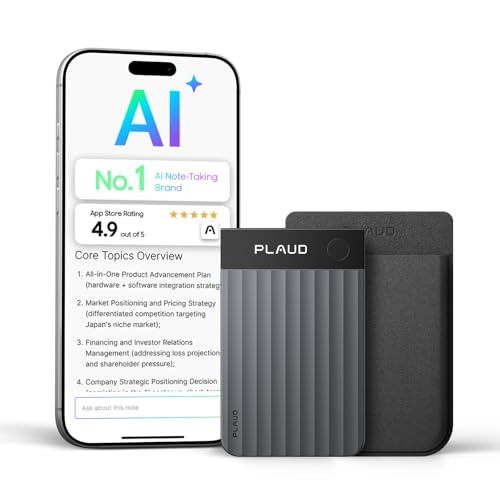
- AI transcription, summaries, and recording Q&A
- Four MEMS microphones plus VPU microphone
- Up to 30 hours in Enhance Mode
Best For: Interviews that need transcription and organized follow-up
Simple Budget Interview Recorder

- One-button recording and built-in playback
- 16GB storage with USB file transfer
- Voice activation and noise reduction
Best For: Simple, affordable interviews and lectures
Best AI-Enabled Interview Recorder

- 3072Kbps recording with noise reduction and VOR
- AI transcription and summaries in 113 languages
- 128GB storage with OTG phone transfers
Best For: Interviewers who want built-in AI organization tools
Best Heavy-Duty Pick

- Stereo recording with noise reduction
- Voice activation and easy three-button operation
- Up to 20 hours of continuous recording
Best For: Straightforward interview and meeting recording
Best Long-Battery Interview Recorder

- Up to 68 hours of continuous recording
- Dual microphones with automatic noise reduction
- 136GB total storage with included TF card
Best For: Long interviews, meetings, and extended recording sessions
Best Value – EVISTR L357 64GB Digital Voice Recorder
If you want straightforward voice recorders for interviews, the EVISTR L357 focuses on clear capture, easy controls, and generous storage. Its PCM noise reduction, adjustable recording gain, and voice activation make it practical for conversations, meetings, and lectures.
Best For: Interviewers who want a traditional recorder with long battery life, playback controls, and simple computer file transfer.
Pros:
- 1536kbps stereo recording with PCM noise reduction and seven gain levels
- 64GB storage, up to 32 hours of continuous recording, and up to 35 hours of playback
- Voice activation, A-B repeat, variable-speed playback, and scheduled recording
- USB-C transfer works with Windows and Mac computers
Cons:
- It does not provide built-in AI transcription or summaries
- Voice activation may require sensitivity adjustment for different interview environments
The L357 is a solid choice when dependable local recording matters more than automated transcription. Its physical controls and organized timestamped files also suit users who prefer a conventional dictaphone workflow.
Best AI Workflow – Plaud Note AI Voice Recorder
The Plaud Note is designed for people who want voice recorders for interviews that can also turn conversations into usable notes. It combines dual-mode recording with app-based transcription, summaries, templates, and cross-device access.
Best For: Professionals who need interview transcripts, structured summaries, and organized follow-up information.
Pros:
- Transcription support for 112 languages through the Plaud app and web platform
- Dual modes capture in-person meetings and phone calls
- 64GB of local storage, up to 30 hours of continuous recording, and 60 days of standby time
- Very slim 0.12-inch design with encrypted local data and privacy-focused controls
Cons:
- Transcription features use a monthly Starter allowance or optional paid plans
- No headphone jack is included
- Its workflow depends on the Plaud app or web platform for transcription and summaries
Choose the Plaud Note if the value of an interview recorder includes what happens after recording. It is particularly compelling for users who want conversations converted into searchable, structured work products rather than simply stored as audio files.
Best High-Capacity Option – EVIDA 128GB Voice Recorder
For buyers comparing voice recorders for interviews with extensive storage needs, the EVIDA recorder offers a conventional recording setup with 128GB of capacity. It adds PCM recording, voice activation, password protection, and folder-based file management.
Best For: Students, interviewers, and business users who want long recording capacity and practical onboard organization.
Pros:
- 128GB storage rated for up to 9,296 hours of recording
- 1536Kbps PCM recording with an upgraded noise-canceling microphone
- Voice activation with six sensitivity levels helps reduce silent sections
- Password protection, four storage folders, bookmarks, and USB computer transfer
Cons:
- The recorder uses a built-in mono microphone rather than stereo recording
- It has no headphone jack according to the supplied specifications
- It lacks AI transcription and automated interview summaries
The EVIDA is a practical pick when storage, basic security, and file organization take priority. Its password feature and large capacity are useful for users managing many recordings over time, while voice activation can help conserve space.
Best Wearable Recorder – soundcore Work by Anker AI Recorder
The soundcore Work by Anker takes a different approach to voice recorders for interviews: its coin-sized design can clip to clothing, attach to a phone, or hang from a necklace. It combines one-touch recording with AI transcription, speaker identification, and structured summaries.
Best For: Sales professionals, consultants, and iPhone users who want a discreet, wearable recorder with AI-assisted follow-up.
Pros:
- Compact 0.35-ounce design with clip, necklace, and phone-attachment options
- AI transcription supports more than 150 languages and can identify speakers
- Creates summaries with key points, decisions, and follow-up actions
- MFi-certified for iPhone and also compatible with Android devices
Cons:
- It includes 300 free transcription minutes per month, with optional paid plans for more
- Audio cannot be exported through USB
- Initial setup requires connecting through the soundcore app
The soundcore Work is best when portability and post-interview productivity matter more than traditional standalone recorder controls. Its wearable format can keep recording accessible, while the app and web portal help turn conversations into actionable information.
Reliable Interview Recorder – Sony ICD-PX370
Sony ICD-PX370 Mono Digital Voice Recorder with Built-In USB Voice Recorder,black
Check Price On AmazonThe Sony ICD-PX370 is a straightforward option for shoppers comparing voice recorders for interviews. Its built-in microphone records MP3 audio, while the direct USB connection makes transferring files to a computer simple.
Best For: Interviewers who want a familiar, practical recorder with long battery life and easy computer transfers.
Pros:
- Up to 57 hours of battery life for extended recording sessions.
- Built-in USB connection supports quick file transfer to a PC.
- 4GB of storage and MP3 recording provide a simple workflow.
Cons:
- Mono recording may be less immersive than a dedicated stereo setup.
- Uses two AA batteries rather than a rechargeable battery.
- The 2.5mm headphone jack may require an adapter for some headphones.
Choose the ICD-PX370 if dependable operation and extended recording time matter more than advanced transcription or connected features. It is a sensible traditional recorder for interviews, meetings, and everyday note-taking.
AI Interview Note-Taker – Plaud Note Pro
The Plaud Note Pro takes a more connected approach to voice recorders for interviews, combining multi-microphone recording with transcription and AI-assisted summaries. It can capture audio, mark key moments, and let you add typed notes or images for richer interview context.
Best For: Professionals who want interview recordings connected to transcription, searchable insights, and cross-device organization.
Pros:
- Four MEMS microphones and a VPU microphone support clear speech capture.
- Enhance Mode records speech from up to 16.4 feet for up to 30 hours.
- AI tools can extract key points, answer questions, and suggest next steps from recordings.
- 64GB storage, app access, and a Starter Plan with 300 monthly transcription minutes are included.
Cons:
- Advanced transcription features depend on the Plaud app and plan limits.
- It has no headphone jack.
- Users should obtain consent and follow applicable privacy laws before recording.
The Note Pro is best suited to interview workflows where recording is only the first step. Its AI, synchronization, and multimodal note features add convenience, though buyers should account for the platform and transcription-plan requirements.
Simple Budget Interview Recorder – 16GB Digital Voice Recorder
This compact digital recorder is a practical entry-level choice among voice recorders for interviews. One-button recording, noise-reduction processing, voice activation, and built-in playback make it easy to capture and review conversations without a complicated setup.
Best For: Students, casual interviewers, and buyers seeking inexpensive recording with generous storage and direct USB access.
Pros:
- Simple REC, STOP, and PLAY controls are easy to operate.
- 16GB storage provides room for recorded WAV files and other data.
- Voice activation can begin recording when sound is detected.
- USB connectivity allows drag-and-drop file transfers on Windows computers.
Cons:
- Continuous recording and playback figures are approximately 30 and 7 hours, respectively.
- The built-in microphone is a basic mono, noise-cancellation setup.
- Its feature set is less advanced than an AI-connected recorder.
This recorder makes sense when affordability, straightforward controls, and onboard playback are priorities. It offers useful interview-focused functions without requiring an app, subscription workflow, or complicated configuration.
Best AI-Enabled Interview Recorder – EVISTR L359
For shoppers comparing voice recorders for interviews, the EVISTR L359 stands out by pairing high-bitrate recording with an AI-assisted workflow. It records at up to 3072Kbps, includes noise reduction and voice-activated recording, and can connect to a phone through the included OTG accessories for transcription and summaries.
Best For: Interviewers, students, and professionals who want recording, transcription, summaries, and file security in one compact device.
Pros:
- AI DVR Link support offers transcription in 113 languages, summaries, mind maps, speaker identification, and Ask AI insights.
- Up to 3072Kbps recording with intelligent noise reduction and VOR recording.
- 128GB storage, a 33-hour continuous recording claim, password encryption, and a HOLD switch.
- Lightweight 65g design with wired OTG phone transfers and included adapters.
Cons:
- AI processing requires connecting the recorder to a phone and using the AI DVR Link app.
- The built-in microphone is listed as mono, which may be less suitable for wide stereo ambience.
The L359 is a strong choice when interview recording is only part of the workflow. Its large storage and one-touch controls keep capture simple, while the connected AI tools can reduce the time spent organizing spoken material.
Best Heavy-Duty Pick – HoTiyan H-10001
The HoTiyan H-10001 is a straightforward option for shoppers seeking voice recorders for interviews without an app-based workflow. Its stereo microphone, noise reduction, voice activation, and three-button controls make it practical for recording meetings, conversations, and lectures.
Best For: Buyers who want an uncomplicated recorder with stereo capture, long low-bitrate recording capacity, and basic playback features.
Pros:
- Stereo recording uses a more sensitive microphone, professional recording chip, and noise reduction function.
- Voice activation can begin recording when sound rises above the selected decibel level.
- 16GB storage supports up to 1,120 hours at 32kbps and up to 20 hours of continuous recording.
- Includes A-B repeat, variable playback speed, password protection, timestamps, and MP3 playback.
Cons:
- Its 16GB capacity is much smaller than the storage offered by some larger recorders.
- File transfers use the supplied Micro USB cable rather than USB-C.
This recorder favors ease of use over advanced processing. It is a sensible fit for routine interviews and meetings when you mainly need dependable capture, convenient playback, and simple computer file transfers.
Best Long-Battery Interview Recorder – Tonfarb A20
For extended interviews, the Tonfarb A20 emphasizes endurance and storage. It combines dual noise-reduction microphones, 1536kbps PCM recording, voice activation, and a claimed 68-hour continuous battery life, making it useful for back-to-back conversations or long sessions.
Best For: Journalists, students, and professionals who need lengthy recording sessions with abundant storage and quick one-touch operation.
Pros:
- Dual microphones, automatic noise reduction, and 1536kbps PCM recording are designed for clear capture.
- Built-in 8GB storage plus a complimentary 128GB TF card provides substantial capacity.
- Up to 68 hours of continuous recording on a 1100mAh rechargeable battery.
- One-click recording, a large LCD screen, A-B repeat, password protection, and USB-C transfers.
Cons:
- At about 97–100g, it is heavier than the smaller EVISTR and HoTiyan models.
- The supplied details list MP3 under supported formats, while the product description also references WAV capacity; buyers should confirm format settings before purchase.
The A20 is compelling when battery life and recording capacity matter most. Its larger metal-bodied design and clear controls suit demanding schedules, while voice activation can help conserve storage during quiet stretches.
How We Picked the Best Voice Recorders for Interviews
We focused on features that matter during real interviews rather than headline specifications alone. Our comparison considers recording clarity, storage capacity, battery practicality, controls, file access, portability, and the effort required to organize recordings afterward. We also included both conventional digital recorders and AI-enabled models because they suit different workflows.
For Voice Recorders for Interviews, dependable operation is especially important. A recorder should start quickly, provide enough storage for several sessions, and let you confirm that recording is active. Devices with playback, voice activation, password protection, or built-in USB connections can also simplify common interview tasks.
Quick Comparison
- Best for straightforward recording: Traditional EVISTR, Sony, EVIDA, Tonfarb, and 16GB models offer familiar controls and generous storage.
- Best for transcription-focused workflows: PLAUD and EVISTR AI models are designed to turn recordings into searchable notes or summaries.
- Best for portability: The coin-sized soundcore Work by Anker emphasizes a small footprint for discreet carrying.
- Best for calls and meetings: The PLAUD Note Pro is aimed at capturing and processing more than conventional in-person recordings.
Key Buying Factors for Voice Recorders for Interviews
Audio Quality and Microphone Performance
Prioritize clear speech over maximum advertised recording time. For one-on-one interviews, a sensitive microphone and sensible placement usually matter more than extreme storage capacity. If you record in busy environments, look for a device with useful noise-handling features and test it before an important session.
Storage, Battery, and File Management
Higher capacities reduce the need to transfer files frequently, while rechargeable designs can be convenient for regular use. Check how recordings are exported and whether the recorder works with your computer or phone without special software. Built-in USB connectivity can be particularly useful when speed matters.
Transcription and Privacy
AI transcription can save substantial time, but it may require an app, account, subscription, or internet connection. Review how recordings are uploaded and stored before using these products for confidential interviews. A conventional recorder may be preferable when local file control is more important than automated summaries.
Controls and Reliability
Physical record, pause, stop, and playback controls are helpful when you need to operate the device without looking away from a subject. Voice activation can reduce silent sections, but it should be tested because quiet speech or pauses may be missed. Password protection is useful when recordings contain sensitive information.
Who Should Buy Which Voice Recorders for Interviews?
Choose a traditional digital recorder if you want simple operation, broad compatibility, and predictable file handling. These models are well suited to students, journalists, researchers, and anyone who prefers to review recordings manually. Select an AI recorder if you regularly need transcripts, summaries, or searchable meeting notes and are comfortable with the required software or cloud workflow.
For frequent travel or discreet carrying, a compact model may be the best fit. For long lectures, research sessions, or repeated interviews, prioritize storage and battery endurance. Whichever model you choose, conduct a short test recording before each important interview, keep a backup power plan, and obtain the appropriate consent before recording.