The best SDI converters make it easier to connect professional SDI equipment with HDMI cameras, monitors, switchers, and recording devices. The right model can also add signal conversion, audio embedding or de-embedding, loop-through, and distribution to your setup.
This roundup compares 10 SDI converters across common production needs, including 3G-SDI and 12G-SDI workflows. Use the guide below to narrow your choice by format support, direction, audio features, outputs, and installation requirements.
Best 10 Sdi Converters Picks for 2026
Flexible 3G Signal Conversion
Blackmagic Micro Converter BiDirect

- Bidirectional SDI and HDMI conversion
- Multi-speed support for flexible workflows
- AC power included
Best For: Compact camera-to-monitor setups
Format Conversion Control
Blackmagic Mini Converter UpDownCross HD

- Converts SD and HD formats
- Includes SDI and HDMI I/O
- Built-in re-sync with reference input
Best For: Studio and broadcast format conversion
Long-Run SDI Monitoring
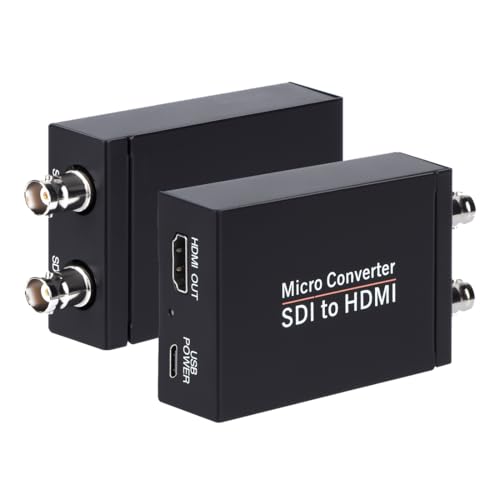
- Auto-detects 3G, HD, and SD-SDI
- HDMI output plus SDI loopout
- Supports long SDI cable runs
Best For: SDI camera monitoring on HDMI displays
Multi-Output Signal Splitting
Blackmagic Mini Converter SDI Distribution

- Eight re-clocked SDI outputs
- Auto-switches SD, HD, and 3G-SDI
- Supports embedded audio and ancillary data
Best For: Broadcast and live-event SDI distribution
Long-Range HDMI-to-SDI Pick
Anber-Tech HDMI to 3G-SDI Converter

- Dual SDI output for HDMI sources
- Supports 1080p 3G-SDI output
- Up to 100m 3G-SDI distance
Best For: HDMI cameras and sources feeding multiple SDI displays
Professional Compact Pick
Blackmagic Micro Converter SDI to HDMI 12G
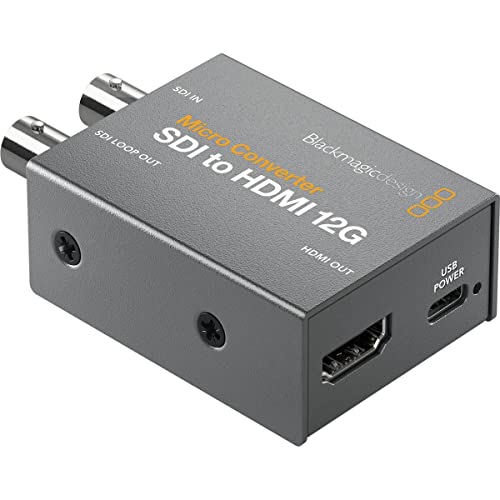
- 33-point 3D LUT for calibration
- LUT output through SDI loop
- Compact, robust metal construction
Best For: Portable SDI monitoring and professional color-calibration setups
Simple Full-HD Monitoring Pick
SHUITING SDI to HDMI Converter with Loop Out

- Supports SD, HD, and 3G-SDI
- Full-HD output up to 1080p
- Includes SDI loop-out functionality
Best For: Connecting SDI cameras to HDMI displays and projectors
Versatile 12G Pick
Blackmagic Micro Converter BiDirectional 12G

- Bidirectional SDI/HDMI conversion
- HDMI 2.0 input and automatic matching
- Universal power supply included
Best For: Flexible camera, monitor, and projector setups
HDMI-to-SDI Specialist
Blackmagic Micro Converter HDMI to SDI 12G

- One HDMI input to two SDI outputs
- Supports rates up to 12G
- Automatic format detection and reclocking
Best For: HDMI sources feeding SDI equipment
Compact 3G Value
Blackmagic Micro Converter BiDirectional 3G

- Bidirectional SDI/HDMI conversion
- Supports SD, HD, and 3G-SDI
- Universal power supply with adapters
Best For: Portable HD and 3G-SDI projector setups
Flexible 3G Signal Conversion – Blackmagic Micro Converter BiDirect
For compact setups, this Blackmagic Micro Converter is one of the more versatile SDI converters in the group. It supports bidirectional SDI and HDMI conversion, multi-speed operation, and includes AC power, making it useful when you need to move signals between a camera and monitor.
Best For: Camera-to-monitor setups requiring SDI-to-HDMI or HDMI-to-SDI conversion.
Pros:
- Supports bidirectional SDI and HDMI conversion
- Offers multi-speed support
- AC power supply is included
- Compact 5.6 x 4.7 x 2.9-inch design
Cons:
- Only one SDI and one HDMI connection are listed
- Power plug type is listed as no plug, so regional compatibility should be checked
This is a practical pick for users who want a small, flexible converter rather than a dedicated one-way unit. Its bidirectional operation adds convenience for portable production and monitoring workflows.
Format Conversion Control – Blackmagic Mini Converter UpDownCross HD
This Blackmagic Mini Converter is designed for more involved video-format workflows. It converts SD and HD video formats, includes SDI and HDMI inputs and outputs, provides reference input for built-in re-sync, and uses Teranex conversion algorithms for up, down, and cross conversion.
Best For: Broadcast, studio, and event systems that need SD/HD format conversion with re-sync capability.
Pros:
- Converts and up/down/cross-converts SD and HD SDI formats
- Includes SDI and HDMI inputs and outputs
- Reference input supports built-in re-sync
- Universal +12V power supply with international socket adapters
Cons:
- More feature-heavy than a basic one-way converter
- Power consumption is listed at 5W, which may matter in portable systems
Choose this model when format standards conversion is more important than minimizing features or size. Software upgrades through the updater application and support for several Mac and Windows versions add useful maintenance flexibility.
Long-Run SDI Monitoring – Anber-Tech SDI to HDMI
The Anber-Tech SDI to HDMI Converter is a dedicated one-way option for displaying SDI sources on HDMI equipment. It automatically detects 3G-SDI, HD-SDI, and SD-SDI formats, provides an SDI loopout, and de-embeds up to eight channels of 48 kHz digital audio.
Best For: Connecting professional SDI cameras or sources to HDMI monitors, televisions, or projectors.
Pros:
- Supports 3G-SDI, HD-SDI, and SD-SDI input formats
- Includes HDMI output and SDI loopout
- Supports long cable runs up to 300 feet for 3G-SDI
- De-embeds eight channels of 48 kHz digital audio
Cons:
- Not bidirectional; it does not convert HDMI to SDI
- Its format support is limited to the listed SDI standards
This is a straightforward choice when your signal path is SDI in and HDMI out. The loopout and long-run support make it especially useful for monitoring or passing the SDI feed onward while sending a display signal to a nearby HDMI device.
Multi-Output Signal Splitting – Blackmagic Mini Converter SDI Distribution
This Blackmagic Mini Converter is built for distributing one SDI source to multiple destinations. Its auto-switching SD, HD, and 3G-SDI input feeds eight re-clocked outputs, while support for ancillary data, embedded audio, and ASI suits signal-splitting duties in broadcast and live-event systems.
Best For: Sending one SDI feed to several monitors, recorders, or other SDI devices.
Pros:
- Provides eight re-clocked SDI outputs
- Automatically switches between SD, HD, and 3G-SDI
- Supports ancillary data and embedded audio
- Redundant SDI input is suited to mission-critical tasks
Cons:
- This is a distribution amplifier, not a general SDI-to-HDMI converter
- Only the main unit is listed as an included component
- Requires a 12-volt minimum supply
For installations that need multiple synchronized SDI feeds, this model is more appropriate than a simple point-to-point converter. Its eight outputs and re-clocking are the key reasons to consider it for live production or broadcast signal distribution.
Long-Range HDMI-to-SDI Pick – Anber-Tech HDMI to 3G-SDI Converter
For buyers comparing sdi converters, the Anber-Tech model is a practical choice when the source is HDMI but the displays or transmission setup use SDI. It provides two SDI outputs, supports input formats through 1080p at 60Hz, and automatically detects HD-SDI or 3G-SDI output.
Best For: Connecting an HDMI camera, CCTV source, or other compatible HDMI device to two SDI displays over longer cable runs.
Pros:
- Converts HDMI to dual SDI outputs.
- Supports 3G-SDI 1080p and HD-SDI 720p output formats.
- Supports output distances up to 100 meters for 3G-SDI and 200 meters for HD-SDI.
- Includes a power adapter and supports audio with the HDMI signal.
Cons:
- It is not bidirectional and cannot convert SDI to HDMI.
- It supports only the listed HDMI input resolutions and frequencies.
This is a straightforward option for HDMI-to-SDI distribution, especially where dual outputs and extended cable distance matter. Confirm your source format before buying, since unsupported HDMI signals will not work.
Professional Compact Pick – Blackmagic Micro Converter SDI to HDMI 12G
Among sdi converters, the Blackmagic Design Micro Converter is aimed at users who want SDI-to-HDMI conversion in a compact, durable form. Its metal body uses broadcast-oriented technology, and the included 33-point 3D LUT feature can help calibrate a connected monitor, projector, or television.
Best For: Portable professional setups that need SDI-to-HDMI conversion and monitor color calibration.
Pros:
- Includes a 33-point 3D LUT for display color calibration.
- Can output the 3D LUT through the SDI loop output.
- Uses a compact, robust metal body.
- Designed for a 5-volt power supply.
Cons:
- The supplied notes identify it as SDI-to-HDMI rather than a bidirectional converter.
- The listing provides limited details about included accessories beyond the main unit.
Choose this model when build quality and LUT functionality are more important than a basic, low-feature converter. Its compact metal construction also suits portable production and monitoring work.
Simple Full-HD Monitoring Pick – SHUITING SDI to HDMI Converter with Loop Out
For a simple SDI-to-HDMI workflow, this SHUITING unit is one of the more accessible sdi converters for connecting an SDI camera to an HDTV, monitor, or projector. It supports SD-SDI, HD-SDI, and 3G-SDI signals up to 1080p, with synchronized audio and video output.
Best For: Full-HD SDI cameras that need to feed an HDMI monitor, projector, or television.
Pros:
- Accepts SD-SDI, HD-SDI, and 3G-SDI input signals.
- Supports up to 1920×1080 full-HD output.
- Provides SDI loop out for passing the signal onward.
- Uses a durable metal shell with heat dissipation and plug-and-play operation.
Cons:
- It does not support 4K resolution.
- It only converts SDI to HDMI and cannot convert HDMI to SDI.
- It requires a BNC male coaxial cable and does not support RF, CVBS, AHD, TVI, or CVI signals.
This converter makes sense for straightforward 1080p monitoring and distribution rather than higher-resolution production. Check that your camera outputs genuine SDI and that your cable uses the specified BNC connection.
Versatile 12G Pick – Blackmagic Micro Converter BiDirectional 12G
Blackmagic Design Micro Converter BiDirectional SDI/HDMI 12G with Power Supply CONVBDC/SDI/HDMI12G/P
Check Price On AmazonFor buyers comparing SDI converters, this Blackmagic Design model is a flexible choice when a setup needs both SDI and HDMI connectivity. It supports an SDI input, an HDMI 2.0 input, and automatic HDMI output matching, with a universal power supply included.
Best For: Camera, monitor, projector, and display setups that need bidirectional SDI/HDMI conversion with 12G support.
Pros:
- Supports SDI and HDMI 2.0 inputs.
- Provides automatic HDMI video output matching.
- Includes a 5V universal power supply and international socket adapters.
- Compatible with SDI cameras, computers, monitors, projectors, and displays.
Cons:
- The supplied notes do not specify the supported SDI rates.
- Its four listed ports may be more than needed for a simple one-way conversion setup.
This is a practical all-around option when flexibility matters more than minimizing features. Its bidirectional design and included international adapters make it suitable for varied production and presentation environments.
HDMI-to-SDI Specialist – Blackmagic Micro Converter HDMI to SDI 12G
Among SDI converters, this compact Blackmagic Design unit is aimed specifically at sending an HDMI source into an SDI workflow. It offers two SDI video outputs, automatic HDMI input matching, multi-rate support through 12G, and SDI reclocking.
Best For: Desktop, laptop, and other HDMI source devices that need distribution to SDI equipment.
Pros:
- Converts an HDMI input to two SDI video outputs.
- Supports 270Mb, 1.5G, 3G, 6G, and 12G SDI rates.
- Automatically detects SD, HD, 2K, Ultra HD, and 4K formats.
- Includes SDI reclocking for the signal path.
Cons:
- This model is designed for HDMI-to-SDI conversion rather than bidirectional use.
- The supplied notes do not mention an included power supply.
Choose this converter when the workflow starts with HDMI and needs two SDI outputs. Its broad rate support and automatic format detection make it particularly useful for mixed-resolution installations.
Compact 3G Value – Blackmagic Micro Converter BiDirectional 3G
This Blackmagic Design model is a straightforward option for buyers seeking SDI converters for SD, HD, or 3G workflows. It provides bidirectional SDI/HDMI connections, automatically matches the HDMI video input, and includes a 5V universal power supply with international adapters.
Best For: Portable projector and display setups using SD, HD, or 3G-SDI equipment.
Pros:
- Supports SD, HD, and 3G-SDI input formats.
- Offers both HDMI Type A input and HDMI Type A output.
- Provides automatic matching for the HDMI video input.
- Includes a universal power supply with international socket adapters.
Cons:
- Its stated SDI support stops at 3G rather than 6G or 12G.
- The supplied notes do not list detailed SDI rate options.
This is a sensible pick for established HD and 3G-SDI systems where 12G performance is unnecessary. Its portable metal construction and included power accessories suit mobile presentation or production use.
How We Picked These Sdi Converters
We selected these Sdi Converters based on the connection problems they solve in real video systems. The lineup includes bidirectional units, HDMI-to-SDI and SDI-to-HDMI adapters, standards converters, distribution hardware, and models with audio embedding or de-embedding.
We also considered supported SDI speeds, resolution compatibility, automatic format detection, loop-through or multiple outputs, power requirements, and suitability for portable or permanent installations. Blackmagic Design models cover several professional workflow categories, while Anber-Tech options provide practical conversion features at a different price point.
Quick Comparison
| Need | Look For | Best Fit From This Roundup |
|---|---|---|
| HDMI and SDI in either direction | Bidirectional conversion | Blackmagic Micro Converter BiDirectional models |
| Convert HDMI sources to SDI | HDMI input with one or more SDI outputs | Blackmagic Micro Converter HDMI to SDI 12G or Anber-Tech HDMI to SDI |
| Convert SDI sources to HDMI | HDMI output and compatible SDI input | Blackmagic Micro Converter SDI to HDMI or an SDI-to-HDMI converter with loop out |
| Change video standards | Up, down, and cross conversion | Blackmagic Design Mini Converter UpDownCross HD |
| Send one SDI signal to multiple devices | SDI distribution outputs | Blackmagic Design Mini Converter SDI Distribution |
Key Buying Factors for Sdi Converters
Signal Direction and Standards
Start by confirming which device is the source and which is the destination. An SDI-to-HDMI converter is appropriate for connecting a professional camera or SDI switcher to a consumer display, while HDMI-to-SDI models suit DSLR, mirrorless, computer, and HDMI switcher sources. Bidirectional units are more flexible when your setup changes frequently.
Check whether you need SD-SDI, HD-SDI, 3G-SDI, or 12G-SDI. A 12G-SDI converter generally offers the most bandwidth for compatible 4K workflows, but it may cost more and does not automatically improve an HD source. Verify the exact frame rates and resolutions supported by both the converter and connected equipment.
Audio Handling and Signal Routing
If your workflow carries embedded audio, choose a model that supports the required embedding or de-embedding function. A de-embedder can send SDI audio to an analog or HDMI path, while an embedder can combine audio with an HDMI-to-SDI signal. For monitoring or backup connections, SDI loop-through and multiple outputs can be more useful than simple conversion.
Power, Cabling, and Installation
Small converters are convenient for mobile production, but they still need reliable power and appropriate cables. Check whether a power supply is included, whether the unit can be mounted securely, and whether your SDI cable length and connector quality match the signal speed. Keep ventilation and access to status indicators in mind for rack, studio, or event installations.
Who Should Buy Which Sdi Converters?
Choose a bidirectional Blackmagic Micro Converter when you need maximum flexibility between HDMI and SDI. Pick a dedicated SDI-to-HDMI model for straightforward camera-to-monitor or switcher-to-display connections, and choose HDMI-to-SDI hardware when extending consumer or computer sources into an SDI production chain.
For 4K-capable systems, prioritize a 12G-SDI model and confirm every device in the signal path supports the desired format. For HD production, 3G-SDI equipment may provide the necessary bandwidth at a lower cost. Choose the UpDownCross HD when format mismatches are the main problem, and use the SDI Distribution converter when one source must feed several SDI destinations reliably.