The best portable RAID enclosures make it easier to combine, protect, and move your drives without committing to a full network-attached storage system. The right model can turn spare SATA or NVMe drives into a practical desktop backup, media, or performance-storage setup.
This roundup compares 10 options across dual-bay, multi-bay, SATA, and NVMe designs. Focus on drive compatibility, RAID modes, connection speed, cooling, and the level of portability you actually need.
Best 10 Portable Raid Enclosures Picks for 2026
Best Value Dual-Bay RAID
CENMATE 2-Bay SATA RAID Enclosure

- Supports 2.5-inch and 3.5-inch SATA drives
- Four modes include RAID 0 and RAID 1
- USB-A/C 3.0 with aluminum cooling design
Best For: Flexible two-drive storage for home or small-business use
Best for NAS Expansion
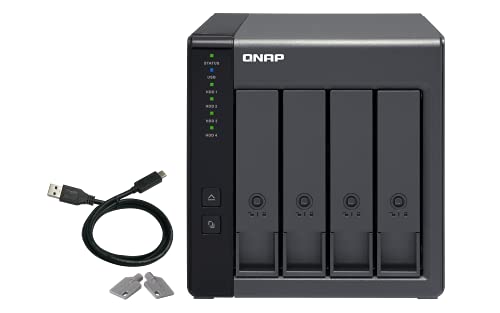
- Four 3.5-inch SATA bays
- Hardware RAID 0, 1, 5, JBOD, and individual disks
- Lockable bays and USB Type-C connectivity
Best For: Compatible QNAP NAS expansion and multi-drive backups
Best for NVMe Speed
NEWQ Dual-Bay M.2 RAID Enclosure

- Dual M.2 2280 NVMe support
- 20Gbps USB 3.2 transfer capability
- RAID, JBOD, and offline clone modes
Best For: Fast NVMe transfers, redundancy, and drive cloning
Best High-Capacity Option

- Five 3.5-inch bays with up to 110TB stated capacity
- Eight RAID, JBOD, clone, and clear modes
- 80mm fan and 150W built-in power supply
Best For: Large desktop storage, media libraries, and multi-drive backups
Hybrid Capacity Pick
5-Bay SATA and NVMe RAID Enclosure

- Combines two SATA bays with three M.2 NVMe slots
- Supports RAID 0, 1, JBOD, and Normal modes
- Up to 68TB listed capacity with USB 3.2 Gen 2
Best For: High-capacity workstation storage
Compact Dual-Bay Pick
CineRAID 2.5-Inch RAID Enclosure

- Dual-bay design supports 2.5-inch SATA drives
- Includes RAID 0, 1, JBOD, and Normal modes
- Lightweight build includes a protective TPU cover
Best For: Portable two-drive RAID setups
Best with Extra Features
Vantec NexStar GX 2.5-Inch RAID Enclosure

- Supports two 2.5-inch SATA SSDs or HDDs
- Offers individual, RAID 0, and RAID 1 modes
- Compact aluminum enclosure with USB 3.0
Best For: Portable two-drive laptop-size storage setups
High-Capacity Workhorse
Yottamaster PS500RC3 5-Bay RAID Enclosure

- Holds five SATA drives with up to 110TB total capacity
- Supports RAID 0/1/3/5/10, JBOD, and CLONE
- USB-C connectivity with removable drive trays
Best For: Large media libraries and multi-drive DAS storage
Flexible Dual-Drive Choice
CENMATE 2-Bay USB A/C RAID Enclosure

- Accepts both 2.5-inch and 3.5-inch SATA drives
- Offers RAID 0, RAID 1, Normal, and JBOD modes
- Includes USB A and USB-C 3.0 cables
Best For: Mixed-size SATA drive setups with basic RAID flexibility
Best Value Dual-Bay RAID – CENMATE 2-Bay SATA RAID Enclosure
For shoppers comparing portable raid enclosures, the CENMATE offers a practical two-drive setup for 2.5-inch or 3.5-inch SATA HDDs and SSDs. Its USB 3.0 A/C connectivity, tool-free design, and four selectable modes make it suitable for flexible external storage, though RAID configuration requires care because changing modes can cause data loss.
Best For: Home users and small businesses needing a compact two-drive SATA enclosure with RAID 0, RAID 1, Normal, and JBOD options.
Pros:
- Supports both 2.5-inch and 3.5-inch SATA HDDs and SSDs.
- Offers RAID 0, RAID 1, Normal, and JBOD modes.
- Includes USB-A and USB-C 3.0 connectivity and tool-free drive installation.
- Aluminum construction and a built-in cooling fan help manage heat.
Cons:
- The fan produces approximately 40–50 dB of noise.
- RAID mode changes may result in data loss, so backups are important.
- RAID software is not available for macOS.
The CENMATE is a versatile choice when you want two-bay SATA flexibility without moving to a larger enclosure. Its cooling and broad operating-system support are useful, but noise-sensitive users and anyone changing RAID modes should plan accordingly.
Best for NAS Expansion – QNAP TR-004 4-Bay USB-C DAS
QNAP TR-004 4 Bay USB Type-C Direct Attached Storage (DAS) with hardware RAID (Diskless)
Check Price On AmazonAmong portable raid enclosures, the QNAP TR-004 stands out as a four-bay direct-attached storage unit with hardware RAID. It connects to Windows, macOS, or Linux computers over USB Type-C and can also expand compatible QNAP NAS storage, but it arrives diskless and has specific NAS compatibility limitations.
Best For: Users who need a lockable four-drive enclosure for computer storage, backups, or expansion of a compatible QNAP NAS.
Pros:
- Provides four 3.5-inch SATA drive bays.
- Hardware RAID supports RAID 0, 1, 5, JBOD, and individual disks.
- Includes USB Type-C to Type-A connectivity for broad host compatibility.
- Lockable drive bays add physical protection against accidental removal.
Cons:
- Drives are not included.
- Some older QNAP NAS models are unsupported.
- The TR-004 cannot combine its storage pool or volume with the connected NAS.
The TR-004 is a strong fit for buyers who want four-bay capacity and hardware RAID in a direct-attached format. Check QNAP compatibility before purchase, especially if NAS expansion is the main reason for choosing it.
Best for NVMe Speed – NEWQ Dual-Bay M.2 RAID Enclosure
For portable raid enclosures built around modern solid-state storage, the NEWQ dual-bay enclosure combines M.2 2280 NVMe support with a rated 20Gbps USB 3.2 connection. It provides RAID 0, RAID 1, JBOD, and offline clone modes in a compact aluminum body, making it useful for fast transfers and drive duplication.
Best For: Professionals and power users working with two M.2 2280 NVMe SSDs who need fast transfers, redundancy, or offline cloning.
Pros:
- Supports two M.2 2280 NVMe SSDs.
- Offers RAID 0, RAID 1, JBOD, and clone modes.
- 20Gbps transfer capability suits large files and data-intensive tasks.
- Tool-free installation and an aluminum casing support portability and heat dissipation.
Cons:
- It is designed for M.2 NVMe drives rather than 2.5-inch or 3.5-inch SATA drives.
- Drive capacity and performance depend on the installed SSDs and host connection.
- Using two high-capacity SSDs may require the auxiliary USB-C input for stable operation.
The NEWQ is the most speed-focused option in this group, especially for users already invested in NVMe SSDs. Its clone mode adds practical utility, while RAID 1 offers redundancy for data that needs an automatic second copy.
Best High-Capacity Option – ORICO 5-Bay RAID 5 Enclosure
If your storage needs exceed a typical two- or four-drive unit, this ORICO model is one of the more capable portable raid enclosures, with five 3.5-inch SATA bays and support for up to 22TB per disk. Its eight RAID modes, 150W power supply, and cooling system are aimed at large desktop storage, backups, and media collections.
Best For: Large-capacity users managing multiple 3.5-inch SATA drives for video, engineering, backup, or centralized desktop storage.
Pros:
- Five bays support a stated maximum capacity of up to 110TB.
- Eight modes include RAID 0, 1, 3, 5, 10, JBOD, CLONE, and CLEAR.
- An 80mm fan, aluminum enclosure, and front and rear vents support heat dissipation.
- 150W built-in power supply supports multiple drives under sustained load.
Cons:
- It is larger and less travel-friendly than dual-bay enclosures.
- Mode switching can affect data, so backups are recommended beforehand.
- USB 3.0 limits the listed interface speed to up to 5Gbps.
The ORICO is the logical choice when bay count and capacity matter more than compact portability. RAID 5 and RAID 10 provide additional configuration flexibility, while the integrated power supply keeps a multi-drive desktop setup tidier.
Hybrid Capacity Pick – 5-Bay SATA and NVMe RAID Enclosure
For shoppers comparing portable raid enclosures, this CENMATE model stands out by combining two SATA drive bays with three M.2 NVMe slots. It supports RAID 0, RAID 1, JBOD, and Normal modes, with up to 68TB of listed combined capacity and USB 3.2 Gen 2 connectivity.
Best For: Users who need unusually high capacity and want to combine large SATA drives with faster NVMe storage in one enclosure.
Pros:
- Supports two 2.5/3.5-inch SATA drives and three M.2 NVMe SSDs.
- Offers RAID 0, RAID 1, JBOD, and Normal modes.
- USB A/C 3.2 Gen 2 supports up to 10Gbps connectivity.
- Tool-free trays and built-in fans simplify installation and cooling.
Cons:
- The continuously running fans may be noticeable in quiet environments.
- RAID setup can result in data loss, and the notes state that macOS has no RAID software.
- Its larger five-drive design is less compact than a simple dual-bay enclosure.
This is the most expandable option of the three, but its capacity and cooling-oriented design make it better suited to a desk or workstation than highly mobile use.
Portable Flash Pick – ORICO 4-Bay 2.5-Inch RAID Enclosure
This ORICO enclosure is a compelling choice among portable raid enclosures for photographers and video editors who use 2.5-inch drives. Its compact all-flash design supports multiple RAID configurations, adds USB and memory-card expansion, and is designed to travel easily in a backpack or camera bag.
Best For: On-location photographers and video editors using 2.5-inch SSDs or HDDs who want storage, card access, and portability in one unit.
Pros:
- Supports RAID 0, 1, 3, 5, 10, JBOD, and CLEAR modes.
- Four bays accommodate 2.5-inch drives, with up to 40TB listed total capacity.
- Includes two USB 3.2 10Gbps ports plus SD and TF 3.0 card slots.
- All-solid-state construction is described as lightweight and shock resistant.
Cons:
- It does not support 3.5-inch drives.
- Reported speeds vary by connection: up to 10Gbps with PSSD and 5Gbps through SATA.
- The product details list four supported devices, while the feature notes describe five total bays; verify the intended configuration before buying.
With its card readers and compact 2.5-inch format, this model is particularly workflow-friendly for field media work, though users with desktop-size hard drives will need another enclosure.
Compact Dual-Bay Pick – CineRAID 2.5-Inch RAID Enclosure
For a straightforward portable raid enclosures setup, the CineRAID CR-H218P uses two 2.5-inch SATA SSDs or HDDs in a compact aluminum-case design. It offers USB 3.1 Gen 2 connectivity with UASP and built-in RAID 0, RAID 1, JBOD, and Normal modes.
Best For: Laptop users, gamers, and creators who need a lightweight dual-drive enclosure with basic RAID flexibility.
Pros:
- Supports RAID 0, RAID 1, JBOD, and Normal modes.
- USB 3.1 Gen 2 provides up to 10Gbps connectivity and is backward compatible with USB 3.0 and 2.0.
- Supports 2.5-inch drives up to 12.5mm thick.
- Includes a TPU cover for added protection and weighs 8 ounces.
Cons:
- Only two internal bays are available.
- It is designed for 2.5-inch SATA drives and does not offer M.2 or 3.5-inch support.
- The listed power design is bus powered, which may limit suitability for some higher-power drive setups.
This is the simplest and most travel-friendly choice here for two-drive RAID, especially when a protective cover and low weight matter more than maximum capacity.
Best with Extra Features – Vantec NexStar GX 2.5-Inch RAID Enclosure
Vantec Nexstar GX USB 3.0 Dual 2.5" SATA SSD/HDD RAID Enclosure, Black (NST-272S3-BK)
Check Price On AmazonIf you need portable RAID enclosures for two laptop-size drives, the Vantec NexStar GX offers a compact aluminum design with USB 3.0 connectivity. It supports individual disks, RAID 0, and RAID 1, making it suitable for speed, redundancy, or straightforward external storage.
Best For: Users building a compact two-drive SSD or 2.5-inch HDD setup for laptops, desktops, or small workspaces.
Pros:
- Supports two 2.5-inch SATA I/II/III SSDs or HDDs.
- Offers individual, RAID 0, and RAID 1 modes, plus automatic RAID 1 rebuild.
- Aluminum housing with front vents helps with heat dissipation.
- Includes a USB 3.0 cable, power adapter, screws, and stand.
Cons:
- Does not include hard drives.
- Limited to two 2.5-inch drives rather than larger 3.5-inch disks.
- USB 3.0 transfer speed is rated up to 5Gbps.
At about 4.72 by 3.15 by 0.98 inches, this is one of the more portable options in the group. Its main appeal is the combination of a small footprint, RAID 1 support, and included AC power for dual-drive operation.
High-Capacity Workhorse – Yottamaster PS500RC3 5-Bay RAID Enclosure
The Yottamaster PS500RC3 is a five-bay option for shoppers who need portable RAID enclosures with substantial capacity. Its USB-C connection, removable trays, and support for multiple RAID configurations make it suited to large media libraries, backups, and direct-attached storage workflows.
Best For: Photographers, video editors, and businesses managing up to five SATA HDDs or SSDs in one enclosure.
Pros:
- Supports up to five SATA drives and up to 110TB total capacity based on five 22TB drives.
- Supports RAID 0/1/3/5/10, JBOD, and CLONE modes.
- Works with both 2.5-inch and 3.5-inch SATA drives using removable trays.
- Aluminum construction and an 80mm temperature-controlled fan support cooling.
Cons:
- Five-drive operation requires total drive power consumption to stay within 78W.
- New drives may need formatting and partitioning before use.
- USB 3.1 transfer speed is rated up to 5Gbps.
This enclosure offers the broadest RAID selection and largest expansion potential here, but its five-drive capacity also means more attention to power, formatting, and storage planning. It is a practical choice when portability means consolidating several drives rather than carrying a tiny enclosure.
Flexible Dual-Drive Choice – CENMATE 2-Bay USB A/C RAID Enclosure
For shoppers comparing portable RAID enclosures that accept both desktop and laptop drives, the CENMATE two-bay model is a flexible option. It supports 2.5-inch and 3.5-inch SATA HDDs or SSDs, includes USB A and USB-C cables, and provides four selectable storage modes.
Best For: Users who want one two-drive enclosure for mixed-size SATA disks and basic RAID flexibility.
Pros:
- Accepts two 2.5-inch or 3.5-inch SATA HDDs or SSDs, up to 20TB per drive.
- Provides RAID 0, RAID 1, Normal, and JBOD modes.
- Includes both USB A and USB-C 3.0 connectivity options.
- Aluminum-alloy housing and a built-in fan support cooling.
Cons:
- The fan is rated around 40–50 decibels and may be noticeable in quiet spaces.
- Changing the RAID array requires holding the Reset button for five seconds after resetting it.
- RAID setup may result in data loss, and the notes specify no RAID software for Mac OS.
The CENMATE stands out for drive-size compatibility and included cable options rather than maximum bay count. Its cooling fan is useful for sustained operation, though noise-sensitive users should consider the stated fan volume before buying.
How We Picked These Portable Raid Enclosures
We evaluated these Portable Raid Enclosures by comparing their drive compatibility, bay count, supported RAID modes, interface standards, cooling provisions, tool-free installation, and intended workload. The selection includes compact dual-bay models for travel and desktop backups, as well as larger five-bay enclosures for high-capacity media libraries and expandable storage.
We also considered whether each enclosure is best suited to SATA HDDs, SATA SSDs, PCIe NVMe drives, or a combination of formats. Hardware RAID support, USB-C connectivity, UASP compatibility, and practical capacity limits were weighted more heavily than headline speed claims alone.
Quick Comparison
- Best for compact SATA storage: Dual-bay enclosures with 2.5-inch and 3.5-inch support.
- Best for larger libraries: Four- and five-bay models with hardware RAID and high capacity limits.
- Best for SSD-focused setups: All-flash or dual-NVMe enclosures with USB 3.2 or 20Gbps interfaces.
- Best for mixed drives: Hybrid models that combine SATA bays with M.2 NVMe slots.
- Best for simple backups: RAID 1-capable units with cloning, normal, or JBOD modes.
Key Buying Factors for Portable Raid Enclosures
Drive Format and Bay Layout
Check whether the enclosure accepts 2.5-inch SATA drives, 3.5-inch SATA drives, M.2 NVMe modules, or a combination. A 3.5-inch hard drive offers economical capacity, while 2.5-inch SSDs are quieter and easier to transport. NVMe support can deliver higher performance, but only when the host computer and enclosure interface support it.
RAID Modes and Data Protection
RAID 1 mirrors data across two drives and is the safest choice for important working files, although usable capacity is reduced. RAID 0 combines drives for higher throughput but provides no redundancy. JBOD and normal modes are useful when you want independent drive access. RAID is not a substitute for an external backup.
Connection Speed and Compatibility
USB 3.0 is adequate for many hard-drive arrays, while USB 3.1, USB 3.2, and 20Gbps connections are more valuable for SSD or NVMe setups. Confirm the included cable, connector type, operating-system support, and whether the computer has a matching high-speed port.
Cooling, Noise, and Capacity
Multiple hard drives generate heat, so a fan-equipped enclosure is preferable for sustained transfers. Check the stated per-drive and total capacity limits, power requirements, fan noise, and whether drives can be installed without tools.
Who Should Buy Which Portable Raid Enclosures?
Choose a dual-bay enclosure if you need a manageable backup device, mirrored storage, or a portable way to reuse two existing drives. These models are generally the easiest to install and move.
Choose a four- or five-bay enclosure if you manage large photo, video, music, or project libraries. More bays provide greater capacity and expansion flexibility, but they require more desk space, power, and cooling.
Choose an NVMe or hybrid enclosure if speed is more important than low-cost capacity. These are well suited to editing scratch disks, active project files, and fast transfers, provided your computer supports the required USB standard.
Before buying, match the enclosure to your drives and workflow first, then select the fastest interface your computer can actually use. Finally, maintain a separate backup of irreplaceable data regardless of the RAID mode selected.