Choosing the right recorder can make business interviews sound polished, professional, and easy to edit. For remote guests, on-the-go meetings, and fast turnaround content, the best option is the one that captures clean speech with minimal setup.
Below, we focus on podcast recorders for business interviews that balance portability, audio quality, battery life, and practical features like voice activation and transcription support.
Best 10 Podcast Recorders for Business Interviews Picks for 2026
Compact Pro Recorder
Zoom H1 XLR for Interviews and Podcasts

- 32-bit / 96kHz recording
- Two XLR/TRS combo inputs
- OLED waveform display for level monitoring
Best For: Interviewers needing a compact, flexible recorder
AI Note-Taking Recorder
Comu Action Pro for Busy Teams

- Auto-generates docs, emails, and reminders
- Six-mic setup for interviews and meetings
- 70-hour battery life with USB-C charging
Best For: Teams that want AI summaries and follow-up automation
4-Track Interview Recorder
Zoom H4 Essential for Creators

- 4-track recording for bigger sessions
- Built-in stereo mics plus two XLR/TRS inputs
- USB-C recording to device or SD card
Best For: Creators needing flexible multi-source recording
AI Transcription Recorder
Mobvoi TicNote for Business Calls

- Dual-mode recording for calls and meetings
- Voiceprint identification for speaker tracking
- Built-in summaries, mind maps, and templates
Best For: Users who need AI transcription and speaker attribution
Portable Stereo Recorder for Clear Interviews

- X/Y stereo mics for clear voice capture
- 32-bit float helps reduce clipping risk
- USB-C mic mode for calls and livestreams
Best For: Interviewers and podcasters who want simple portable recording
AI Transcription Recorder for Client Calls
RECPOINT Note AI Voice Recorder

- AI summaries, mind maps, and to-do lists
- Claims 98% transcription accuracy
- 64GB storage with 30-hour battery life
Best For: Professionals who want fast interview transcription and summaries
Long-Run Voice Recorder for Meetings

- Voice activation reduces silent gaps
- Noise reduction and gain control for clearer speech
- 64GB storage plus long battery life
Best For: People recording long meetings and interviews with simple controls
Portable Interview Recorder
Tonfarb 136GB Digital Voice Recorder with Playback

- PCM recording with dual noise reduction microphones
- 136GB total storage with included 128GB TF card
- Up to 68 hours of continuous recording
Best For: Long business interviews and simple, hands-free recording
Simple Budget Recorder
Digital Voice Recorder 16GB with Playback
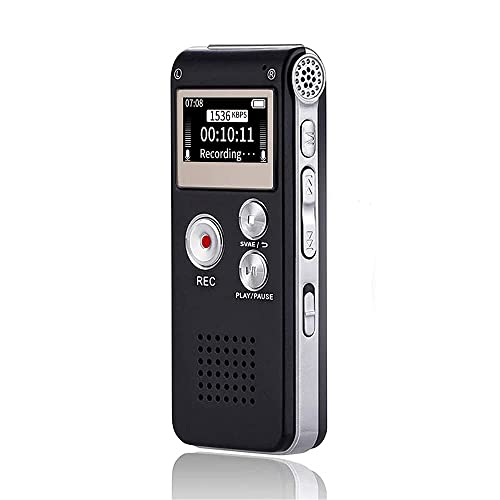
- One-button REC/STOP/PLAY operation
- Noise reduction with voice-activated recording
- USB storage mode for easy file transfer
Best For: Basic business interviews on a budget
High-Capacity Interview Recorder
EVIDA 128GB Voice Activated Recorder
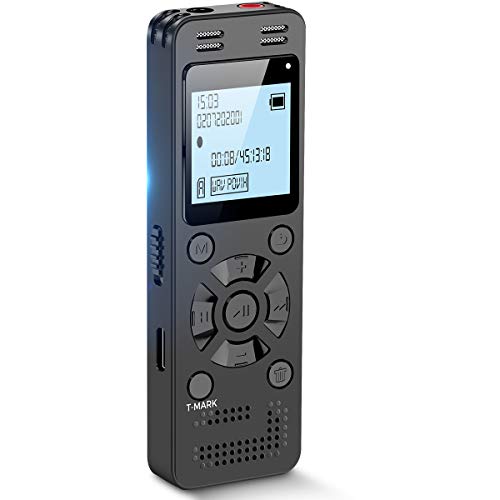
- 1536Kbps PCM recording with noise-cancelling mic
- 128GB storage with up to 9,296 hours capacity
- Four-folder organization plus password protection
Best For: Long interview archives and organized business recording
Compact Pro Recorder – Zoom H1 XLR for Interviews and Podcasts
If you want podcast recorders for business interviews that stay simple but still deliver pro-quality sound, the Zoom H1 XLR is an easy pick. It records in 32-bit / 96kHz, includes two XLR/TRS combo inputs, and adds a waveform display so you can monitor levels quickly during interviews or on-the-go conversations.
Best For: Interviewers and podcasters who want a compact recorder with XLR flexibility and easy level checks.
Pros:
- 32-bit / 96kHz recording for detailed audio capture
- Two XLR/TRS combo inputs for mics and other sources
- OLED waveform display helps you check levels at a glance
- 3.5mm input and headphone output add monitoring flexibility
Cons:
- Uses 2 AA batteries, so you’ll want spares for longer sessions
- More basic than larger multi-track recorders
The H1 XLR makes sense if you value portability and straightforward operation over extra production features. It gives business interviewers a reliable, compact path to clean recordings without adding much setup complexity.
AI Note-Taking Recorder – Comu Action Pro for Busy Teams
For podcast recorders for business interviews where follow-up work matters as much as the audio, the Comu Action Pro focuses on automation. It combines AI-drafted docs, transcription, and summaries with a six-mic setup designed to capture conversations in interviews, meetings, and calls.
Best For: Professionals who want recordings turned into action items, drafts, and summaries automatically.
Pros:
- Auto-generates editable docs, emails, reminders, and to-do lists
- Six-mic setup is built for interviews, meetings, and calls
- Supports transcription and summaries in 113 languages
- 70-hour recording time and USB-C charging for portability
Cons:
- No headphones jack for direct wired monitoring
- AI-driven workflow may be more than you need if you only want simple audio recording
This is a smart choice if you want a recorder that helps reduce manual note-taking after interviews. It stands out most when your workflow benefits from AI outputs instead of just stored audio files.
4-Track Interview Recorder – Zoom H4 Essential for Creators
If your search for podcast recorders for business interviews includes room for growth, the Zoom H4 Essential offers a stronger feature set. Its 4-track design, built-in stereo mics, and two XLR/TRS inputs make it suitable for interviews, podcasts, and video audio when you need more capture options.
Best For: Creators who want a flexible 4-track recorder for interviews, podcasts, and mixed-source audio.
Pros:
- 4-track recording provides extra flexibility for larger sessions
- Built-in stereo mics plus two XLR/TRS inputs
- USB-C connection can record to a phone, tablet, or computer
- Spoken menu guidance can make it easier to navigate
Cons:
- Battery life is listed at 10 hours of digital recording time
- Bulkier than simpler pocket-style recorders
The H4 Essential is a good fit when you want more control and flexibility than a basic handheld recorder can offer. It balances onboard mics, external inputs, and USB recording for interview workflows that may expand over time.
AI Transcription Recorder – Mobvoi TicNote for Business Calls
Among podcast recorders for business interviews, the Mobvoi TicNote leans heavily into transcription, speaker tracking, and call-versus-meeting capture modes. Its 3-mic array, dual-mode recording, and built-in AI tools are designed for professionals who need organized notes from conversations, interviews, and phone calls.
Best For: Business users who need speaker tracking, transcription, and AI summaries from calls or interviews.
Pros:
- Dual-mode recording handles phone calls and in-person meetings
- 3-mic array records at 1536 kbps for clearer capture
- Voiceprint identification helps distinguish speakers in interviews
- Includes summaries, mind maps, and templates for business workflows
Cons:
- Designed around AI features, so it may be more complex than a basic recorder
- No headphones jack listed for direct monitoring
If your interview process involves a lot of post-call organization, this recorder does more than just store audio. It is especially appealing when you want structured outputs and speaker attribution without building everything manually.
Portable Stereo Recorder for Clear Interviews – Zoom H1 Essential
If you need one of the more flexible podcast recorders for business interviews, the Zoom H1 Essential is built for clear voice capture without much setup. Its X/Y stereo mics and 32-bit float recording make it a practical option for conversations, meetings, lectures, and remote voice work where easy, polished audio matters more than complex controls.
Best For: Interviewers, podcasters, and business users who want a simple portable recorder for clear conversations and USB microphone use.
Pros:
- X/Y stereo mics help voices come through clearly in interviews and podcast conversations.
- 32-bit float recording supports clip-free audio for more forgiving capture.
- USB-C microphone mode works for livestreams, video calls, remote meetings, and voiceovers.
- Compact design with up to 10 hours of battery life for on-the-go recording.
Cons:
- Uses AAA batteries rather than a built-in rechargeable battery.
- Stereo capture is useful, but it is not a dedicated multi-mic interview setup.
Overall, this is a strong choice if you want a lightweight recorder that can handle interviews, meetings, and content creation with minimal fuss. It is especially appealing when you want clean voice capture plus the option to plug in as a USB microphone.
AI Transcription Recorder for Client Calls – RECPOINT Note AI Voice Recorder
For business interviews where notes matter as much as the recording itself, this Note AI Voice Recorder is designed to turn conversations into usable output fast. It focuses on transcription, summaries, mind maps, and to-do lists, which makes it a practical option for interviews, meetings, negotiations, and lecture-style capture.
Best For: Professionals who want a recorder that captures interviews and quickly turns them into summarized notes and action items.
Pros:
- AI transcription and analysis are built in for structured summaries and action lists.
- Claims 98% transcription accuracy with the GPT-5.5 engine.
- Supports 150 languages and includes smart noise cancellation.
- Long 30-hour battery life and 64GB storage for extended recording sessions.
Cons:
- Uses a Micro USB 2.0 connection rather than a newer USB-C interface.
- Built-in microphone design offers less flexibility than external-mic recorders.
This recorder stands out when your workflow depends on quickly reviewing business interviews instead of manually organizing audio later. It is best viewed as an interview-to-notes tool first, and a recorder second.
Long-Run Voice Recorder for Meetings – EVISTR L357 Digital Recorder
When you need a straightforward option among podcast recorders for business interviews, the EVISTR L357 focuses on long recording time, voice activation, and easy file handling. Its noise reduction microphone, adjustable gain, and playback features make it useful for interviews, meetings, and lecture-style recordings where reliable capture is the priority.
Best For: Users who want a simple, durable recorder for long interviews, meetings, and voice-activated capture.
Pros:
- Voice-activated recording helps skip silent gaps and capture speech more efficiently.
- 7-level gain adjustment and noise reduction are aimed at clearer voice pickup.
- Up to 64GB storage and long battery life support extended sessions.
- Playback, A-B repeat, and variable speed options make review easier.
Cons:
- Built-in microphone design is less flexible than a recorder with external mic support.
- Feature set is practical rather than advanced for studio-style podcasting.
This is a solid pick if your main goal is to capture business conversations without a complicated workflow. It is especially useful if you value long runtime, voice activation, and simple file transfer over premium podcast production features.
Portable Interview Recorder – Tonfarb 136GB Digital Voice Recorder with Playback
If you’re comparing podcast recorders for business interviews, this Tonfarb unit is built for straightforward capture, long sessions, and easy file transfer. Its PCM recording, voice-activated mode, and large storage make it practical for interviewing on the go or recording back-to-back conversations without juggling settings.
Best For: Interviewers who want long battery life, high-capacity storage, and simple one-button operation.
Pros:
- 1536 kbps PCM recording with dual noise reduction microphones for clearer speech capture.
- 136GB total storage, including 8GB built in plus a 128GB TF card, supports very long recording capacity.
- Up to 68 hours of continuous recording on a single charge for extended interview days.
- One-click record/save, USB-C transfer, and voice-activated recording make it easy to use.
Cons:
- No detailed mention of dedicated podcast editing or multitrack features.
- Best suited to speech capture rather than more advanced production workflows.
Overall, this is a strong pick when your priority is dependable interview recording with minimal setup. It focuses on the basics that matter most: clarity, capacity, and convenience.
Simple Budget Recorder – Digital Voice Recorder 16GB with Playback
For shoppers seeking podcast recorders for business interviews without a steep learning curve, this 16GB recorder keeps the process simple. It offers one-button recording, noise reduction, and voice activation, making it a practical option for quick interviews, meetings, and lecture-style conversations.
Best For: Users who want an easy-to-operate recorder for basic interview capture and playback.
Pros:
- Simple REC/STOP/PLAY controls make it easy to start recording fast.
- Noise reduction and a sensitive microphone help capture spoken words clearly.
- Voice-activated recording can save space and reduce unnecessary silence.
- USB connectivity lets it function as a removable drive for file transfer.
Cons:
- 16GB capacity is more modest than higher-storage competitors.
- Continuous recording time is shorter than some larger-capacity models.
This model makes sense if you want a no-frills recorder for interviews and quick turnarounds. It is best viewed as a practical everyday tool rather than a feature-heavy production device.
High-Capacity Interview Recorder – EVIDA 128GB Voice Activated Recorder
If you need podcast recorders for business interviews that can handle long sessions and organized file storage, the EVIDA model stands out. It combines 1536Kbps PCM recording, voice activation with adjustable sensitivity, and a folder system that makes it easier to keep interviews sorted.
Best For: Business interviewers who want high capacity, organized file management, and flexible recording settings.
Pros:
- 128GB storage supports very large archives, up to 9,296 hours of recordings.
- PCM recording at 1536Kbps and a noise-cancelling microphone support clearer voice capture.
- Six voice decibel levels help the recorder focus on speaking voices and reduce dead air.
- Four-folder storage, password protection, A-B repeat, and bookmark features improve organization.
Cons:
- Battery life is listed at up to 54 hours, which is less than some longer-running competitors.
- No mention of advanced podcast-specific production tools beyond recording and playback.
For interview-heavy workflows, this recorder offers a strong mix of capacity and control. The folder structure and voice-trigger settings are especially useful if you handle frequent meetings or repeated interview sessions.
How We Picked These Podcast Recorders for Business Interviews
We prioritized devices that are simple to carry, quick to start, and dependable for spoken-word recording. Clean microphone performance, easy file transfer, battery endurance, and interview-friendly controls mattered most. We also considered models with voice activation, onboard playback, and AI note features for teams that want faster post-interview workflows.
Quick Comparison: What Matters Most
If you need the cleanest hands-on recording experience, choose a dedicated handheld recorder. If your workflow depends on speed and organization, AI voice recorders may be better. For longer interview days, battery life and storage capacity should weigh heavily. Business interviewers who travel often should also look for compact designs and straightforward USB charging.
Key Buying Factors for Podcast Recorders for Business Interviews
Audio Quality and Mic Setup
Look for recorders that capture clear dialogue without excessive background noise. A simple stereo or two-channel setup is often enough for one-on-one interviews, while better built-in mics can reduce the need for extra accessories.
Battery Life and Storage
Long battery life is especially valuable for back-to-back interviews, conferences, and field reporting. Storage capacity matters too if you record at high quality or do not want to manage files constantly.
Ease of Use
For business interviews, speed matters. One-touch recording, visible status indicators, and voice-activated modes can prevent missed moments. Easy playback and quick transfer to a laptop or phone also help streamline production.
Transcription and AI Tools
Some Podcast Recorders for Business Interviews now include transcription, summaries, or note-taking features. These can save time, but they work best as workflow helpers rather than replacements for careful editing and review.
Who Should Buy Which Podcast Recorders for Business Interviews?
Choose a compact recorder if you want maximum portability and simple operation. Pick a higher-capacity model if you record long meetings or multi-hour interview sessions. If you value speed, organization, and searchable notes, an AI-enhanced recorder is a strong fit. For creators who want dependable voice capture without extra complexity, a classic handheld recorder remains the safest all-around choice.
In short, the best Podcast Recorders for Business Interviews are the ones that fit your interview style, recording environment, and post-production workflow. Start with audio reliability, then narrow down by battery life, storage, and the features you will actually use.