The right HDMI splitter makes it easy to send one source to multiple displays without repeatedly swapping cables. This roundup covers compact 1×2 models, 1×4 distribution boxes, and a USB-based multi-monitor adapter for more specialized setups.
Before choosing, confirm your required resolution, refresh rate, HDCP compatibility, audio behavior, and whether you need mirrored output or an extended desktop.
Best 10 Hdmi Splitters Picks for 2026
Best 4K60 Multi-Display Pick

- 4K@60Hz and 18Gbps support
- Four mirrored HDMI outputs
- Advanced audio and EDID control
Best For: Four-screen 4K home theater, classroom, retail, or presentation setups
Best Long-Run Value

- Four mirrored HDMI outputs
- Powered signal amplification
- Up to 100 feet total transmission
Best For: Longer-run commercial, classroom, and conference-room installations
Best Flexible 4K Setup

- 4K60, HDR, and 18Gbps support
- EDID resolution management
- Broad source and audio compatibility
Best For: Gaming, home theater, and office systems with varied HDMI devices
Best Compact Two-Screen Option
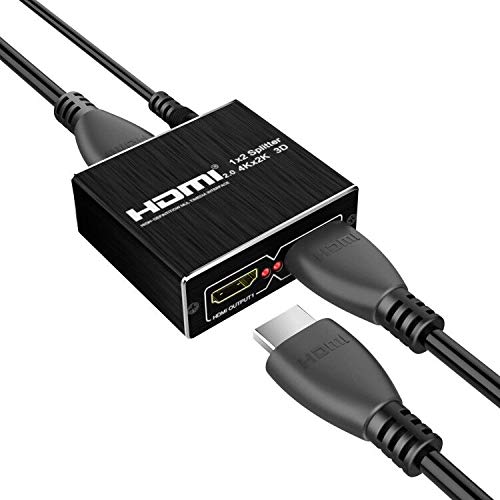
- Duplicates one source to two displays
- Supports 4K60 and 3D video
- Compact plug-and-play design
Best For: Two-screen home theater, gaming, and streaming setups
Best for Four Extended Displays
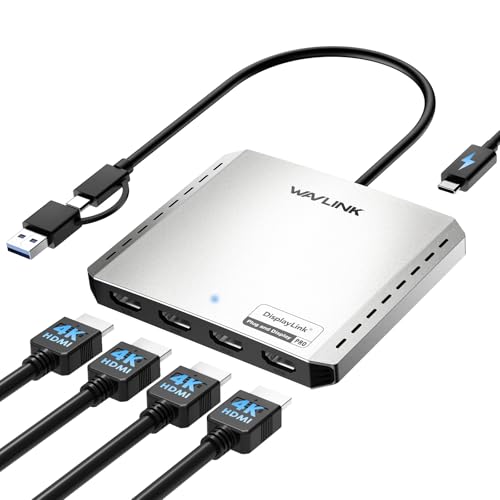
- Adds four extended displays at up to 4K@60Hz
- Supports USB-C, USB-A, Thunderbolt, and USB 4
- Includes up to 85W power delivery
Best For: Productivity workstations needing four monitors
Best 1x4 Value
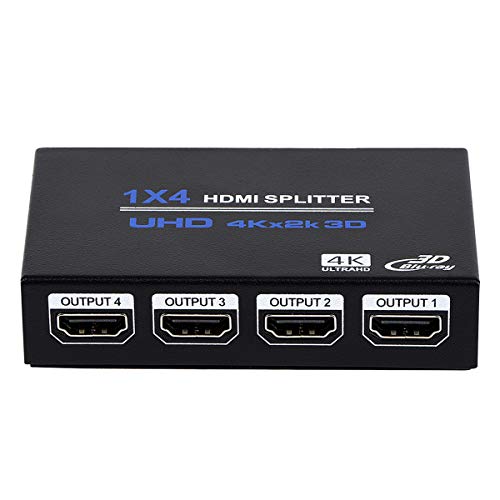
- Duplicates one HDMI source across four outputs
- Supports 4K@30Hz and 1080p@120Hz
- Plug-and-play design with no driver needed
Best For: Mirrored presentations and multi-screen viewing
Best for Two TVs

- Mirrors one HDMI source to two displays
- Supports up to 4K@30Hz and 3D video
- Includes power adapter and metal enclosure
Best For: Two-screen home entertainment setups
Best Budget Mirror Splitter
4K HDMI Splitter with 4-Ft Cable

- Mirrors one source to two displays
- Supports 4K at 30Hz
- Includes HDMI and USB cables
Best For: Simple two-screen mirroring on a budget
Best Long-Run Option
Compact 4K HDMI Splitter for Two Screens

- Mirrors one input to two displays
- Supports 4K and 10.2 Gbps bandwidth
- Up to 52 feet for 1080p with suitable cables
Best For: Longer 1080p mirrored-display runs
Best 4K/60Hz Choice
HDMI 2.0b Splitter with Downscaling

- Supports 4K at 60Hz
- Handles mixed 4K and 1080p displays
- Includes HDMI cable and power adapter
Best For: High-refresh 4K mirroring and mixed displays
Best 4K60 Multi-Display Pick – OREI 1×4 HDMI Splitter
For buyers comparing HDMI splitters for four-screen setups, this OREI model combines 4K at 60Hz support, 18Gbps bandwidth, and EDID control in a durable metal enclosure. It mirrors one HDMI source to four displays rather than extending the desktop.
Best For: Home theaters, classrooms, retail displays, bars, and presentations needing synchronized 4K video on four screens.
Pros:
- Supports up to 4K@60Hz with HDMI 2.0 and 18Gbps bandwidth.
- Offers broad audio compatibility, including Dolby TrueHD and DTS-HD Master Audio.
- Metal housing aids heat dissipation, with plug-and-play installation and a one-year warranty.
Cons:
- Mirrors the input signal and does not support extended-monitor mode.
- Works best with HDMI cables up to 30 feet.
This is a strong choice when smooth 4K60 distribution and advanced audio support matter more than independent screen content. Its four-output design is practical for both entertainment and commercial installations.
Best Long-Run Value – MT-ViKI 4K HDMI Splitter
This MT-ViKI is one of the practical HDMI splitters for sending the same source to four displays, especially where cable distance and continuous operation are concerns. Its powered design supports 4K at 30Hz and includes signal amplification.
Best For: Conference rooms, schools, retail installations, security monitoring, and other four-display mirror setups.
Pros:
- Splits one HDMI input into four identical outputs.
- Includes a 5V/2A power adapter for stable transmission.
- Supports up to 100 feet total transmission and cascading for larger deployments.
- Rugged metal housing provides heat dissipation and EMI protection.
Cons:
- Supports 4K only up to 30Hz.
- Only mirrors content and does not extend displays.
- Does not include a remote or built-in speaker.
The included power adapter and amplifier make this a sensible option for longer cable runs. Choose it over a 4K60 model when reliable four-screen distribution and installation flexibility are the priorities.
Best Flexible 4K Setup – OREI UHD 1×4 Splitter
Among HDMI splitters for modern source devices, this OREI unit supports equipment such as Fire TV, Roku, PS5, Apple TV, Blu-ray players, laptops, and PCs. It duplicates one HDMI input to four displays with 4K60, HDR, and 18Gbps support.
Best For: Gaming, home theater, office, and multi-display systems that need broad device compatibility and resolution management.
Pros:
- Supports 4K@60Hz, HDR, HDMI 2.0, and 18Gbps bandwidth.
- EDID control helps manage resolution compatibility.
- Supports Dolby TrueHD, DTS-HD, LPCM, and other audio formats.
- Uses a durable metal build and plug-and-play setup.
Cons:
- Duplicates one source and is not intended for extended displays.
- Requires AC power.
- Provides four outputs, but the listed details identify two ports in one specification field.
With EDID control and wide source compatibility, this model is well suited to mixed home entertainment or office systems. It is particularly appealing when 4K60 video and audio support are more important than a minimal footprint.
Best Compact Two-Screen Option – Wonlyus 1×2 HDMI Splitter
If you need HDMI splitters for only two displays, this Wonlyus model offers a straightforward way to duplicate one source. It supports 4K, 3D, and 1080p formats and is designed for plug-and-play use with compatible HDMI equipment.
Best For: Home entertainment, gaming, and small setups that need the same content on two TVs, monitors, or projectors.
Pros:
- Duplicates one HDMI source to two displays simultaneously.
- Supports 4K@60Hz, 3D, and common HD resolutions.
- Compatible with consoles, streaming devices, Blu-ray players, TVs, and projectors.
- Metal construction and no-driver setup simplify installation.
Cons:
- Supports mirror mode only, not extended displays.
- ARC or eARC audio-only ports cannot be used as the input source.
- Transmission distance depends on the HDMI cable, with listed limits of up to 30 feet using 28AWG cable or 48 feet using 26AWG cable.
This is a practical choice for buyers who do not need four outputs. Its two-screen layout keeps the setup focused, while 4K60 support covers many current gaming and streaming applications.
Best for Four Extended Displays – Quad HDMI DisplayLink Adapter
For shoppers comparing HDMI splitters for a multi-monitor workstation, the WAVLINK adapter stands out because it can add four extended displays from one compatible USB, USB-C, Thunderbolt, or USB 4 port. It supports up to 4K at 60Hz on each output and includes a hybrid cable for broader connectivity.
Best For: Productivity-focused Mac and Windows users who need four extended monitors and up to 85W laptop charging.
Pros:
- Supports four simultaneous 4K@60Hz displays.
- Works with USB-C, USB-A, Thunderbolt 3/4, and USB 4 connections.
- Provides up to 85W upstream USB-C power delivery.
- Supports current Windows, macOS, and ChromeOS systems.
Cons:
- Requires DisplayLink driver installation.
- Does not support Linux, Unix, or iOS.
- Not recommended for gaming, graphics-intensive work, or HDCP-protected streaming content such as Netflix and Hulu.
This is the most capable option here for expanding a productivity setup, but buyers should confirm operating-system compatibility and accept the driver requirement before purchasing.
Best 1×4 Value – 4K HDMI Mirror Splitter
This ENBUER model is a straightforward choice among HDMI splitters when you need to duplicate one HDMI source across four screens. It supports 4K video at up to 30Hz, requires no drivers, and uses a plug-and-play design for TVs, monitors, and projectors.
Best For: Presentations, classrooms, signage, or home entertainment setups that need the same picture on four displays.
Pros:
- Splits one HDMI input to four identical outputs.
- Supports up to 4K@30Hz, 2K@60Hz, and 1080p@120Hz.
- Plug-and-play operation with no external driver required.
- Supports formats including 3D, deep color, and several digital audio standards.
Cons:
- Only mirrors or duplicates the source; it cannot extend the desktop.
- Does not support CEC, HDR, or VRR.
- 4K@60Hz is limited to YCbCr.
Choose this splitter when identical output is the goal and simple installation matters. It is not suitable for users seeking four independent displays or modern HDR and VRR features.
Best for Two TVs – OREI 1×2 HDMI Duplicator
The OREI HDS-102 is a compact option for HDMI splitters if you only need to duplicate one source to two TVs or monitors. It supports resolutions up to 4K at 30Hz, includes a power adapter, and works with common sources such as game consoles, streaming devices, Blu-ray players, and PCs.
Best For: Home entertainment or gaming setups that need one HDMI source shown on two displays.
Pros:
- Duplicates one HDMI input to two identical outputs.
- Supports up to 4K@30Hz, 1080p, 3D, and lower resolutions.
- Compatible with HDMI 1.2, 1.3, and 1.4 devices and HDCP 1.4.
- Metal enclosure helps with heat absorption and dissipation.
Cons:
- Does not extend a desktop across multiple monitors.
- Does not support HDCP 2.0 or 2.2 and will not bypass HDCP.
- For best picture quality, HDMI cables should be 30 feet or shorter; cables are not included.
This is a practical two-display duplicator for older HDMI equipment and standard home setups. Check the source and content protection requirements carefully, especially if using newer HDCP formats.
Best Budget Mirror Splitter – 4K HDMI Splitter with 4-Ft Cable
This compact option is one of the more straightforward HDMI splitters for duplicating one source onto two displays. It supports up to 4K at 30Hz, includes a 4-foot HDMI cable, and requires USB power for stable operation.
Best For: Home entertainment, presentations, or gaming setups that need the same image on two TVs, monitors, or projectors.
Pros:
- Mirrors one HDMI source to two displays simultaneously.
- Supports 4K at 30Hz and common lower resolutions.
- Includes a 4-foot HDMI cable and USB power cable.
- Supports several multichannel audio formats, including DTS-HD and LPCM 7.1.
Cons:
- Cannot extend the desktop or show different content on each screen.
- Not a switcher or audio extractor, and it does not support HDCP 2.2.
- Power adapter is not included.
Choose this model when basic 1-in/2-out mirroring meets your needs and 4K at 30Hz is sufficient. For higher-refresh 4K video, another option in this roundup is a better fit.
Best Long-Run Option – Compact 4K HDMI Splitter for Two Screens
This compact HDMI splitter is designed for copying one source to two displays, with stated support for up to 4K and 10.2 Gbps bandwidth. Its advertised 1080p transmission range can reach up to 52 feet total when using suitable AWG26 HDMI 2.0 cables.
Best For: Users duplicating a laptop, console, or media player across two displays where longer 1080p cable runs are useful.
Pros:
- Mirrors synchronized video and audio to two displays.
- Supports 4K, 3D, 1080p, and up to 10.2 Gbps bandwidth.
- Advertised 1080p transmission distance is up to 52 feet with AWG26 cables.
- Small, lightweight design is easy to place or transport.
Cons:
- Does not extend displays or show separate content.
- Cannot function as an HDMI switcher or audio extractor and does not support ARC/eARC.
- HDMI cable and power adapter are not included.
This is a practical choice for basic mirrored signage, classroom, or home setups, especially when a longer 1080p connection is important. Confirm that your devices and cables match its HDMI 1.3/1.4b and HDCP 1.4 support.
Best 4K/60Hz Choice – HDMI 2.0b Splitter with Downscaling
For smoother high-resolution playback, this HDMI splitter supports 4K at 60Hz with HDMI 2.0b bandwidth. It mirrors one source to two displays, includes both a 4-foot HDMI 2.0 cable and a power adapter, and can mix 4K and 1080p outputs with automatic or forced downscaling in supported formats.
Best For: Home theaters, gaming, presentations, and digital signage that need mirrored 4K at 60Hz output.
Pros:
- Supports 4K at 60Hz, 18.5 Gbps bandwidth, and RGB 4:4:4.
- Can mix 4K and 1080p displays with auto or forced downscaling.
- Includes a USB cable with power adapter and a 4-foot HDMI 2.0 cable.
- Works with TVs, monitors, projectors, consoles, computers, and streaming devices.
Cons:
- Mirrors only; it cannot extend separate content to two monitors.
- Not a switcher or audio extractor and does not support ARC/eARC or CEC.
- For 4K output, recommended HDMI cable length is 16 feet or less.
This is the strongest match here for compatible 4K/60Hz equipment and mixed-resolution displays. Check the source, displays, and cable lengths carefully, since the splitter has specific format and downscaling limitations.
How We Picked These Hdmi Splitters
We selected these Hdmi Splitters based on supported resolution and refresh rate, output count, connection type, power requirements, compatibility features, and the needs of common home and office setups. The list includes simple 1-in/2-out devices, four-output distribution models, and a DisplayLink adapter designed for multiple computer monitors.
Because most standard Hdmi Splitters mirror one source across several screens, we also separated conventional video distribution from products intended to create an extended desktop. That distinction is essential when shopping for a workstation accessory rather than a home-theater splitter.
Quick Comparison
| Best For | Typical Output | What to Look For |
|---|---|---|
| Two-screen mirroring | 1 in, 2 out | 4K support, HDCP compatibility, included power |
| Home theater distribution | 1 in, 4 out | 18Gbps bandwidth, EDID management, stable power |
| Gaming and streaming | 1 in, 2 or 4 out | Required resolution and refresh rate, low handshake issues |
| Extended computer displays | USB to multiple HDMI | DisplayLink support, operating-system compatibility, driver requirements |
Key Buying Factors for Hdmi Splitters
Resolution, Refresh Rate, and Bandwidth
Match the splitter to the entire signal chain: source, splitter, cables, and displays. A 4K splitter limited to 30Hz will feel less responsive than a 4K@60Hz model for gaming, desktop work, or fast video. For 4K@60Hz HDR-style setups, look for sufficient bandwidth, commonly listed as 18Gbps, and verify the exact supported color and format specifications.
Mirroring Versus Extended Displays
Most Hdmi Splitters duplicate the same image on every connected screen. They do not turn one HDMI output into two independent desktops. If you need separate content on each monitor, choose a computer dock or DisplayLink-based adapter and confirm support for your operating system and applications.
HDCP, EDID, and Audio Compatibility
HDCP support helps the splitter handle protected content from devices such as streaming players and game consoles. EDID management can improve communication between the source and displays, especially when screens have different capabilities. Also check whether audio is passed through HDMI, extracted separately, or limited by the lowest-capability connected display.
Power, Cabling, and Installation
Powered splitters are generally more dependable than passive cable-based solutions, particularly with longer cables or multiple outputs. Check whether the adapter is included, whether the enclosure provides adequate ventilation, and whether the required HDMI cables are supplied. For permanent installations, confirm connector placement and available shelf or rack space.
Who Should Buy Which Hdmi Splitters?
Choose a 1×2 splitter if you only need to mirror a console, streaming player, laptop, or Blu-ray player to two screens. A 1×4 model is better for classrooms, signage, demonstrations, or home theaters that feed several displays from one source. Prioritize 4K@60Hz and higher bandwidth for modern gaming and premium video equipment.
If your goal is an expanded workspace with different content on four monitors, select the USB-C or USB 3.0 DisplayLink-style option instead of a conventional HDMI splitter. Finally, buyers with mixed-resolution displays should favor models with reliable EDID behavior and verify that the output will not be limited by the least-capable screen.