A dependable UPS can keep business routers, modems, switches, and related network equipment online through brief outages, voltage dips, and electrical disturbances. The right model also gives you time to shut down connected hardware safely during a longer interruption.
We compare 10 UPS battery backups across capacity, waveform, runtime features, management options, form factor, and value so you can match network-protection needs to your office setup.
Best 10 Ups Battery Backup for Business Routers Picks for 2026
Best Overall Home-Office Pick

- Up to 35 minutes at 100W
- Six battery-backup outlets plus two USB-A ports
- User-replaceable battery and three-year warranty
Best For: Small offices protecting routers and connected workstations
Best Rackmount Option

- Short-depth 2U rackmount design
- 1500VA/1000W pure sinewave output
- Eight outlets, AVR, and color LCD
Best For: Rack-based business networks and networking equipment
Best Pure Sine Wave Choice

- 1500VA/900W with up to 73 minutes at 100W
- Pure sine wave output and AVR
- Ethernet/coax protection plus USB-C/A charging
Best For: Sensitive business networks and NAS-equipped offices
Best Outlet Capacity

- 12 outlets with six battery-backed
- 1500VA/900W capacity with AVR
- Color LCD and USB-A/USB-C charging
Best For: Small offices with routers and many connected peripherals
High-Capacity Protection

- 1500VA/900W output for larger setups
- 10 outlets with five battery-backed
- AVR, LCD monitoring, and Ethernet surge protection
Best For: Small offices with routers and multiple essential electronics
Router-First Continuity

- 1500VA/800W for routers and small-business devices
- 2–6ms transfer helps limit interruptions
- AVR, lithium-ion battery, and automatic recovery
Best For: Router, modem, POS, and CCTV continuity
Compact Office Backup

- Compact 850VA/510W UPS design
- 12 outlets, including six battery-backed
- LCD monitoring and ECO power controls
Best For: Small workstations and compact network areas
Business-Grade Protection

- 1500VA/1500W sine-wave output
- Eight battery-backed outlets with AVR
- Removable LCD and business software
Best For: Corporate networks and telecom equipment
Compact Router Backup
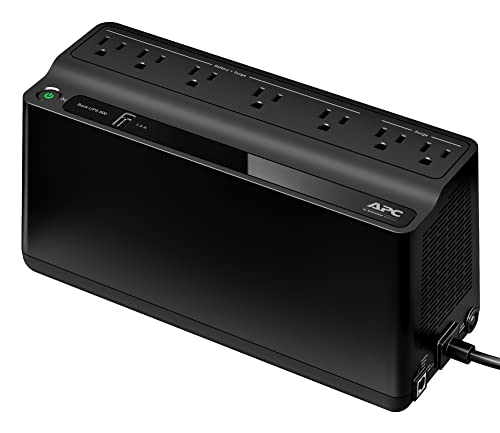
- 600VA/330W compact UPS
- Five battery-backed outlets plus two surge-only
- USB charging and replaceable battery
Best For: Small offices and individual routers
Long-Life Lithium Backup

- LiFePO4 battery rated for 10+ years
- 1000VA/800W pure sine-wave output
- Eight outlets with LCD and BMS protection
Best For: Long-term business network protection
Best Overall Home-Office Pick – APC BE850G2 UPS
For a compact ups battery backup for business routers, the APC BE850G2 balances useful runtime, straightforward monitoring, and enough outlets for a small office. Its 850VA/450W capacity can keep a router, modem, NAS, and computer operating through brief interruptions, while six battery-backed outlets support essential equipment.
Best For: Small offices and home businesses protecting a router alongside computers, NAS devices, and networking equipment.
Pros:
- Provides up to 35 minutes of runtime at a 100W load.
- Includes six battery-backup outlets, three surge-only outlets, and two USB-A charging ports.
- User-replaceable battery, silenceable alarm, and a three-year warranty.
Cons:
- Its 450W maximum output is better suited to small setups than high-power business systems.
- It uses USB-A rather than USB-C charging.
The BE850G2 is a practical choice when router protection is part of a broader desktop or small-network setup. It offers useful capacity without the size and weight of a rackmount model.
Best Rackmount Option – CyberPower CP1500PFCRM2U UPS
The CyberPower CP1500PFCRM2U is a strong ups battery backup for business routers in a short-depth rack. Its 1500VA/1000W rating, pure sinewave output, and automatic voltage regulation suit networking equipment and other connected systems that need stable power in a rack environment.
Best For: Businesses that need a rackmount UPS for routers, networking devices, security systems, or A/V equipment.
Pros:
- Short-depth 2U rackmount design measures 10.5 inches deep.
- Pure sinewave output supports active PFC and conventional power supplies.
- Eight battery-backed and surge-protected outlets, AVR, and a detailed color LCD.
- Includes a three-year warranty covering the battery and a $500,000 connected-equipment guarantee.
Cons:
- The 26.8-pound rack unit is less convenient for desktop placement.
- Its listed runtime is three minutes, so it is primarily intended for brief outages or orderly shutdowns.
Choose this model when rack compatibility and clean power matter more than a compact tower design. The LCD and PowerPanel software also make status checking easier for managed installations.
Best Pure Sine Wave Choice – APC BR1500MS2 UPS
For businesses wanting a higher-capacity ups battery backup for business routers, the APC BR1500MS2 adds pure sine wave output, AVR, and network-line protection. Its six battery-backed outlets can support a router, NAS, PC, and monitor, while the remaining outlets handle surge-only peripherals.
Best For: Business networks with sensitive electronics, NAS storage, or equipment that benefits from pure sine wave power.
Pros:
- Offers 1500VA/900W capacity and up to 73 minutes of runtime at 100W.
- Pure sine wave output helps support modern PCs, NAS devices, and sensitive electronics.
- AVR corrects voltage fluctuations without unnecessarily switching to battery.
- Includes Ethernet and coax surge protection, USB-C/A charging, and a replaceable battery.
Cons:
- Its tower footprint and 27.6-pound weight require dedicated floor or desk space.
- The battery charge time is listed as 16 hours.
The BR1500MS2 is the most feature-rich tower option in this group for sensitive or demanding business equipment. It is especially appealing when data-line protection and long low-load runtime are priorities.
Best Outlet Capacity – CyberPower CP1500AVRLCD3 UPS
The CyberPower CP1500AVRLCD3 is a flexible ups battery backup for business routers when you need many outlets in a desktop-friendly mini-tower. It provides 1500VA/900W capacity, six battery-backup outlets, six surge-only outlets, AVR, and a color LCD for monitoring power conditions.
Best For: Offices that need to protect a router and several peripherals while keeping plenty of surge-only outlets available.
Pros:
- Provides 12 NEMA 5-15R outlets, including six with battery backup.
- AVR corrects minor voltage fluctuations without switching to battery power.
- Color LCD shows detailed battery and power information.
- Includes one USB-A and one USB-C charging port, plus a three-year warranty covering the battery.
Cons:
- Uses simulated sine wave output rather than pure sine wave output.
- Its listed runtime is three minutes, making it better for brief outages or shutdown procedures than extended operation.
This model makes sense for a busy workstation or small office where outlet count and status visibility are more important than pure sine wave output. Its AVR and 900W rating provide useful headroom for typical networking and office loads.
High-Capacity Protection – APC BX1500M
For businesses that need an ups battery backup for business routers plus other networking or office equipment, the APC BX1500M offers substantial capacity and broad protection. Its 1500VA/900W rating, AVR, LCD monitoring, and Ethernet surge protection make it a strong fit for a larger small-business setup.
Best For: Small offices that need router backup alongside computers, networking equipment, and other essential electronics.
Pros:
- 1500VA/900W capacity supports a larger connected setup.
- Five battery-backup outlets and five surge-only outlets provide flexible device coverage.
- AVR corrects voltage fluctuations without using battery power.
- LCD shows load, battery charge, estimated runtime, and input voltage.
Cons:
- The tower form factor is larger than compact router-focused UPS units.
- The replacement battery is sold separately.
- Its lead-acid battery requires an approximately eight-hour charge time.
The BX1500M is the most capable option here for businesses protecting a router as part of a broader electronics stack. Ethernet surge protection adds useful network-line coverage, while the replaceable battery can help extend the unit’s service life.
Router-First Continuity – PowMr 1500VA/800W UPS
The PowMr 1500VA/800W unit is designed with home and small-business connectivity in mind, making it a practical ups battery backup for business routers, modems, POS systems, and CCTV equipment. Its stated 2–6ms transfer time and AVR are aimed at reducing interruptions when utility power fails or fluctuates.
Best For: Small businesses that prioritize uninterrupted router, modem, POS, or surveillance operation during outages.
Pros:
- 1500VA/800W capacity suits essential small-business equipment.
- 2–6ms automatic transfer is designed to help prevent reboots and disconnections.
- AVR stabilizes unstable input voltage without relying solely on battery power.
- Lithium-ion battery system and automatic recovery support unattended operation.
Cons:
- The 12-month warranty is shorter than the three-year warranties listed for the other options.
- The supplied notes do not specify the number or type of outlets.
- Its 110V input and output may require compatibility checking for some installations.
For a router-centered setup, the PowMr stands out for its fast transfer specification and business-oriented use cases. Confirm outlet requirements and voltage compatibility before deploying it with existing networking hardware.
Compact Office Backup – CyberPower EC850LCD
Businesses seeking a compact ups battery backup for business routers may prefer the CyberPower EC850LCD when space and outlet count matter. It provides 850VA/510W capacity, six battery-backed outlets, a multifunction LCD, and a five-foot cord in a compact enclosure.
Best For: Small workstations or network corners that need compact router backup and convenient monitoring.
Pros:
- Compact design fits smaller desks and equipment areas.
- Six battery-backup outlets and six surge-only outlets offer flexible connections.
- LCD panel provides immediate battery and power-condition information.
- Three ECO-controlled outlets can reduce peripheral power usage when a computer sleeps or shuts down.
Cons:
- Its 850VA/510W rating is lower than the two 1500VA models.
- The listed runtime is two minutes, so it is better suited to brief interruptions.
- The supplied specifications list a 230V output despite a 120V input, so buyers should verify compatibility before use.
The EC850LCD is a space-saving choice for a modest router or office setup, particularly where multiple outlets and status visibility are useful. Its lower capacity and short listed runtime make it less suitable for heavier loads or extended outages.
Business-Grade Protection – CyberPower PR1500LCD
For businesses seeking an ups battery backup for business routers, the CyberPower PR1500LCD provides substantial capacity, sine-wave output, and automatic voltage regulation. Its eight battery-backed outlets can support network devices, telecom equipment, and other critical hardware.
Best For: Corporate networks, telecom installations, and businesses needing high-capacity UPS protection.
Pros:
- 1500VA/1500W sine-wave output supports Active PFC and conventional power supplies.
- Eight NEMA 5-15R outlets provide battery backup and surge protection.
- AVR corrects minor voltage fluctuations without using battery power.
- Includes a removable LCD panel, three-year battery warranty, and PowerPanel Business Edition software.
Cons:
- Remote management requires the separately sold RMCARD205.
- The listed runtime is four minutes.
- Its mini-tower design may require dedicated installation space.
This is the strongest choice of the three for larger business router and networking setups. Its high output capacity and sine-wave design are well suited to demanding equipment, while the management and monitoring features support more structured deployments.
Compact Router Backup – APC BE600M1
The APC BE600M1 is a compact ups battery backup for business routers, Wi-Fi equipment, and smaller network setups. It combines 600VA/330W capacity with seven outlets, USB charging, and replaceable battery access in a desk-friendly enclosure.
Best For: Small offices, home offices, and individual routers or networking stations.
Pros:
- Five outlets provide battery backup and surge protection, with two additional surge-only outlets.
- Offers up to 23 minutes of runtime at a 100W load.
- Built-in 1.5A USB port can charge a phone during an outage.
- Internal battery can be replaced without replacing the entire UPS.
Cons:
- Its 330W output is intended for lighter loads rather than larger business racks.
- The battery charge time is listed as 10 hours.
- Only five of the seven outlets have battery backup.
Choose this APC model when compact size and straightforward router protection matter more than high capacity. It is a practical fit for a single router, Wi-Fi system, NAS, or small desk setup, but larger deployments may need a higher-output UPS.
Long-Life Lithium Backup – GOLDENMATE 1000VA/800W
The GOLDENMATE 1000VA/800W is an ups battery backup for business routers that emphasizes long service life and pure sine-wave output. Its LiFePO4 battery, eight protected outlets, LCD, and battery management system make it a versatile option for network and telecom equipment.
Best For: Businesses prioritizing long-term battery life, pure sine-wave output, and multiple protected connections.
Pros:
- LiFePO4 battery is rated for more than 10 years and over 5,000 charge cycles.
- Pure sine-wave 1000VA/800W output supports network devices and telecom equipment.
- Eight outlets provide both battery backup and surge protection.
- LCD monitoring, BMS protection, and buzzer mute support easier operation.
Cons:
- The cooling fan can activate during heavy battery usage and is rated below 50 dB.
- It supports 90–140V AC input, so the outlet voltage should be verified before use.
- The supplied notes do not specify a runtime figure.
This model stands out for organizations focused on reducing battery replacement frequency. It offers less capacity than the CyberPower but more than the APC, making it a balanced choice for network equipment where long-term LiFePO4 service is a priority.
How We Picked the Best Ups Battery Backup for Business Routers
We evaluated these models for the needs of small offices, home-based businesses, branch locations, and network closets. Key considerations included usable watt capacity, battery-backed outlet layout, surge protection, transfer behavior, sine-wave output, runtime information, management features, and physical design.
We also considered whether each unit is best suited to a single router and modem, a complete networking stack, or heavier equipment such as NAS devices and servers. Product specifications and intended use matter more than VA ratings alone, so confirm the actual watt draw of your equipment before buying.
Quick Comparison
- Compact router backup: The APC BE600M1 and BE850G2 are practical choices for basic modem, router, and small-network protection.
- Balanced office protection: The APC BX1500M and CyberPower CP1500AVRLCD3 offer higher capacity for networking equipment and connected electronics.
- Pure sine wave output: The APC BR1500MS2, CyberPower CP1500PFCRM2U, CyberPower PR1500LCD, and PowMr model are better candidates for equipment that benefits from cleaner power.
- Rack installation: The CyberPower CP1500PFCRM2U is designed for rack-oriented environments, while tower models may fit better beside a desk or cabinet.
- Lower-energy operation: The CyberPower EC850LCD emphasizes efficient everyday protection for lighter loads.
Key Buying Factors for Ups Battery Backup for Business Routers
Capacity and Runtime
Estimate the combined wattage of your router, modem, firewall, switch, access point, and any other devices you want to keep online. Choose extra capacity rather than operating near the UPS limit. A larger battery may provide more time, but runtime still falls as the load increases.
Waveform and Compatibility
Simulated sine-wave UPS systems are often adequate for standard networking equipment. Pure sine wave output is a safer choice for sensitive power supplies, business-grade hardware, servers, NAS units, or equipment that reacts poorly to stepped waveforms.
Outlets, Protection, and Placement
Check how many outlets are battery backed rather than surge-only. Look for protection suitable for your installation, a practical cord layout, replaceable batteries when long-term ownership matters, and a form factor that fits your rack, desk, or network cabinet.
Monitoring and Shutdown Control
LCD displays can show load, voltage, and estimated runtime at a glance. USB, serial, network, or app-based management can support automated shutdowns and remote monitoring, which is particularly valuable for unattended offices.
Who Should Buy Which Ups Battery Backup for Business Routers?
Choose a compact APC model if you only need backup for a modem, router, and a few low-power peripherals. Choose a 1500VA-class tower for a broader small-office network or longer runtime under moderate load. Choose pure sine wave when compatibility, servers, NAS hardware, or sensitive power supplies are priorities. Choose a rack-mount UPS for an organized equipment rack, and consider a lithium model if lower weight and potentially longer battery life justify the added cost.
Before purchasing, verify outlet types, input voltage, replacement-battery availability, warranty terms, and the manufacturer’s runtime chart. For critical connectivity, test the UPS with your actual network load and schedule periodic battery checks.