The best kneeling chairs can encourage a more open hip angle and help you vary your sitting position during long desk sessions. The right model should feel stable, adjust easily, and provide enough cushioning for your knees and shins.
We compared 10 kneeling chairs across ergonomic design, adjustability, support, materials, and everyday practicality to help you choose a comfortable fit for your workspace.
Best 10 Kneeling Chairs Picks for 2026
Best Adjustable Pick
Adjustable Rocking Kneeling Chair

- Three height positions for desk compatibility
- Gentle rocking motion shifts pressure points
- 250-pound capacity with a 5-year warranty
Best For: Home-office users wanting adjustable, multi-position seating
Best Mobile Design
DRAGONN Rolling Kneeling Chair
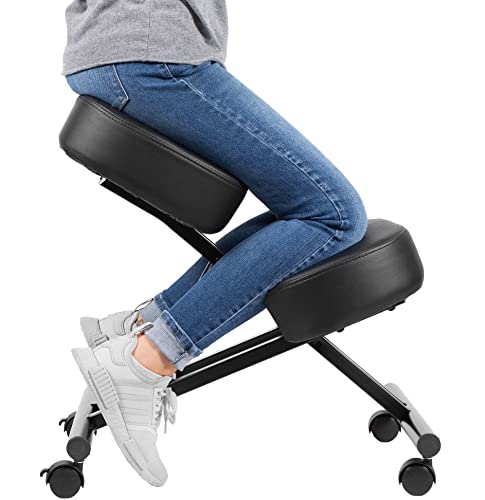
- 21- to 28-inch adjustable height range
- Four caster wheels with brakes
- 3-inch cushion and 250-pound capacity
Best For: Mobile home, office, and classroom workspaces
Best With Backrest Option
Adjustable Kneeling Chair With Backrest

- Optional backrest or backless configurations
- Hydraulic height adjustment from 21 to 26.5 inches
- Silent lockable casters and 250-pound capacity
Best For: Users seeking kneeling posture support with backrest flexibility
Adjustable Posture Pick
DRAGONN Ergonomic Kneeling Chair

- 21- to 31-inch adjustable height
- Back support with angled seat
- Supports up to 250 pounds
Best For: Adults seeking adjustable kneeling support for office or classroom use
Most Cushioning
GIANTEX Adjustable Kneeling Chair

- 4-inch high-density padded cushions
- Adjustable height and seat angle
- Wheeled base with locking brakes
Best For: Users who want a cushioned, mobile kneeling chair for desk work
Full-Support Design
Kneeling Chair with Footrest and Backrest

- Backrest, footrest, and armrests included
- Pneumatic height adjustment
- Four swivel casters with two locks
Best For: Adults wanting multiple support points for office, study, or computer use
Best Adjustable Wooden Pick

- Adjustable cushion for different sitting angles
- Wood frame supports up to 265 pounds
- Designed for 29- to 33-inch desks
Best For: Minimalist home-office and meditation setups
Best Fully Supported Option
Adjustable Kneeling Office Stool

- Gas-lift height adjusts from 32.2 to 36.2 inches
- Backrest, armrests, and foot support included
- Four adjustable seat and leg angles
Best For: Drafting tables and supported office seating
Best Rocking Design

- Rocking base encourages active sitting
- Adjustable height with side screws
- Thick foam cushions and 265-pound capacity
Best For: Backless rocking use in offices, studies, or meditation
Best Adjustable Pick – Adjustable Rocking Kneeling Chair
If you want a flexible option among kneeling chairs, this model combines adjustable seat pads with a gentle rocking motion. Its wood frame supports up to 250 pounds, while the three height positions are designed to work with desks from 29 to 35 inches.
Best For: Home-office users who want adjustable seating, a rocking function, and multiple sitting positions.
Pros:
- Adjustable cushioned seat supports different user heights and desk setups.
- Rocking movement can help shift pressure points during extended sitting.
- Supports up to 250 pounds and includes a 5-year warranty.
- Can also be used for cross-legged, meditation, yoga-office, or criss-cross seating.
Cons:
- Some users may experience initial shin or lower-back discomfort while adapting.
- Proper seat and desk-height matching is important for comfort.
- It has no backrest, so it may not suit shoppers seeking back support from the chair itself.
This is a versatile kneeling chair with useful adjustability and a reassuring warranty. Plan to introduce it gradually and fine-tune the seat height before using it for longer work sessions.
Best Mobile Design – DRAGONN Rolling Kneeling Chair
The DRAGONN by VIVO is a practical choice among kneeling chairs for users who need to reposition easily. It has a 21- to 28-inch height range, a thick 3-inch vinyl cushion, and four caster wheels with brakes.
Best For: Home, office, or classroom users who value rolling mobility and a straightforward adjustable setup.
Pros:
- Height adjusts from 21 to 28 inches.
- Four caster wheels allow convenient movement between work areas.
- Brake casters help keep the chair in place when needed.
- Metal construction supports up to 250 pounds.
Cons:
- Users need an adjustment period because kneeling seating engages different muscles than a standard chair.
- The vinyl cushion may feel less breathable than fabric upholstery.
- The chair is backless and covered by a 1-year warranty.
Choose this kneeling chair if mobility is a priority and you prefer a compact, modern design. Its adjustable height and locking casters make it especially convenient for active workspaces.
Best Angle Adjustment – Yaheetech Rolling Knee Stool
The Yaheetech model stands out among kneeling chairs for its three-level angle adjustment. Its angled seat and knee cushion are paired with pressure-lock casters, a metal frame, and water-resistant faux-leather upholstery.
Best For: Office users who want to experiment with different kneeling angles and need rolling casters that lock under pressure.
Pros:
- Three adjustment levels help customize the kneeling angle.
- Pressure-lock casters prevent sliding while seated.
- High-density foam cushions and faux leather provide padded support.
- Sturdy construction supports up to 220 pounds.
Cons:
- It supports less weight than the 250-pound models in this roundup.
- Assembly is required and is recommended for two adults.
- Faux leather may offer less breathability than fabric upholstery.
This is a solid option for shoppers who want more control over the chair’s tilt rather than a fixed kneeling position. The pressure-lock wheels add stability, while the padded surfaces support routine office use.
Best With Backrest Option – Adjustable Kneeling Chair With Backrest
This model offers a more conventional alternative among kneeling chairs by combining an adjustable kneeling frame with an optional backrest version. It adjusts from 21 to 26.5 inches, uses silent lockable casters, and supports up to 250 pounds.
Best For: Users who want the posture-focused design of a kneeling chair with the option of additional back support.
Pros:
- Hydraulic height adjustment accommodates users from 21 to 26.5 inches.
- Available in backrest or backless versions.
- Silent rolling casters include an integrated brake-lock system.
- Thick padded upholstery and a reinforced frame support up to 250 pounds.
Cons:
- The product is designed for posture correction rather than long-hour continuous sitting.
- Its listed dimensions and backrest version may require more space than a compact stool.
- The supplied notes do not specify a warranty.
Consider this kneeling chair if you want flexibility between a backless configuration and added back support. The height range and lockable wheels make it adaptable, but it is best used with position changes rather than as an all-day stationary seat.
Adjustable Posture Pick – DRAGONN Ergonomic Kneeling Chair
Among kneeling chairs, the DRAGONN by VIVO stands out for its adjustable height, angled seat, back support, and rolling base. Its metal frame supports up to 250 pounds, while the 21- to 31-inch height range helps you position it for a home office, classroom, or traditional desk.
Best For: Adults who want adjustable-height kneeling support with a backrest and casters.
Pros:
- Adjustable from 21 to 31 inches for a more personalized setup
- Angled seat and knee pad encourage a more upright working posture
- Metal construction supports up to 250 pounds
- Includes back support and four casters for added mobility
Cons:
- Assembly is required
- Designed for indoor use on hard floors
- Its armless design may provide less upper-body support than a conventional office chair
This is a practical choice if adjustability and a higher weight capacity matter most. The backrest adds support, while the angled seat preserves the posture-focused design expected from kneeling chairs.
Most Cushioning – GIANTEX Adjustable Kneeling Chair
For shoppers comparing kneeling chairs with substantial padding, the GIANTEX model combines 4-inch high-density sponge cushions with adjustable height and seat angle. Its waterproof PVC leather upholstery is easy to clean, and four wheeled casters with brakes balance mobility with stability.
Best For: Desk users who prioritize thick cushioning, adjustable positioning, and lockable wheels.
Pros:
- 4-inch padded cushions provide substantial knee and seat support
- Gas-rod adjustment offers a 5.5-inch height range
- Adjustable seat angle helps shift weight and support spinal alignment
- Four universal wheels include brakes for movement and stationary use
Cons:
- Supports up to 220 pounds, less than some comparable options
- Assembly is required
- The compact design may not suit users seeking a broad, conventional seat
The GIANTEX is a comfort-focused option with useful positioning controls. Its thick cushions and cleanable upholstery make it appealing for extended desk sessions, while the locking casters help keep the chair in place when needed.
Full-Support Design – Kneeling Chair with Footrest and Backrest
This ergonomic kneeling chair adds features beyond the basic kneeling configuration, including a breathable backrest, footrest, armrests, and a 4-inch cushion. Pneumatic height adjustment and four swivel casters—two of them lockable—make it adaptable for home offices, study areas, and other indoor workspaces.
Best For: Adults 155–185 cm tall who want back, knee, foot, and arm support in one chair.
Pros:
- Includes a backrest, padded knee rests, foot support, and armrests
- 4-inch cushion and kneeling angle promote an upright sitting posture
- Pneumatic height adjustment allows quick customization
- Four 360-degree casters provide mobility, with two locking wheels for stability
Cons:
- Manufacturer guidance advises breaks after each hour of use
- Not suitable for users with severe knee, spine, coccyx, lower-back, or hip conditions
- Product specifications list a maximum weight recommendation of 10,253 g, approximately 22.6 pounds
This model is best viewed as a feature-rich alternative among kneeling chairs, especially for users who want more contact points and mobility. Pay close attention to the stated height range and unusually low listed weight recommendation before buying.
Best Adjustable Wooden Pick – Customizable Kneeling Chair
If you want a straightforward kneeling chair for a home office or desk, this wooden model focuses on adjustable cushioning and an angled sitting position. Its design supports desks from 29 to 33 inches high and accommodates up to 265 pounds.
Best For: Adults seeking a simple, adjustable kneeling chair for desk work, typing, meditation, or occasional posture-focused sitting.
Pros:
- Customizable seat cushion helps accommodate different sitting angles and user heights.
- Angled design encourages a more open trunk-to-thigh position than a conventional 90-degree chair.
- Wood frame and foam cushion offer a simple, modern look for home or office use.
- Supports up to 265 pounds.
Cons:
- May cause leg discomfort during the initial adjustment period.
- Recommended for desks between 29 and 33 inches high, limiting compatibility with some setups.
- Armless, open-back design provides no backrest or arm support.
This is a practical choice if you prefer a minimalist wooden kneeling chair and want cushion adjustment without a complicated mechanism. Plan to alternate sitting with standing and stretching as you get used to the kneeling position.
Best Fully Supported Option – Adjustable Kneeling Office Stool
This kneeling chair stands out for shoppers who want more adjustability and support than a basic stool provides. It combines a gas-lift height range, adjustable seat and shin angles, a curved backrest, armrests, and a breathable foam cushion.
Best For: Adults who need a more conventional office-style kneeling chair for desks, drafting tables, studying, drawing, or salon work.
Pros:
- Gas lift adjusts from 32.2 to 36.2 inches for desks, converters, and drafting tables.
- Four seat and leg-angle positions support users across a range of heights.
- Curved backrest, padded armrests, foot support, and a 3-inch mesh cushion add support.
- Wide base and anti-slip pads are designed to improve stability on several floor types.
Cons:
- Weight capacity is 220 pounds, lower than some wooden alternatives.
- Its kneeling position may place pressure on the knees, calves, and coccyx.
- The manufacturer advises against use by people with existing knee, lumbar, or coccyx medical conditions.
Choose this model if adjustability and back support are priorities. Its taller height range makes it especially useful for elevated work surfaces, but take regular breaks and stop using it if the kneeling position becomes uncomfortable.
Best Rocking Design – VEVOR Wooden Kneeling Chair
For shoppers interested in active sitting, this VEVOR kneeling chair uses a rocking wooden base instead of a fixed stance. Adjustable side screws, thick foam cushions, and linen upholstery make it a flexible option for home offices, study areas, reading, or meditation.
Best For: Adults who want a backless rocking kneeling chair for active sitting and occasional work, reading, or meditation.
Pros:
- Rocking base can help vary posture during reading, thinking, or desk work.
- Side-screw adjustment accommodates different heights and desk setups.
- Thick foam seat and knee cushions use breathable linen fabric.
- Solid wood frame supports up to 265 pounds, while bottom strips help limit sliding.
Cons:
- Backless design offers no backrest or arm support.
- The rocking base may not suit users who prefer a completely stationary chair.
- Extended kneeling can cause discomfort, so standing breaks are recommended.
This is a good fit when you want a kneeling chair with movement rather than a rigid base. Its backless, rocking design encourages active sitting, but it is best used in intervals and on a suitable hard floor.
How We Picked the Best Kneeling Chairs
We evaluated these Kneeling Chairs using the features that matter most in daily use: seat and knee-pad adjustability, cushioning, frame stability, weight capacity, mobility, back support, footrests, and overall workspace fit. We also considered whether each design suits a fixed desk, standing desk, home office, or shared workspace.
Because comfort is highly personal, no single chair is ideal for everyone. A good kneeling chair should let you distribute weight between your seat and shins without creating pressure points or forcing your hips too far forward.
Quick Comparison
| Feature | Best for | What to look for |
|---|---|---|
| Adjustable seat angle | Flexible posture | Several height or tilt positions |
| Thick knee padding | Longer sessions | Dense, supportive foam with durable upholstery |
| Backrest | Extra upper-body support | Adjustable or lightly contoured back support |
| Wheels or rocking base | Active sitting | Stable movement and a secure locking design |
| Wood frame | Durability and style | Solid construction and reinforced joints |
Key Buying Factors for Kneeling Chairs
Adjustability
Look for adjustable seat height, angle, or knee-pad placement. These controls help match the chair to your body size and desk height. If multiple people will use the chair, prioritize broad adjustment ranges.
Padding and Pressure Distribution
Seat and knee cushions should be thick enough to prevent hard-frame contact but firm enough to maintain support. The knee pads should spread pressure across the shins rather than concentrate it at the knees.
Stability and Movement
A wide base is useful for stationary work, while wheels or a rocking mechanism can make repositioning easier. Rolling models should move smoothly but remain stable when you shift your weight. Check the listed weight capacity before buying.
Backrests, Footrests, and Frame Materials
A backrest can be helpful if you want occasional lumbar or upper-body support, although it may reduce the open posture associated with traditional kneeling designs. Footrests improve leg comfort, and solid wood or reinforced metal frames generally offer better long-term durability than lightweight construction.
Desk Compatibility
Measure the chair’s seat height against your desk and monitor position. Your elbows should remain close to a relaxed 90-degree angle, and your screen should be near eye level. A kneeling chair is best used as part of a posture rotation rather than as your only seat all day.
Who Should Buy Which Kneeling Chairs?
Choose a highly adjustable model if you are still learning whether this seating style suits you or if several users will share it. Pick a design with a backrest if you want more conventional support during reading, calls, or extended work. A rocking or rolling model may suit active sitters who frequently change position, while a wooden fixed-frame chair is a strong choice for shoppers prioritizing stability and a classic appearance.
Those with existing knee, hip, back, or circulation concerns should consult a qualified medical professional before switching seating styles. Start with short sessions, adjust the angle gradually, and stop if you experience pain, numbness, or persistent discomfort.