Adding speakers to multiple rooms can improve whole-home listening, but connecting too many pairs directly to one amplifier may create an unsafe load. The right selector switch makes zone management simpler while helping protect compatible equipment.
We evaluated 10 speaker selector switches with impedance protection across zone count, power handling, wiring compatibility, controls, and installation flexibility. This guide helps you choose the best fit for a compact home theater, distributed audio system, or larger multi-room setup.
Best 10 Speaker Selector Switches with Impedance Protection Picks for 2026
Best for Four-Zone Protection
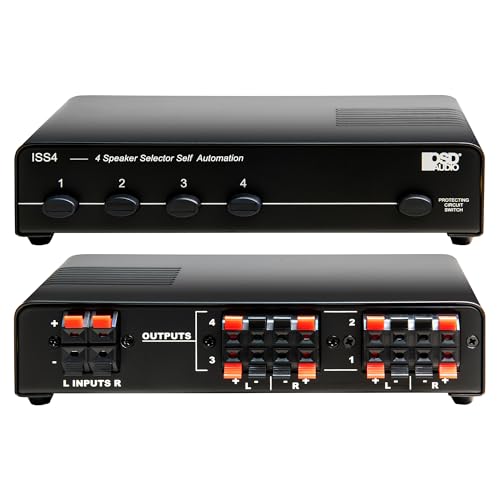
- Four independently switched listening zones
- Selectable impedance matching protection
- Low-profile steel design with removable terminals
Best For: Four-zone systems using one amplifier
Best for Large Multi-Zone Systems

- Supports up to 12 speaker pairs
- Impedance-matching transformers
- Front-panel zone and source controls
Best For: Large whole-home audio installations
Best Budget Eight-Zone Selector
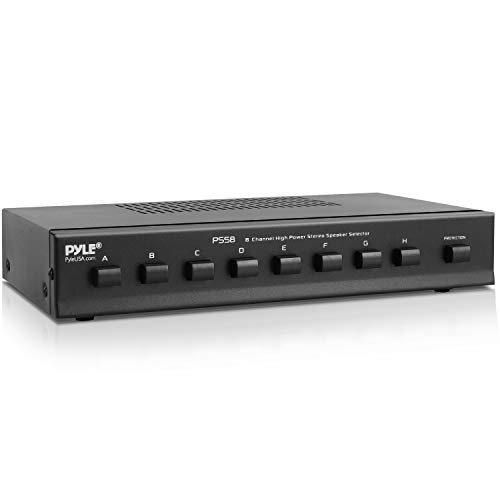
- Independent control for eight speaker sets
- Protection buttons for overload safety
- Supports amplifiers up to 100 watts per channel
Best For: Basic eight-zone speaker distribution
Best for Volume-Controlled Whole-Home Audio

- Six zones with independent 12-step volume controls
- Dual-source A/B switching
- Selectable autoformer impedance matching and overload protection
Best For: Six-room systems needing room-by-room volume control
Whole-Home Coverage
Monoprice 108230 8-Channel Speaker Selector

- Connects up to eight stereo speaker zones
- Impedance matching helps maintain a 5-ohm minimum
- Supports 100W per channel with protection enabled
Best For: Multi-room systems needing eight selectable zones
Simple Six-Zone Control
Pyle PSS6 6-Channel Speaker Selector

- Supports up to six speaker pairs
- Uses easy push-button operation
- Compact design for stereo system distribution
Best For: Basic six-pair speaker switching
Flexible Impedance Management
Monoprice SS-6 Premium 6-Channel Selector
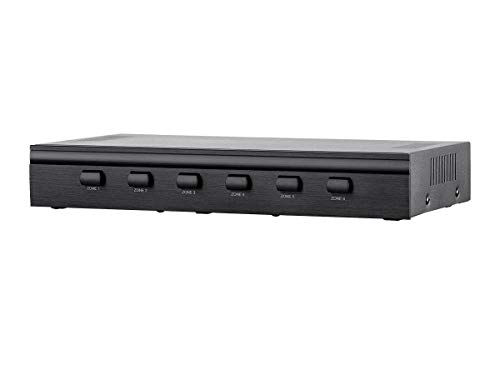
- Automatic impedance protection for multiple speaker pairs
- Individual on/off buttons for six zones
- Supports 12–16 AWG wire and 100W RMS per channel
Best For: Six-zone systems needing detailed load and wiring support
Budget Zone Distributor

- Distributes audio to four zones
- Optional impedance protection
- Up to 70W/ch protected
Best For: Simple, budget-friendly multi-zone audio
Controlled Multi-Zone Pick
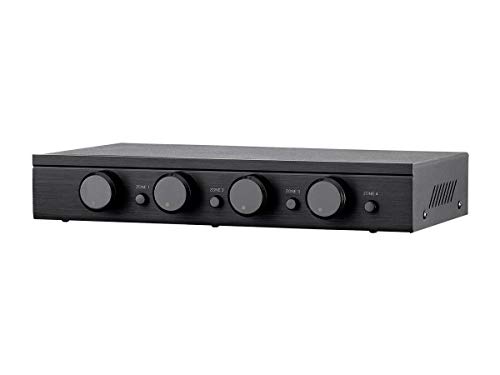
- Automatic impedance protection
- Individual zone volume controls
- 100W/ch continuous handling
Best For: Four-zone systems needing local control
Six-Zone Control Option
Pyle PSLSW6 6-Channel Selector

- Controls up to six speaker pairs
- Independent volume controls
- Overload protection circuitry
Best For: Larger 8-ohm multi-zone systems
Best for Four-Zone Protection – OSD Audio ISS4
The OSD Audio ISS4 is a practical choice among speaker selector switches with impedance protection when you need to distribute one amplifier to four listening zones. Its selectable protection circuitry, individual zone switches, and removable screw-down terminals make it well suited to organized multi-room installations.
Best For: Four-zone home audio systems using one amplifier or receiver.
Pros:
- Supports four zones with individual on/off selectors.
- Selectable impedance matching helps protect the amplifier when powering multiple speaker pairs.
- Handles up to 70 watts per channel with protection engaged and 140 watts per channel total input without manual protection.
- Low-profile steel construction and removable Phoenix connectors simplify installation.
Cons:
- Provides four zones, fewer than larger multi-zone selectors.
- Does not include per-zone volume controls.
The ISS4 balances useful protection features with straightforward installation. It is a strong fit when four independently switched zones are enough and amplifier safety is a priority.
Best for Large Multi-Zone Systems – Monoprice SS-Pro 12
The Monoprice SS-Pro 12 is designed for substantial whole-home audio setups, supporting up to 12 speaker pairs or listening zones. Its audiophile-grade impedance-matching transformers help distribute power safely, while front-panel controls make zone and source selection accessible.
Best For: Large installations requiring up to 12 speaker zones and dual-source switching.
Pros:
- Supports up to 12 pairs of speakers.
- Uses impedance-matching transformers for safer power distribution.
- Provides front-panel zone push-buttons and dual-source selection.
Cons:
- Its large capacity may be excessive for smaller systems.
- The supplied details list RCA cable connectivity, so verify your intended wiring before purchase.
Choose the SS-Pro 12 when expansion capacity matters more than a compact footprint. It is the most suitable option here for managing many zones from a central control point.
Best Budget Eight-Zone Selector – Pyle PSS8
The Pyle PSS8 is a straightforward eight-channel selector for connecting multiple speaker pairs to one source amplifier. As speaker selector switches with impedance protection, it emphasizes simple independent zone control and protection buttons for systems rated up to 100 watts per channel.
Best For: Users who need basic control of up to eight speaker pairs without advanced source or volume features.
Pros:
- Controls up to eight speaker sets independently.
- Built-in protection buttons help guard against overload.
- Compatible with stereo receivers or amplifiers up to 100 watts per channel.
Cons:
- Does not provide per-zone volume controls.
- Does not offer the dual-source switching listed on some competing models.
- Supplied details identify RCA connectivity, so check compatibility with your speaker wiring.
The PSS8 is best for uncomplicated multi-room distribution. Its eight-zone capacity is useful, but buyers wanting impedance settings, volume adjustment, or source switching may need a more feature-rich selector.
Best for Volume-Controlled Whole-Home Audio – OSD SSVC6D
The OSD SSVC6D adds room-by-room volume control to the core benefits of speaker selector switches with impedance protection. It connects up to six speaker pairs, supports two sources, and uses selectable autoformer impedance matching to help keep multi-room loads safe.
Best For: Whole-home audio systems needing independent volume control in six rooms.
Pros:
- Supports six zones, each with a 12-step volume control and on/off button.
- Switches between two stereo receivers or amplifiers.
- Offers 1X, 2X, 4X, and 8X impedance settings plus automatic overload protection.
- Handles up to 300 watts and uses a passive design requiring no outlet.
Cons:
- Has six zones rather than the eight- or 12-zone capacity of some alternatives.
- Its added volume and source controls may be unnecessary for simple zone switching.
The SSVC6D is the most versatile choice when different rooms need different listening levels. Its six-zone capacity, dual-source switching, and adjustable impedance protection make it particularly well suited to centrally managed whole-home audio.
Whole-Home Coverage – Monoprice 108230 8-Channel Speaker Selector
If you need speaker selector switches with impedance protection for several rooms, the Monoprice 108230 supports up to eight stereo speaker zones. Its built-in impedance-matching circuitry is designed to keep the amplifier’s overall impedance from dropping below 5 ohms when multiple zones are selected.
Best For: Whole-home or small-business audio systems that need up to eight selectable stereo zones.
Pros:
- Supports up to eight stereo speaker zones.
- Impedance-matching protection helps maintain at least 5 ohms at the amplifier.
- Handles up to 100 watts per channel with protection enabled, or up to 200 watts with it disabled.
- Includes zone-identification stickers.
Cons:
- Disabling the protection circuit changes the rated power-handling setup.
- No warranty is listed in the supplied details.
The eight-zone capacity makes this a strong choice when room coverage matters most. Its selectable protection setup also gives you flexibility, provided the amplifier and speaker load are configured appropriately.
Simple Six-Zone Control – Pyle PSS6 6-Channel Speaker Selector
The Pyle PSS6 is a straightforward option for systems needing speaker selector switches with impedance protection-style distribution features and simple controls. It connects up to six separate speaker pairs to a stereo system and uses push-button operation for easy zone selection.
Best For: Users who want basic six-pair speaker distribution with a plug-and-play setup.
Pros:
- Connects up to six separate speaker pairs.
- Push-button operation is simple to use.
- Designed for high-power stereo systems.
- Compact 5.9-by-9.05-by-1.85-inch form factor.
Cons:
- The supplied details do not specify an impedance-protection circuit.
- Power information is listed as 100 watts without a per-channel clarification.
Choose the PSS6 when ease of use and six-zone capacity are more important than detailed impedance specifications. For installations where amplifier-load protection is essential, verify compatibility before connecting multiple speaker pairs.
Flexible Impedance Management – Monoprice SS-6 Premium 6-Channel Selector
The Monoprice SS-6 is built for users specifically comparing speaker selector switches with impedance protection. It provides automatic impedance protection, individual zone on/off buttons, and stated minimum-impedance figures for different speaker loads.
Best For: Six-zone installations that need automatic protection, heavier-gauge wire support, and detailed connection features.
Pros:
- Automatic impedance protection supports multi-speaker operation.
- Provides individual on/off control for six zones.
- Supports 12–16 AWG speaker wire with heavy-duty screw connectors.
- Isolated left/right grounds support floating-ground or bridged amplifiers.
Cons:
- Rated capacity is 100 watts RMS per channel.
- The supplied details do not identify a specific included cable or accessory set.
With automatic protection and clearly stated load guidance, the SS-6 is the most specification-focused option here. Its wiring support and isolated grounds add flexibility for more demanding amplifier and installation configurations.
Budget Zone Distributor – 4-Channel Speaker Selector
If you need speaker selector switches with impedance protection for a straightforward whole-home audio setup, this Monoprice model distributes one amplifier’s signal across up to four speaker zones. Its optional protection circuit helps keep the impedance seen by the amplifier consistent as speakers are added.
Best For: Budget-conscious users who want simple four-zone speaker distribution.
Pros:
- Supports up to four separate speaker zones.
- Optional impedance protection supports safer multi-speaker operation.
- Handles up to 70 watts per channel with protection enabled, or 140 watts without it.
- Rugged Monoprice design at a fair price.
Cons:
- Does not list individual zone volume controls.
- Power capacity is lower when the protection circuit is enabled.
This is a practical choice when zone selection is the priority and you do not need built-in volume adjustment. Verify your amplifier and speaker requirements before choosing the protected or unprotected operating mode.
Controlled Multi-Zone Pick – SSVC-4.1 Speaker Selector
For shoppers comparing speaker selector switches with impedance protection, the Monoprice SSVC-4.1 adds individual zone controls to its automatic protection circuitry. It connects multiple speaker pairs to one amplifier while providing separate on/off buttons and volume controls for each zone.
Best For: Users who want four-zone switching with independent volume adjustment.
Pros:
- Automatic impedance protection circuitry.
- Individual zone on/off buttons and volume controls.
- Supports 100 watts per channel continuous and 200 watts peak.
- Screw-type connectors accept 12–18 AWG speaker wire.
Cons:
- Its impedance requirements vary with speaker selection.
- Heavier and more substantial than a basic selector, weighing 6.9 pounds.
The SSVC-4.1 is the most feature-rich option here for managing four zones from one location. Its stated minimum amplifier impedance figures are useful, but system compatibility should still be checked before connecting multiple speaker pairs.
Six-Zone Control Option – Pyle PSLSW6 6-Channel Selector
If your setup needs more than four zones, the Pyle PSLSW6 is a six-channel speaker selector switch with overload protection and independent volume controls. It is designed for 8-ohm speakers and connects to a stereo receiver or home theater system through screw-type terminals.
Best For: Home audio systems controlling up to six speaker pairs with separate volume adjustment.
Pros:
- Controls up to six speaker pairs, or 12 speakers.
- Independent volume controls for each pair.
- Provides overload safety protection circuitry.
- Accepts speaker wire up to 14 AWG through screw terminals.
Cons:
- Designed for 8-ohm impedance speakers.
- Rated for 100 watts maximum per channel.
- Its larger tabletop footprint may require more installation space.
The PSLSW6 stands out when zone count matters more than compact size. Its six-pair capacity and separate rotary controls offer flexible distribution, while the stated 8-ohm speaker requirement should guide system matching.
How We Picked the Best Speaker Selector Switches with Impedance Protection
We compared the selected models by the number of speaker zones they support, claimed power capacity, impedance-matching or protection features, source flexibility, and control layout. We also considered practical installation details, including support for heavier speaker wire, individual zone switching, and built-in volume controls.
Specifications such as wattage are not directly interchangeable across brands, so treat them as system-planning guidance rather than a guarantee of amplifier compatibility. Your amplifier’s minimum impedance, speaker impedance, and wiring configuration remain the final checks before installation.
Quick Comparison
- Best for four zones: Choose a four-channel model when you need straightforward distribution without unused controls.
- Best for six zones: Six-channel selectors balance expansion, cost, and manageable wiring for many homes.
- Best for larger systems: Eight- and 12-zone models suit extensive whole-home audio layouts or future expansion.
- Best for room-level control: Select a model with independent volume controls when listeners need different levels in each area.
- Best for multiple sources: A dual-source selector can be useful when separate audio sources must feed different zones.
Key Buying Factors for Speaker Selector Switches with Impedance Protection
Zone Count and Expansion
Count the speaker pairs you plan to connect now, then consider whether you may add rooms later. Buying a slightly larger selector can prevent replacing the unit as your system grows, but unused zones may not justify the additional cost in a small installation.
Impedance Protection and Amplifier Limits
Impedance protection helps reduce the risk of an overly demanding load when multiple speaker pairs are active. It does not make every amplifier and speaker combination safe. Confirm the selector’s recommended speaker impedance, the amplifier’s supported load, and whether the protection circuit is intended for simultaneous zone use.
Power Handling
Compare continuous or rated power information where available, not just peak figures. The selector should comfortably support your amplifier’s output and the speakers connected to each zone. Avoid using a selector as a substitute for a properly sized multi-channel amplifier in high-volume installations.
Controls, Sources, and Wiring
Individual on/off buttons are useful for simple zone management, while built-in volume controls provide more convenient room-by-room adjustment. Check whether the unit supports your speaker-wire gauge, terminal style, and source arrangement before purchasing.
Who Should Buy Which Speaker Selector Switches with Impedance Protection?
Choose a compact four-zone selector for a few rooms and a simple centralized setup. A six-zone model is a practical middle ground for households adding several listening areas. Choose an eight- or 12-zone unit when whole-home coverage, future expansion, or many simultaneous speaker pairs matters most. If different rooms need independent loudness control, prioritize a selector with zone volume knobs. For installations involving demanding speakers, long cable runs, or frequent high-volume use, verify the electrical specifications carefully and consider professional installation or a dedicated multi-zone amplifier.