Finding the right network cable tester can turn a frustrating installation problem into a quick diagnosis. The best models identify wiring errors, confirm continuity, and help trace cables through walls, racks, and patch panels.
This roundup compares 10 practical options for home networks, IT work, structured cabling, and professional service calls, with attention to wire mapping, PoE support, tracing features, and ease of use.
Best 10 Network Cable Testers with Wire Mapping Picks for 2026
Best Overall

- Backlit pin-to-pin wire mapping
- Detects multiple common cable faults
- Compact kit includes remote and batteries
Best For: RJ45 cable testing and everyday network troubleshooting
Best Feature Set

- Combines mapping, length, PoE, and tracing
- Locates breakpoints on 5–350 m cables
- Rechargeable kit with port-flash and crimp tests
Best For: Field installers handling varied cabling diagnostics
Best for Wire Tracing
Klein Tools Tone and Probe Kit

- Maps and traces several low-voltage cable types
- Includes clips and an RJ45 test cable
- Probe has work light and adjustable audio
Best For: Locating and mapping open-ended low-voltage wiring
Best Simple Tester

- One-button testing for RJ11, RJ12, and RJ45
- LEDs show common wiring faults
- Compact body stores the remote
Best For: Quick, portable checks of common voice and data cables
Professional Tracing Kit
Klein Tools VDV500-820 Wire Tracer

- Traces Ethernet, telephone, coax, speaker, and data wiring
- Five tone cadences reach up to 1,000 feet
- Checks continuity and polarity with LED indicators
Best For: Professional low-voltage wire tracing and basic cable checks
Versatile Wiremap Tester
Klein Tools Scout Pro 3 Starter Set
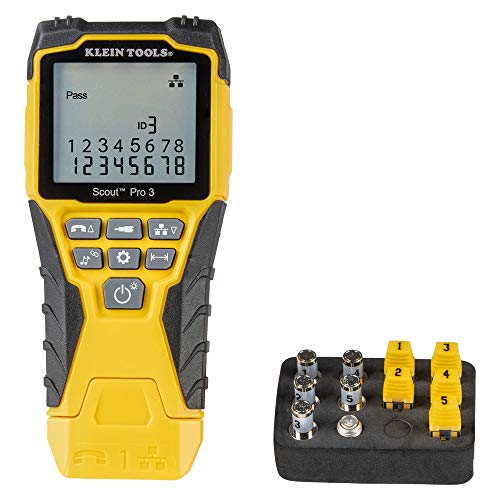
- Tests RJ11/12, RJ45, and coaxial cables
- Finds opens, shorts, miswires, and split pairs
- Measures cable length up to 2,000 feet
Best For: Unenergized voice, data, and coax cable diagnostics
PoE Network Analyzer

- Maps faults and measures CAT5/CAT6 pairs from 2.5–200m
- Tests standard and non-standard PoE from 5–60V
- Adds NCV, anti-interference tracing, and port link testing
Best For: PoE-enabled Ethernet installation and troubleshooting
Versatile Tracing Pick
KAIWEETS Network Cable Tester Kit

- Maps RJ11/RJ45 wiring faults
- Traces cables up to 300 meters
- Includes telephone testing and flashlight
Best For: Mixed Ethernet, telephone, and low-voltage tracing
Multifunction Safety Pick

- Tests CAT5/CAT6, POE, and shielded cables
- Checks sequence, continuity, shorts, and opens
- Adds NCV and RJ45 crimp inspection
Best For: Network maintenance and cable sorting
Professional Mapping Pick

- Verifies pins and detects cable shields
- Offers digital and analog tracing modes
- Tests RJ45, RJ11, and RJ12 cables
Best For: Technicians handling varied voice, data, and video cabling
Best Overall – Klein Tools LAN Scout Jr
For shoppers comparing network cable testers with wire mapping, the Klein Tools LAN Scout Jr is a compact option for checking RJ45-terminated data cables and patch cords. Its backlit display presents pin-to-pin results and identifies several common wiring faults.
Best For: Technicians and home network users testing CAT5e, CAT6, and CAT6A cables with RJ45 connectors.
Pros:
- Displays pin-to-pin wiremap results on a large backlit LCD.
- Detects opens, shorts, miswires, split pairs, crossovers, and shield issues.
- Includes a remote and batteries in a compact 4.32-ounce design.
- Offers solid or warble tone generation across a wire, pair, or all eight conductors when used with a compatible probe.
Cons:
- The tone probe is sold separately.
- Designed for RJ45-terminated cables rather than a broad range of connector types.
This is a straightforward wire-mapping tester with useful fault detection and an easy-to-read screen. It is a strong fit when portability and clear RJ45 test results matter more than advanced length or PoE functions.
Best Feature Set – NOYAFA NF-8209PRO
The NOYAFA NF-8209PRO goes beyond basic wire mapping for shoppers seeking network cable testers with wire mapping and additional maintenance tools. It combines cable mapping with length testing, breakpoint locating, PoE detection, port flashing, crimp testing, wire tracking, and NCV detection.
Best For: Network installers and maintenance workers who need cable diagnostics and tracing features in one rechargeable kit.
Pros:
- Measures cable lengths from 5 to 350 meters and helps locate breakpoints.
- Checks open, short, and cross connections on RJ45, RJ11, CAT5, and CAT6 cables.
- Identifies standard and non-standard PoE power and voltage details.
- Includes a rechargeable battery, port-flash function, flashlight, and crimp test.
Cons:
- At 500 grams, it is less lightweight than a basic pocket cable tester.
- Its broader feature set may be unnecessary for simple pass/fail wire mapping.
With its rechargeable design and wide diagnostic range, this is the most versatile choice in the group. It makes particular sense for field work where cable length, PoE, port identification, and tracing are part of the same job.
Best for Wire Tracing – Klein Tools Tone and Probe Kit
The Klein Tools VDV500-705 is a tone generator and probe kit for tracing and mapping low-voltage wiring. Among network cable testers with wire mapping, it is especially suited to following cables through a workspace, with support for Ethernet, telephone, speaker, coax, video, and other data wiring.
Best For: Users tracing open-ended, non-active low-voltage wires and mapping cables across multiple cable types.
Pros:
- Performs pin-to-pin wire mapping when the toner and probe are used together.
- Supports RJ45, RJ11, RJ12, coax, speaker, telephone, video, and data cables.
- Includes alligator clips and an RJ45-to-RJ45 test cable.
- Features adjustable volume, a headphone jack, and a probe work light.
Cons:
- Intended for non-active wires under 60 volts.
- Analog tracing performance depends on separating wires and using proper grounding.
- It is a tone-and-probe kit rather than a dedicated screen-based fault tester.
This kit is a practical choice when identifying a cable’s physical path is as important as checking its pin arrangement. Its interchangeable connection options make it more flexible than an RJ45-only tester, though it requires more hands-on tracing technique.
Best Simple Tester – Network LAN Cable Tester
This compact LAN Explorer is a simple option for shoppers who want network cable testers with wire mapping without a long setup process. A single button tests RJ11, RJ12, and RJ45 cables, while LED indicators show pass, miswire, open, short, or shield results.
Best For: Home users and technicians who need quick checks of common voice and data cables.
Pros:
- Tests RJ11, RJ12, and RJ45 terminated cables.
- Supports CAT3, CAT5e, CAT6, and CAT6A cabling.
- Provides fast LED status responses for several wiring conditions.
- Includes a remote that stores inside the tester body and a 9V battery.
Cons:
- Uses LED responses rather than a backlit text display.
- Does not list length, PoE, or breakpoint testing features.
- Its functions are focused on basic cable status and wire mapping.
For straightforward pass/fail checks, this tester keeps the process quick and portable. The built-in remote storage is convenient for avoiding misplaced accessories, making it a sensible basic tool for routine cable verification.
Professional Tracing Kit – Klein Tools VDV500-820 Wire Tracer
For buyers comparing network cable testers with wire mapping, the Klein Tools VDV500-820 is primarily a professional tracing kit with continuity and polarity testing. Its analog tone generator and probe are designed for identifying low-voltage, open-ended, non-energized wiring, including Ethernet, telephone, speaker, coax, video, and data cables.
Best For: Technicians who need to trace cable runs and check continuity or polarity on non-energized low-voltage wiring.
Pros:
- Supports Ethernet, telephone, speaker, coax, video, and data cable tracing.
- Offers five tone cadences and can transmit signals over 1,000 feet.
- Tests continuity and polarity with clearly labeled LED indicators.
- Includes ABN clips, an RJ11 connection, and a headphone jack for noisy environments.
Cons:
- Does not trace through drywall or other solid barriers.
- Designed for open-ended, non-energized wiring under 60V rather than live cable testing.
- Headphones for the probe’s 3.5 mm jack are not included.
This is a focused wire-tracing solution rather than a comprehensive digital wire-mapping tester. Choose it when tracing capability, continuity checks, and broad low-voltage cable compatibility matter most.
Versatile Wiremap Tester – Klein Tools Scout Pro 3 Starter Set
The Klein Tools VDV501-851 is a practical choice among network cable testers with wire mapping for unenergized RJ45, RJ11/12, and coaxial cables. Its backlit display reports wiremap results, cable IDs, length, and detected faults, making it useful for installation checks and troubleshooting.
Best For: Home repair and field testing of voice, data, and coaxial cable runs up to 2,000 feet.
Pros:
- Tests voice, data, and video cables with RJ11/12, RJ45, and coax F-connectors.
- Detects open, short, miswire, and split-pair faults.
- Measures cable length up to 2,000 feet and displays wiremap results.
- Includes self-storing remote and multiple LanMap and CoaxMap locator remotes.
Cons:
- Not designed to test Power over Ethernet.
- Cable tracing requires an analog probe, which is sold separately.
- Testing is specified for unenergized Ethernet cables.
With its clear LCD readout and included remotes, the Scout Pro 3 offers more structured wiremap and fault diagnostics than a basic continuity checker. It is a strong fit when cable length and fault identification are priorities, provided PoE testing is not required.
PoE Network Analyzer – NOYAFA NF-8209 Cable Tester
The NOYAFA NF-8209 combines wire mapping, cable tracing, length measurement, PoE testing, and NCV detection in one network tester. For shoppers seeking network cable testers with wire mapping, it supports CAT5/CAT6 RJ45 cables, identifies common wiring faults, and measures twisted-pair runs from 2.5 to 200 meters.
Best For: Network installation and repair work involving CAT5/CAT6 cable tracing, wire mapping, length checks, and PoE troubleshooting.
Pros:
- Tests open circuits, shorts, miswiring, and normal connections with a remote adapter.
- Measures individual twisted-pair lengths from 2.5 to 200 meters.
- Supports standard and non-standard PoE from 5–60V and identifies power method, voltage, and polarity.
- Includes anti-interference tracing, live cable tracing up to 600 meters, NCV detection, and port flash/link testing.
Cons:
- Its stated network compatibility centers on CAT5/CAT6 and RJ45 cables rather than a broad range of connector types.
- The receiver uses a 9V battery, while the transmitter has a rechargeable battery.
- Length measurement is limited to the listed 2.5–200 meter range.
This is the most feature-rich option of the three for active network troubleshooting. Its PoE analysis, length measurement, wire mapping, and digital tracing modes make it especially useful for installers handling modern Ethernet runs.
Versatile Tracing Pick – KAIWEETS Network Cable Tester Kit
If you need network cable testers with wire mapping, the KAIWEETS kit combines pin-to-pin testing with practical cable tracing. It checks RJ11 and RJ45 wiring for opens, shorts, miswiring, and reversals, while also supporting telephone-line checks and tracing of other metal wires with the included adapter.
Best For: Home users, installers, and low-voltage technicians who need one kit for Ethernet, telephone, and general wire tracing.
Pros:
- Maps network cable pins and identifies open circuits, shorts, miswiring, and reversals.
- Traces RJ11, RJ45, electrical, and speaker wires; power off metal wires before testing.
- Supports cable testing over distances up to 300 meters.
- Includes adjustable receiver volume, an LED flashlight, batteries, and a 3-year warranty.
Cons:
- Metal-wire tracing requires the cable to be powered off to avoid damaging the tester.
- Its broad feature set may be more than needed for simple Ethernet continuity checks.
This is a well-rounded choice when wire mapping is only part of the job. Its long-distance testing, telephone diagnostics, and tracing accessories make it especially useful for mixed low-voltage work.
Multifunction Safety Pick – TESMEN TLP-900AR Cable Tester
The TESMEN TLP-900AR is a practical option among network cable testers with wire mapping, covering CAT5, CAT6, POE, shielded, and telephone cables. Its LED indicators check sequence and continuity, while the receiver adds cable tracing, non-contact voltage detection, and telephone-line diagnostics.
Best For: Network maintenance, cable sorting, and installers who want wire testing plus added live-wire awareness.
Pros:
- Checks cable sequence and continuity and flags incorrect connections, shorts, and opens.
- Supports CAT5/CAT6, POE, shielded, RJ45, and RJ11 applications.
- Includes RJ45 crystal-head crimping inspection and NCV detection on the receiver.
- Provides alligator clips, a storage box, work light, low-battery alert, and automatic shutoff.
Cons:
- The supplied notes do not specify a maximum cable-testing distance.
- NCV detection improves awareness but does not replace appropriate electrical safety procedures.
Choose this model if you want more than basic mapping. Its combination of fault detection, tracing, telephone testing, crimp inspection, and NCV functionality gives maintenance work a broad toolset in one portable kit.
Professional Mapping Pick – Klein Tools VDV500-920
For buyers comparing network cable testers with wire mapping, the Klein Tools VDV500-920 combines digital and analog tracing with pin-to-pin verification. It can test RJ45, RJ11, and RJ12 data cables while also supporting continuity, polarity, shield detection, and tracing across voice, data, video, audio, speaker, and coax applications.
Best For: Technicians who need a rugged, multi-mode tracer and wire-mapping tool for varied cable systems.
Pros:
- Wire mapping verifies pin-to-pin connections and detects shields.
- Digital mode supports tracing on an active network, while analog mode isolates wire pairs.
- Clearly labeled LEDs display continuity and polarity results.
- Includes angled bed-of-nails clips for attaching to unstripped wires and a 60Hz filter for tracing.
Cons:
- The supplied notes do not list included batteries or a storage case.
- At 1.4 pounds, it may be less convenient than smaller basic testers for occasional users.
This is the strongest fit for technicians who value flexible tracing modes and broader cable support. Its mapping and shield-detection features are useful when diagnosing structured cabling beyond straightforward Ethernet continuity.
How We Picked the Best Network Cable Testers with Wire Mapping
We focused on testers that can do more than indicate a basic pass or fail. Useful wire mapping should show the order of conductors and help identify opens, shorts, reversed pairs, crossed wires, and missing connections. We also considered support for common RJ45 Ethernet cabling, compatibility with RJ11 or coax where applicable, remote units for installed runs, and practical troubleshooting features.
Additional factors included PoE detection, cable-length measurement, tone generation, probe quality, display readability, portability, included accessories, and whether the tester suits occasional household use or repeated professional jobs. Because feature sets vary widely, the best choice depends on the type of cable work you perform most often.
Quick Comparison
| Feature | Why It Matters |
|---|---|
| Wire mapping | Shows conductor order and highlights wiring faults. |
| Remote units | Allow testing of cables installed between rooms, outlets, or patch panels. |
| Tone generation and probe | Helps identify one cable among many bundled or hidden runs. |
| PoE testing | Indicates whether Ethernet lines carry power and can support troubleshooting. |
| Length testing | Estimates cable distance and can help locate breaks or termination problems. |
| NCV detection | Adds a convenient way to detect nearby energized wiring, but it is not a replacement for electrical safety procedures. |
Key Buying Factors for Network Cable Testers with Wire Mapping
Choose the Right Cable Coverage
For most Ethernet work, prioritize RJ45 support for Cat5e, Cat6, and similar twisted-pair cables. If you also service phones, security systems, video, or legacy installations, a model with RJ11, coax, or broader tone-tracing support may save you from carrying a second tool.
Look Beyond a Pass/fail Result
A clear pinout or wire-map display is more useful than a simple status light because it tells you what went wrong. Consider whether the screen identifies individual faults, shows split pairs, and works with remote terminators at the far end of a long run.
Match Advanced Features to Your Workload
PoE and NCV are useful for network technicians working around switches and active cabling. Length measurement is valuable when diagnosing intermittent runs or locating suspected damage. Tone-and-probe kits are especially helpful when cables are unlabeled or disappear into walls, ceilings, and crowded equipment rooms.
Check Usability and Durability
Look for intuitive controls, a readable display, replaceable batteries, sturdy connectors, and included remotes or adapters. A compact tester may be best for a home toolkit, while frequent field work justifies a rugged body, carrying case, and a more capable probe.
Who Should Buy Which Network Cable Testers with Wire Mapping?
Home users and occasional DIY installers: Choose a straightforward RJ45 tester with a remote and clear wire mapping. It should verify newly terminated patch cables without adding unnecessary complexity.
IT technicians and network installers: Favor models that combine wire mapping with tone tracing, multiple remotes, PoE awareness, or length testing. These features reduce time spent identifying and isolating problems in active installations.
Structured-cabling professionals: Prioritize durable testers with comprehensive fault reporting, broad cable compatibility, and dependable probe performance. A starter set can be suitable for routine certification checks, while a multifunction tester is better for varied service calls.
Buyers working around active equipment: Treat PoE and NCV features as helpful diagnostics, not substitutes for proper lockout, verification, or electrical safety practices. Before choosing, confirm the tester’s stated limits and the connector types used in your installations.