Choosing a large-format machine is about more than build volume. You also need dependable motion, strong bed adhesion, stable temperatures, and software that won’t slow down big jobs.
Our picks focus on printers that make oversized prototypes, cosplay parts, functional enclosures, and production runs easier to print with fewer compromises.
Best 10 Large Format 3d Printers Picks for 2026
Large-Format Speed Pick
Sovol SV08 MAX CoreXY 3D Printer
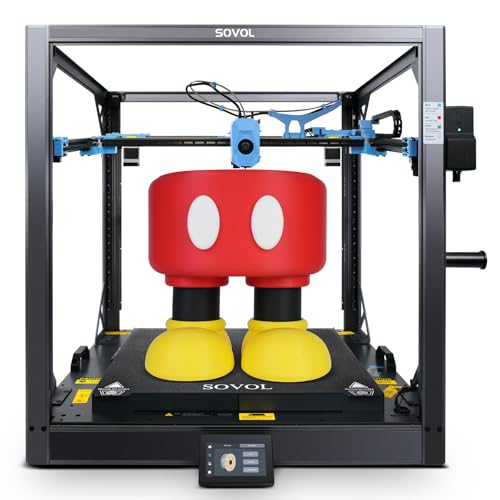
- 500×500×500mm build volume
- Up to 700mm/s speed with CoreXY motion
- Auto leveling plus 720p camera monitoring
Best For: Oversized prints and fast turnaround
Industrial Chamber Choice
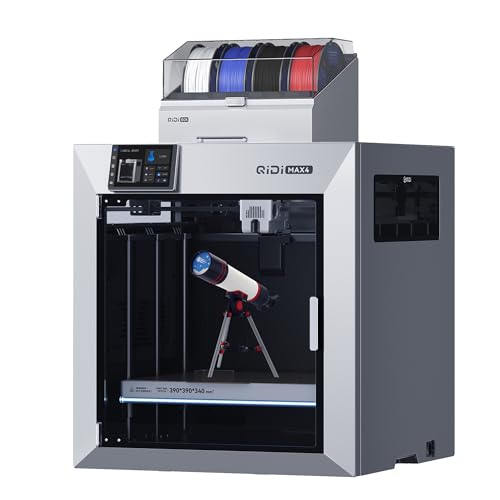
- 390×390×340mm build volume
- 65°C heated chamber for demanding filaments
- AI camera and up to 800mm/s speed
Best For: Engineering parts and heated-chamber printing
Print Farm Color Choice

- Native 4-color printing
- Up to 19 colors with expansion hardware
- 81.25% less filament change length
Best For: High-volume multi-color production
Ultra-Large High-Throughput Choice
Creality Ender 5 Max 400×400×400mm

- 400×400×400 mm build volume
- Up to 700 mm/s claimed speed
- 64-point auto leveling and auto Z-offset
Best For: Large parts, batch production, and print-farm workflows
High-Capacity Multi-Material Pick
QIDI Plus5 Combo 320×320×300mm

- 320×320×300 mm build volume
- 65°C heated chamber and 370°C max nozzle
- Up to 16-color printing with optional QIDI BOX
Best For: Technical materials, enclosed printing, and multi-color projects
Fast Compact Benchmark
FLASHFORGE Adventurer 5M 220×220×220mm

- Automatic bed leveling
- Up to 600 mm/s travel speed
- 280°C direct extruder with quick nozzle swaps
Best For: Fast everyday printing in a compact desktop size
Compact Multicolor Pick
Creality K2 Combo (A) for Fast, Quiet Printing

- Up to 16 colors with four CFS units
- 260 × 260 × 260 mm build volume
- 95% pre-assembled with AI monitoring
Best For: Makers who want a plug-and-play multicolor printer with strong automation
Speedy Mid-Size Choice
FLASHFORGE AD5X for Multicolor Efficiency

- Up to 4-color printing
- CoreXY design with 600 mm/s speed
- 1-click auto leveling and 300°C extruder
Best For: Users who want a fast, easy-to-run printer for prototyping and batch jobs
Large-Volume Flagship
Creality K2 Plus Combo for Big Builds

- 350 × 350 × 350 mm build volume
- Up to 16 colors with CFS expansion
- Supports ASA and PPA at up to 350°C
Best For: Makers who need a true large-volume printer with advanced automation
Large-Format Speed Pick – Sovol SV08 MAX CoreXY 3D Printer
If you want large format 3d printers that can handle oversized parts without turning every job into an all-day wait, the Sovol SV08 MAX is built for exactly that. Its 500×500×500mm build area, CoreXY motion, and 700mm/s claim make it a strong fit for big prototypes, props, and industrial parts where speed still matters.
Best For: Makers and businesses that need very large prints, fast turnaround, and high-temperature material support.
Pros:
- Massive 500×500×500mm build volume for full-scale parts and oversized models
- Fast CoreXY system with up to 700mm/s speed and 40,000mm/s² acceleration
- Eddy current bed leveling with pressure-sensing touch points for automatic calibration
- Built-in 1280×720 HD camera for remote monitoring, timelapses, and Obico support
Cons:
- The heated chamber module is only a future upgrade option and sold separately
- Advanced setup may be more machine than casual users need
- Large footprint and 86.8-pound weight require real workspace
The SV08 MAX stands out when the priority is scale plus speed, not just one or the other. If you need a serious large-format machine that is also designed for fast production-style printing, this one is easy to place near the top of the list.
Industrial Chamber Choice – QIDI Max4 Combo 3D Printer
Among large format 3d printers, the QIDI Max4 Combo is aimed at users who want a roomy build space and better control over demanding materials. Its 390×390×340mm volume, 65°C heated chamber, and high-flow hotend make it a practical option for industrial parts, molds, and prototypes that need consistent conditions.
Best For: Users printing large technical parts with engineering filaments and a preference for a heated chamber.
Pros:
- Large 390×390×340mm build volume for one-piece prints
- 65°C active heated chamber and full-surface heated bed help with temperature control and adhesion
- Up to 800mm/s speed with closed-loop motors on X/Y axes
- AI camera can detect print failures and pause automatically
Cons:
- Polar Cooler is not included and must be purchased separately
- At 120 pounds, it is a heavy machine to move and place
- Multi-color printing depends on the separate QIDI BOX
The Max4 Combo is the more specialized pick here: less about sheer size alone, more about controlled printing with tougher materials. If your workflow includes ABS-CF, PC, or PPS-CF and you want a large enclosed system, it makes a strong case.
Compact Multi-Color Speed Pick – FLASHFORGE AD5X Multi-Material 3D Printer
If you are comparing large format 3d printers only by print area, the FLASHFORGE AD5X is not the biggest machine here. But it earns a place in a roundup because it focuses on speed, auto calibration, and multi-color productivity in a compact CoreXY package, which is useful when your priority is output efficiency rather than maximum build size.
Best For: Users who want fast multi-color printing, easy calibration, and a space-saving machine.
Pros:
- Up to 4-color printing with the Intelligent Filament System
- Fast printing up to 600mm/s with 20,000mm/s² acceleration
- Full auto leveling sensor supports more consistent first-layer setup
- Compact, modular design saves bench space
Cons:
- Much smaller build size than true large-format machines
- Best suited to compact parts rather than oversized prototypes
- Multi-material capability depends on the IFS setup
The AD5X is a smart pick if you care more about production speed and color capability than print volume. It is not the largest option here, but it can be a better fit for users who want a faster, more compact workflow.
Print Farm Color Choice – ANYCUBIC Kobra X 3D Printer
The ANYCUBIC Kobra X is built less like a hobby printer and more like a production tool for color-heavy jobs. While its 260×260×260mm build volume is smaller than the biggest large format 3d printers, its native 4-color printing, 19-color expansion, and waste-saving filament handling make it a strong fit for high-density, repeatable output.
Best For: Print farms and business users who want multi-color capability, low waste, and fleet-friendly management.
Pros:
- Native 4-color printing with expansion up to 19 colors using 4 ACE 2 Pro units
- 81.25% less filament change length to cut purge waste
- 49-point LeviQ 3.0 auto-leveling for consistent first layers
- Top-mount, space-efficient design helps pack more machines into a workshop
Cons:
- Build volume is smaller than true large-format printers
- Multi-color expansion requires additional hardware
- Best value comes when used in a production or farm setup
The Kobra X is a workflow-focused machine: it is about efficient color printing, low waste, and managing multiple printers well. If your buying decision is driven by throughput and multi-color output, this one is especially compelling.
Ultra-Large High-Throughput Choice – Creality Ender 5 Max 400×400×400mm
If you want large format 3D printers that can handle oversized parts or batch runs without splitting models, the Creality Ender 5 Max is built around scale and speed. Its 400×400×400 mm build volume, 700 mm/s claimed speed, and multi-printer WLAN control make it a strong fit for busy workspaces and print farms.
Best For: Makers, studios, and small production teams that need a very large build area and fast multi-printer workflow.
Pros:
- Extra-large 400×400×400 mm build volume for big models or multiple parts.
- CoreXY system and high-torque motors are designed for up to 700 mm/s printing.
- 64-point auto leveling and auto Z-offset simplify first-layer setup.
- WLAN grouped control helps manage multiple printers more efficiently.
Cons:
- Large and heavy machine at 70.4 lb, so placement matters.
- More of a production-focused machine than a compact desktop printer.
Overall, the Ender 5 Max is a practical pick if volume, throughput, and automation matter more than a small footprint. It stands out for users who want a serious large-format machine that can support repeatable, high-output work.
High-Capacity Multi-Material Pick – QIDI Plus5 Combo 320×320×300mm
The QIDI Plus5 Combo is aimed at buyers comparing large format 3D printers for engineering materials, enclosed printing, and multi-color output. With a 320×320×300 mm build volume, heated chamber, and support for advanced filaments, it is positioned for demanding functional parts and longer print runs.
Best For: Engineers and advanced makers who want a large enclosed printer for technical materials and multi-color capability.
Pros:
- 320×320×300 mm build volume supports oversized prints and batch production.
- Heated 65°C chamber and 370°C max extrusion temperature suit engineering filaments.
- CoreXY motion system is rated up to 600 mm/s for fast, stable printing.
- AI camera monitoring and remote control add convenience for long jobs.
Cons:
- Multi-color printing depends on the optional QIDI BOX accessory.
- At 96.8 lb, it is a substantial machine to place and move.
For users who need more than just a bigger build plate, the Plus5 combines size with temperature control and material support. It is especially appealing if your large format 3D printers shortlist includes enclosed machines for tougher functional parts.
Fast Compact Benchmark – FLASHFORGE Adventurer 5M 220×220×220mm
The FLASHFORGE Adventurer 5M is not a large format 3D printer, but it earns a place in a size-focused roundup as a faster, simpler option for users who do not need a huge build volume. Its automatic leveling, CoreXY frame, and 600 mm/s travel speed make it a practical pick for rapid everyday printing.
Best For: Buyers who want fast, low-fuss printing in a compact size rather than a large build area.
Pros:
- Automatic bed leveling helps deliver consistent first layers.
- CoreXY design supports up to 600 mm/s travel speed and high acceleration.
- 3-second detachable nozzle changes improve convenience.
- 280°C direct extruder and dual-fan cooling support flexible print settings.
Cons:
- 220×220×220 mm build volume is much smaller than true large-format models.
- Best suited to standard-size prints rather than oversized parts.
If you are comparing print performance as well as size, the Adventurer 5M is a fast and approachable machine. It is a useful alternative for users who want speed and automation but do not need the footprint of a large format 3D printer.
Compact Multicolor Pick – Creality K2 Combo (A) for Fast, Quiet Printing
If you want large format 3d printers with multicolor capability in a more compact footprint, the Creality K2 Combo is built around speed, automation, and convenience. Its 260 × 260 × 260 mm build volume covers many everyday projects, while the included CFS system can support multicolor workflows without extra painting.
Best For: Makers who want a plug-and-play multicolor printer with fast setup and a smaller large-format build area.
Pros:
- Supports up to 16 colors with up to four CFS units
- 95% pre-assembled for a quick out-of-box setup
- Smart auto leveling targets only the needed bed area
- AI camera helps monitor failures and idle prints
Cons:
- Build volume is smaller than true oversized large-format models
- CFS multicolor expansion requires additional units beyond the included one
- Best suited to users who value automation over maximum size
The K2 Combo is a practical choice if you want multicolor printing and modern automation without jumping to a very large machine. It balances speed, quiet operation, and smart monitoring in a size that still fits many workshop setups.
Speedy Mid-Size Choice – FLASHFORGE AD5X for Multicolor Efficiency
The FLASHFORGE AD5X is a strong pick for buyers comparing large format 3d printers that prioritize speed and workflow efficiency over sheer build size. With a 220 × 220 × 220 mm build volume, CoreXY architecture, and 600 mm/s speeds, it is designed for quick prototyping and efficient batch work.
Best For: Users who want a fast, user-friendly multicolor printer for everyday production and detailed parts.
Pros:
- Prints up to 4 colors simultaneously
- CoreXY frame supports speeds up to 600 mm/s
- 1-click auto leveling simplifies setup
- 300°C direct-drive extruder supports broader material use
Cons:
- Build volume is smaller than larger-format alternatives
- Multicolor support is limited to 4 colors at once
- Focused more on speed than oversized model capacity
The AD5X stands out if you want a fast, compact machine with practical automation and multicolor printing. It is especially appealing for users who care about throughput, easy operation, and versatile nozzle options.
Large-Volume Flagship – Creality K2 Plus Combo for Big Builds
Among large format 3d printers, the Creality K2 Plus Combo is the one here that clearly leans into oversized builds. Its 350 × 350 × 350 mm volume makes room for bigger single-piece models or larger batch runs, while 16-color capability and high-speed motion keep it flexible for demanding work.
Best For: Makers who need a true large-volume printer with multicolor support and advanced automation.
Pros:
- Large 350 × 350 × 350 mm build volume
- Supports up to 16 colors with four CFS units
- Handles high-end filaments like ASA and PPA
- Dual AI cameras and 18 sensors support automation
Cons:
- Larger size and 70.4-pound weight make it less compact
- Advanced feature set may be more than casual users need
- Full multicolor expansion requires additional CFS units
The K2 Plus Combo is the most capable option in this group when build size matters most. It combines large-format capacity with fast motion, strong material support, and smart monitoring for ambitious projects.
How We Picked the Best Large Format 3d Printers
We prioritized printers with genuinely useful build space, consistent high-speed performance, and features that reduce failure risk on long prints. We also looked at assembly complexity, chamber or enclosure support, calibration automation, material compatibility, and multicolor capability where it adds real value.
For Large Format 3d Printers, reliability matters as much as raw size. A machine that can hold first-layer consistency and dimensional accuracy over a bigger bed is usually the better buy than one that only looks impressive on paper.
Quick Comparison
Some models in this roundup are best for maximum build volume, while others are better for faster turnaround or multicolor production. If your priority is one-piece prints, focus on the 400 mm-class and above machines. If you want more versatility in a smaller footprint, the mid-size options may offer a better balance of speed, automation, and cost.
Key Buying Factors for Large Format 3d Printers
Build Volume and Usable Space
Check the actual printable dimensions, not just the headline size. Tall enclosures, raised beds, toolheads, and cable routing can reduce usable space if the printer is poorly designed.
Frame Rigidity and Motion System
Larger machines benefit from stiff frames, stable gantries, and well-tuned motion systems. CoreXY designs often help maintain speed and accuracy on bigger builds, especially when printing fast.
Heating and Material Support
If you plan to print ABS, ASA, nylon, or other demanding materials, look for heated chambers or strong enclosure compatibility. Stable thermal control is especially important on large parts to reduce warping and layer separation.
Automation and Workflow
Auto leveling, filament runout detection, camera monitoring, and assisted calibration can save a lot of time on big prints. These features are especially useful when a failed first layer could waste hours of print time and a lot of filament.
Speed Vs. Real-World Reliability
High advertised speeds are useful, but only when the printer can maintain quality across a full build plate. For Large Format 3d Printers, consistency usually beats peak speed in everyday use.
Who Should Buy Which Large Format 3d Printers?
Choose the largest-volume printer if you regularly make helmets, props, fixtures, jigs, or production parts that need to come out in one piece. Pick a mid-size high-speed model if you want faster prototyping with more manageable footprint and cost. If you work with multiple colors or materials, prioritize the multi-material systems that simplify loading and reduce manual intervention. For most buyers, the best choice is the printer that matches both part size and your typical material mix, not just the biggest machine available.