Choosing a power amplifier with balanced inputs can make a real difference in noise control, connection flexibility, and overall system integration. Whether you’re building a compact desktop setup or a full home audio chain, balanced inputs help preserve signal integrity over longer cable runs.
Below, we’ve narrowed the field to 10 standout options for 2026, focusing on practical performance, input options, and value for different kinds of listeners.
Best 10 Power Amplifier with Balanced Inputs Picks for 2026
Mono Power Headroom for AVR Setups

- 240W monoblock Class D design
- Balanced XLR/TRS and RCA inputs
- PFFB, auto sensing, op-amp rolling
Best For: Adding clean power to one passive speaker at a time
All-in-One Desktop DAC Amp

- ESS9038Q2M DAC plus TPA3255 amp
- TRS balanced input with multiple digital inputs
- Tone control, sub out, remote, 12V trigger
Best For: A compact stereo DAC amp with balanced desktop connectivity
Compact GaN Monoblock for Desktop HiFi

- Balanced XLR/TRS and RCA inputs
- Fanless GaN Class D monoblock
- 12V trigger with selectable gain
Best For: A quiet compact monoblock for desktop or near-field listening
Traditional Integrated Stereo Amplifier
- 2-channel integrated amp with built-in DAC
- Bluetooth, optical, coaxial, and phono inputs
- Analog mode can disable Bluetooth circuitry
Best For: A simple home stereo amplifier with DAC and phono support
Reference-Grade 2.1 Control
AIYIMA A20 Balanced Stereo Amplifier

- Balanced XLR/RCA input switching
- Adjustable 60-200Hz high-pass filter
- 116dB SNR and 0.002% THD+N
Best For: Balanced-input 2.1 systems with flexible tuning
All-in-One Desktop Hub

- CS43131 DAC with USB MQA support
- 4.4mm balanced output and headphone amp
- 2.1 sub support plus HDMI eARC
Best For: Desktop hi-fi setups needing one compact all-in-one box
Flexible Balanced Mini Amp
Fosi Audio ZA3 Stereo Amplifier

- Balanced XLR/TRS combo input
- Stereo or mono mode up to 235W
- 12V trigger-in and op-amp rolling
Best For: Compact balanced setups that may grow into mono systems
PA Rack-Mount Performer

- TRS and XLR balanced inputs
- Bridgeable up to 2000W peak
- Bluetooth and USB-A MP3 playback
Best For: rack systems needing balanced inputs and flexible playback
Balanced HiFi Standout

- XLR-balanced stereo input support
- 250W per channel into 4Ω stereo
- RCA, XLR, and XLR-mono inputs
Best For: home audio setups that prioritize balanced XLR connectivity
Mono Power Upgrade

- XLR/TRS balanced plus RCA inputs
- Up to 240W at 4Ω per speaker
- PFFB and high-grade components
Best For: multi-channel home audio and home theater expansion
Mono Power Headroom for AVR Setups – Fosi Audio V3 Mono
If you’re looking for a power amplifier with balanced inputs for a compact home theater or hi-fi upgrade, the Fosi Audio V3 Mono is built to do exactly that. It combines a single-channel Class D design with XLR and 1/4″ TRS balanced input support, plus RCA, so it fits both consumer and more studio-style source gear.
Best For: Users who want a single-channel amp for adding power to passive speakers in a home theater or modular multi-channel system.
Pros:
- Single-channel monoblock design can deliver up to 240W into 4Ω.
- Supports balanced XLR/TRS and RCA inputs with easy switching.
- Uses TPA3255 with PFFB, Nichicon, ELNA, WIMA, and Sumida components.
- Includes auto power/signal sensing and op-amp rolling support.
Cons:
- Requires one amp per speaker for stereo use.
- No built-in source selection beyond the input switch.
- External power supply is part of the setup.
The V3 Mono makes the most sense when you need flexible balanced connectivity and serious power in a very small footprint. It is especially attractive for buyers building a larger system one channel at a time.
All-in-One Desktop DAC Amp – AIYIMA A80
The AIYIMA A80 is a practical pick if you want a power amplifier with balanced inputs and a built-in DAC in one box. It pairs a TPA3255 amplifier stage with an ESS9038Q2M decoder, and its TRS balanced input is a standout for reducing EMI and speaker hiss on desktop systems.
Best For: Listeners who want a compact stereo amp with balanced input support, digital inputs, and a built-in DAC.
Pros:
- Integrated ESS9038Q2M DAC with TPA3255 amplification.
- TRS balanced input plus Bluetooth, USB, optical, and coaxial.
- Claims up to 300W x2 output with PFFB and low THD.
- Includes tone control, sub pre-out, 12V trigger, and remote.
Cons:
- Balanced input is TRS, not XLR.
- Many features may be more than needed for simple analog setups.
- Compact all-in-one design may not suit users who prefer separate components.
Overall, the A80 is aimed at buyers who want convenience without giving up balanced connectivity or modern source support. It fits well in desks, small hi-fi rooms, or flexible 2.1 systems.
Compact GaN Monoblock for Desktop HiFi – GaN Mono
For buyers seeking a power amplifier with balanced inputs in a small desktop-friendly package, the GaN Mono is a focused monoblock option. It supports balanced XLR/TRS and RCA inputs, making it easy to connect to DACs, preamps, streamers, and audio interfaces while keeping the setup neat.
Best For: Desktop hi-fi listeners who want one compact monoblock per speaker with balanced input flexibility.
Pros:
- True monoblock design powers one passive speaker per amp.
- Balanced XLR/TRS and RCA inputs with selectable gain.
- GaN-based Class D design is fanless, efficient, and compact.
- Includes 12V trigger, auto mode, and adjustable auto sensitivity.
Cons:
- One amplifier is included, so stereo requires two units.
- Power adapter is not included.
- Best suited to near-field or desktop use rather than larger full-size racks.
The GaN Mono is a good match if you value low heat, low noise, and balanced connectivity in a streamlined desktop system. Its combination of efficiency and form factor makes it especially appealing for modern minimalist setups.
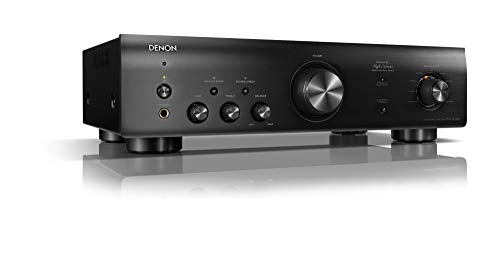
Traditional Integrated Stereo Amplifier – Denon PMA-600NE
The Denon PMA-600NE is a conventional integrated amp rather than a modern power amplifier with balanced inputs, but it remains a strong choice if you want a simple two-channel home audio center. It offers Bluetooth, digital inputs, and a phono stage in a vibration-resistant design aimed at clean, accurate playback.
Best For: Buyers who want a straightforward integrated stereo amplifier with Bluetooth, DAC, and phono support.
Pros:
- Integrated 2-channel amplifier with built-in DAC and phono preamp.
- Offers Bluetooth plus 2 optical and 1 coaxial input.
- Advanced High Current push-pull circuit is designed for detailed sound.
- Bluetooth can be disabled for a more purely analog path.
Cons:
- No balanced XLR or TRS input support.
- Less compact than the mini Class D options in this roundup.
- Not a monoblock design for modular multi-amp systems.
If balanced connectivity is a must-have, this model is not the right fit. But for buyers prioritizing Denon’s integrated-feature approach and solid two-channel performance, it is still an easy amplifier to live with.
Reference-Grade 2.1 Control – AIYIMA A20 Balanced Stereo Amplifier
If you want a power amplifier with balanced inputs that also makes 2.1 integration easier, the AIYIMA A20 is built for exactly that kind of setup. Its XLR/RCA input switching, adjustable high-pass filter, and subwoofer output make it a practical choice for a clean desktop or living-room system.
Best For: Listeners building a balanced-input 2.1 system who want HPF control, bypass mode, and flexible gain settings.
Pros:
- Fully balanced design with XLR input support and RCA input toggle
- Adjustable HPF from 60-200Hz helps protect main speakers and sharpen midrange clarity
- Includes bypass mode, +3dB gain switch, 12V trigger, and swappable op-amp design
- Strong published specs: 116dB SNR and 0.002% THD+N
Cons:
- Best suited to systems that can use its 2.1 and balanced-input features
- More feature-rich than a basic plug-and-play amp
The A20 stands out if you value setup flexibility as much as raw amplification. Between the balanced input path, tuning tools, and premium component list, it looks like a serious match for an audiophile-style 2.1 build.
All-in-One Desktop Hub – SMSL AO300 PRO DAC Amplifier
The SMSL AO300 PRO is a strong pick if you want a power amplifier with balanced inputs in a compact all-in-one unit. It combines DAC, power amp, and headphone amp functions, while the 4.4mm balanced output, multiple digital inputs, and subwoofer support make it easy to build a tidy desktop or small-room setup.
Best For: Desktop hi-fi listeners who want one box for digital sources, balanced headphone output, and speaker power.
Pros:
- CS43131 DAC with XMOS XU-316 interface supports high-res playback and full USB MQA decoding
- 4.4mm balanced output plus 6.35mm headphone jack for flexible listening
- 2.1-channel subwoofer expansion and multiple inputs including USB, coaxial, optical, and RCA
- Built-in EQ modes, filters, remote control, and HDMI eARC support for TV use
Cons:
- Balanced connection is on the headphone output rather than an XLR amp input
- Feature-packed design may be more than needed for a simple speaker-only setup
For buyers who want an integrated solution, the AO300 PRO covers a lot of ground without adding clutter. It is especially appealing if you want balanced output, digital flexibility, and speaker amplification in one chassis.
Flexible Balanced Mini Amp – Fosi Audio ZA3 Stereo Amplifier
The Fosi Audio ZA3 is a compact power amplifier with balanced inputs designed for flexible two-channel or mono use. With XLR and 1/4″ TRS support, trigger-in, and a choice of stereo or mono mode, it is a practical fit for desktop speakers, passive bookshelves, or a small home theater.
Best For: Buyers who want a compact balanced-input amp that can scale from stereo to mono duty.
Pros:
- Balanced combo input accepts XLR and 1/4" TRS plugs to help reduce noise
- Stereo mode delivers up to 180W, while mono mode can reach 235W
- 12V trigger-in simplifies system power control
- Swappable op-amps and premium capacitors/inductors for tuning and build quality
Cons:
- Requires external power supply and careful system matching
- Mono output performance depends on pairing and configuration
The ZA3 is a strong choice if you want a small chassis with real setup flexibility. Its balanced input, trigger support, and stereo/mono switching make it easy to adapt as your system grows.
PA Rack-Mount Performer – Pyle 2-Channel Bluetooth Amp
If you need a power amplifier with balanced inputs for a rack system, the Pyle PTA1000BT covers the basics well: TRS and XLR input options, bridge mode, and speaker outputs for flexible hookup. It’s built for multi-speaker use, with Bluetooth streaming and front-panel monitoring that make it practical for everyday PA or install applications.
Best For: Rack-mounted setups that need balanced XLR/TRS connectivity, bridge mode, and simple wireless playback.
Pros:
- Includes 2 TRS inputs and 2 XLR inputs for balanced signal connections
- Bridgeable design with up to 2000W peak power in bridged mode
- Bluetooth plus USB-A MP3 playback adds convenient source options
- Front-panel level meters and status LEDs help with quick monitoring
Cons:
- Peak power rating is more useful for reference than continuous listening comparisons
- Rack-mount format is less ideal for portable desktop use
For buyers prioritizing balanced inputs and flexible output options, this Pyle is a straightforward, feature-heavy choice. Its cooling fan, bridge mode, and multiple connector types make it better suited to practical system building than audiophile refinement.
Balanced HiFi Standout – SMSL PA400 GaN Amplifier
The SMSL PA400 is a strong pick if you want a power amplifier with balanced inputs for home audio and higher-fidelity listening. It offers XLR-balanced stereo operation, RCA compatibility, and XLR mono-bridge support, so it can adapt to both a single-amp stereo setup and a two-unit configuration for more demanding speakers.
Best For: Home audio listeners who want balanced XLR input support and a compact hi-fi amp with flexible stereo or mono operation.
Pros:
- XLR-balanced stereo mode for cleaner integration with a preamp
- RCA, XLR, and XLR-mono inputs broaden compatibility with DACs
- GaN-based Class D design delivers 250W per channel into 4Ω stereo
- Fully aluminum chassis doubles as a rigid enclosure and heat sink
Cons:
- Mono-bridge use requires two PA400 units
- Freestanding design may not suit rack-based systems
In practical terms, the PA400 is aimed at listeners who value balanced signal paths and tidy desktop or shelf placement. Its mono and stereo modes give it more flexibility than a basic integrated amp, while the aluminum build supports its hi-fi positioning.
Mono Power Upgrade – Fosi Audio V3 Mono Amplifier
For a power amplifier with balanced inputs in a single-channel format, the Fosi Audio V3 Mono is built to drive one passive speaker per unit with RCA or XLR/TRS balanced connections. It is designed for home audio and home theater systems where you want to add power, choose between balanced and single-ended input, and scale a multi-channel setup over time.
Best For: Home theater or hi-fi users who want a mono amp with balanced input support and flexible system expansion.
Pros:
- Supports XLR/¼" TRS balanced inputs plus RCA single-ended input
- Rated up to 240W at 4Ω for a single passive speaker
- PFFB technology is included to improve distortion and frequency response
- Uses premium components and a four-layer PCB for high-fidelity output
Cons:
- Mono design means one amp per speaker channel
- Sold as a two-pack in the listed configuration, which may be more than some setups need
The V3 Mono makes sense when you want balanced-input flexibility without moving to a full stereo chassis. Its signal-sensing, gain selection, and compact monoblock approach make it especially useful for building out a surround or multi-channel setup.
How We Picked the Best Power Amplifier with Balanced Inputs
We focused on models that offer balanced connectivity in a way that actually helps buyers: XLR, TRS, or fully balanced designs where appropriate. We also weighed power output, amp topology, feature set, and how well each unit fits common use cases like desktop audio, bookshelf speakers, home theater, and rack-mounted systems.
Because not every buyer needs the same thing, we gave extra attention to versatility, ease of setup, and whether the amp includes useful extras such as subwoofer support, DAC functions, Bluetooth, or bridgeable operation.
Quick Comparison: What Matters Most
If you want the simplest path to better sound, compare these amps by output power, input type, and system role. A compact Power Amplifier with Balanced Inputs may be ideal for nearfield listening, while a higher-powered rack amp is better for larger speakers or multiroom duties. DAC-equipped models can reduce box count, while pure power amps are often the cleaner choice if you already have a preamp or streamer.
Key Buying Factors for Power Amplifier with Balanced Inputs
Input Compatibility
Make sure the amplifier matches your source gear. XLR is common on hi-fi and pro-style equipment, while TRS may be useful in studio or desktop setups. If your source is unbalanced, confirm that the amp also includes RCA so you can connect without adapters.
Power and Speaker Match
RMS output matters more than headline peak wattage. Match the amplifier’s realistic power to your speaker sensitivity and room size. Efficient bookshelf speakers need far less power than low-sensitivity towers or outdoor speakers.
Balanced Signal Benefits
A balanced connection can reduce hum and interference, especially with longer cable runs or in environments with lots of electronics. That makes a Power Amplifier with Balanced Inputs a smart choice for cleaner installs and more reliable performance.
Extra Features
Features like Bluetooth, DAC inputs, subwoofer integration, and high-pass filtering can be helpful, but only if they fit your setup. Avoid paying for functions you won’t use.
Who Should Buy Which Power Amplifier with Balanced Inputs?
Choose a compact balanced-input amp if you want a simple desktop or bookshelf system with cleaner wiring. Pick a higher-output stereo or mono amp if you need more headroom for larger speakers, home theater duty, or a more demanding listening room. If you want an all-in-one solution, a DAC amplifier can simplify your setup. If you already have a source component you trust, a dedicated power amp may deliver the best long-term flexibility.
In short, the best choice depends on your source gear, speaker load, and how much system expansion you expect in the future.