The right audio crossover separates frequencies before they reach your speakers, helping subs, mids, and tweeters work more efficiently. The models in this roundup cover compact passive networks, RCA car-audio processors, and flexible PA crossovers.
Use the buying guide below to compare crossover types, connection options, channel layouts, and adjustment features before choosing the best fit for your system.
Best 10 Audio Crossover Picks for 2026
Best Digital Control

- Four independent outputs with flexible source selection
- 15-band EQ with 12 built-in presets
- LCD interface and sequencer connection
Best For: Detailed car-audio system tuning
Best Pro Connectivity
Rockville RX230 Audio Crossover

- Two-way stereo or three-way mono operation
- Balanced XLR inputs and outputs
- Adjustable subwoofer crossover and gain
Best For: Live and studio audio systems
Best OEM Upgrade
Taramps PRO 2.4S DSP Crossover

- RCA and high-level inputs support factory radios
- Four outputs with flexible DSP routing
- Time alignment, phase inversion, and 48 dB/octave filters
Best For: Factory-stereo car-audio upgrades
Best Subwoofer Control
Clarion MCD360 Electronic Crossover

- Three-way, six-channel car-audio design
- Front, rear, and subwoofer lever controls
- Includes remote subwoofer level control
Best For: Simple multi-channel car-audio setups
Compact Digital Control

- Variable 12–48 dB/octave slopes
- 10–16V DC operation
- Surface-mount design
Best For: Low-voltage systems needing adjustable crossover control
Professional PA Routing

- Two-way, three-way, and four-way modes
- XLR balanced inputs and outputs
- Individual gain and phase controls
Best For: PA and DJ systems with separate amplifiers
Passive Car Audio Splitter
Audiopipe CRX-203 2-Way Crossover

- Two-way passive car audio design
- Two-pack for stereo installations
- 150W RMS/300W peak rating
Best For: Vehicle systems using separate tweeter and woofer speakers
Pro-Level Signal Control
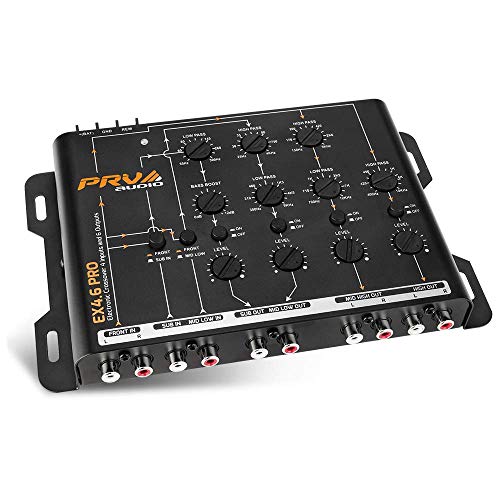
- 2-, 3-, or 4-RCA input options
- Up to 9V RMS maximum output
- 0–12dB bass boost at 45Hz
Best For: Multi-channel car audio systems with speakers and subwoofers
Simple Two-Way Setup
Pyle PLXR2B Electronic Crossover

- Two RCA inputs and four RCA outputs
- 6dB or 18dB-per-octave slopes
- Remote subwoofer control included
Best For: Basic two-way speaker and subwoofer installations
Compact Four-Way Tuning

- Four channels for sound adjustment
- Bass boost for low-frequency tuning
- Compact RCA-based design
Best For: Space-conscious four-way car audio builds
Best Digital Control – PRV Audio DSP 2.4X Crossover
The PRV Audio DSP 2.4X is a versatile audio crossover and signal processor for car systems that need detailed routing, equalization, and output control. Its two inputs, four independent outputs, LCD interface, and sequencer connection support hands-on system tuning.
Best For: Car-audio builders who want four-channel digital crossover control with integrated equalization.
Pros:
- Routes two input sources across four independent outputs.
- Includes a 15-band graphic equalizer and 12 presets.
- Offers parametric EQ adjustment for frequency, gain, and bandwidth.
- LCD display and sequencer output support practical system control.
Cons:
- The interface may require time to learn for first-time DSP users.
- Its feature set is geared toward car-audio installations rather than simple plug-and-play use.
With extensive routing and tuning options in a compact chassis, the PRV is a strong choice when flexibility matters more than simplicity.
Best Pro Connectivity – Rockville RX230 Audio Crossover
The Rockville RX230 is an audio crossover for setups that use balanced XLR connections and need clear separation between frequency ranges. It supports two-way stereo or three-way mono operation, with adjustable mid/high and subwoofer crossover controls.
Best For: Live-performance and studio systems using powered speakers, amplifiers, and subwoofers.
Pros:
- Supports two-way stereo and three-way mono configurations.
- Balanced XLR inputs and outputs help simplify professional connections.
- Provides adjustable crossover ranges for mids, highs, and subwoofer output.
- 24 dB/octave filters enable steep frequency separation.
Cons:
- Its rack-style dimensions are less suited to compact installations.
- It is a dedicated analog crossover rather than a full digital DSP platform.
The RX230 makes sense for users who prioritize XLR connectivity, straightforward frequency division, and dedicated subwoofer level control.
Best OEM Upgrade – Taramps PRO 2.4S DSP Crossover
The Taramps PRO 2.4S is a compact car-audio DSP and audio crossover designed for flexible upgrades. It combines two inputs, four outputs, adjustable high- and low-pass filters, time alignment, phase inversion, and compatibility with both factory and aftermarket head units.
Best For: Car owners upgrading an OEM stereo while adding advanced DSP tuning and output management.
Pros:
- Accepts RCA and high-level inputs for factory-stereo compatibility.
- Offers four outputs with flexible signal routing.
- Includes filters up to 48 dB/octave, time alignment, and phase inversion.
- Anti-pop protection and clip indicators help monitor system behavior.
Cons:
- Advanced features may require careful setup and tuning.
- The product is intended for car audio rather than general home-audio use.
For an OEM-friendly digital crossover with robust tuning tools, the PRO 2.4S offers a practical balance of installation flexibility and control.
Best Subwoofer Control – Clarion MCD360 Electronic Crossover
Clarion Mobile Electronics Mcd360 3 Way 6 Channel Electronic Crossover with Subwoofer Control
Check Price On AmazonThe Clarion MCD360 is a three-way, six-channel electronic audio crossover for car systems that need dedicated front, rear, and subwoofer control. It provides RCA connectivity, lever controls, subwoofer boost adjustment, and an included remote subwoofer level control.
Best For: Car-audio installations needing simple front/rear/subwoofer adjustment from a wired control setup.
Pros:
- Provides six RCA inputs and six-channel, 5-volt RCA outputs.
- Supports front, rear, and subwoofer signal management.
- Includes subwoofer equalizer and boost level controls.
- Comes with a remote subwoofer level control and gold-plated terminals.
Cons:
- Its control approach is less feature-rich than a modern digital DSP.
- Supplied notes do not specify detailed crossover frequency ranges.
The MCD360 is a straightforward choice for a multi-channel car system when accessible subwoofer control is more important than extensive digital programming.
Compact Digital Control – Stetsom STX 104
The Stetsom STX 104 is a compact digital audio crossover for systems that need adjustable frequency control. Its variable slope options—12, 18, 24, 36, and 48 dB/octave—give you flexibility when tuning an audio setup, while its 10–16V DC operating range suits compatible low-voltage installations.
Best For: Low-voltage audio systems needing adjustable crossover slopes in a surface-mounted format.
Pros:
- Offers five selectable slope options from 12 to 48 dB/octave.
- Designed for 10–16V DC supply voltage.
- Surface-mount design and included audio processor keep the installation focused.
- Includes a one-year warranty.
Cons:
- The supplied specifications list one channel, so it may not suit multichannel requirements.
- Power is limited to compatible 10–16V DC installations rather than standard 110V AC setups.
Choose this audio crossover when adjustable filtering and low-voltage compatibility matter more than extensive channel capacity. Confirm the one-channel specification matches your system before buying.
Professional PA Routing – 2/3-Way Stereo Crossover
This professional audio crossover is built for PA systems that need flexible signal routing. It supports two-way stereo, three-way stereo, and four-way mono operation, with XLR balanced inputs and outputs, separate band gain controls, and a rack-mount metal chassis.
Best For: PA systems, DJ setups, studios, and venues using amplifiers, speakers, and subwoofers.
Pros:
- Provides three operating modes: two-way stereo, three-way stereo, and four-way mono.
- Uses XLR balanced inputs and outputs for compatible equipment.
- Offers individual output gain controls and phase-reverse switches for each band.
- Includes a 40Hz, 12 dB/octave Butterworth low-cut filter.
Cons:
- Requires 110V AC operation.
- Its 18.9-inch by 5.9-inch footprint is better suited to rack or fixed installations than compact setups.
- Its extensive controls may be more than a basic two-way system needs.
This is the most versatile option here for routing multiple frequency bands to separate amplifiers. Its selectable modes and independent controls make it a strong fit for expandable PA systems, provided your equipment uses XLR connections and 110V power.
Passive Car Audio Splitter – Audiopipe CRX-203 2-Way Crossover
300 Watts 2 Way Crossover - (2 Pack) Passive Car Audio Speaker Tweeter Mids and Highs CRX-203
Check Price On AmazonThe Audiopipe CRX-203 is a two-way passive car audio crossover supplied as a two-pack. It separates tweeter and woofer frequencies, handles 150 watts RMS and 300 watts peak per crossover according to the supplied notes, and uses gold-plated screw terminals for wired installation.
Best For: Car audio systems pairing tweeters and mids or woofers in a passive two-way configuration.
Pros:
- Two-way design supports separate tweeter and woofer frequency paths.
- Supplied as a two-pack for stereo vehicle installations.
- Uses gold-plated screw terminals for speaker wiring.
- Includes high-grade polymer capacitors in an ABS enclosure.
Cons:
- It is a passive crossover, so it does not provide digital processing or adjustable electronic controls.
- The supplied specifications identify it for car stereo use rather than home or PA systems.
- The enclosure is not waterproof.
For a straightforward vehicle installation, the CRX-203 offers a practical passive audio crossover solution with a pair of units and dedicated tweeter and woofer frequency ranges. Check speaker power and wiring compatibility before installation.
Pro-Level Signal Control – PRV Audio EX4.6 PRO
The PRV Audio EX4.6 PRO is a versatile audio crossover for car systems that need three- or four-way signal routing. It accepts two, three, or four RCA input configurations, provides six RCA outputs, and offers up to 9 volts RMS maximum output.
Best For: Multi-channel car audio systems using speakers and subwoofers with adjustable bass enhancement.
Pros:
- Supports 2-, 3-, or 4-RCA input signal options.
- Offers up to 9 volts RMS maximum output.
- Includes 0–12dB bass boost at 45Hz.
- Quick on/off buttons are provided for each channel.
Cons:
- Its 4.2-channel configuration may require careful system planning.
- It is larger and heavier than some compact crossover options.
With mechanical knob controls, RCA connectivity, and Butterworth 12dB-per-octave slopes, this model is a strong choice when you want hands-on control over a more elaborate car audio setup.
Simple Two-Way Setup – Pyle PLXR2B Electronic Crossover
The Pyle PLXR2B is a practical two-way audio crossover for separating high-pass and low-pass signals in a car audio system. It has two RCA inputs, four RCA outputs, a power LED indicator, and a remote subwoofer control.
Best For: Straightforward two-way installations that need separate speaker and subwoofer signal paths.
Pros:
- Provides two RCA inputs and four RCA outputs.
- Supports selectable 6dB or 18dB-per-octave crossover slopes.
- Includes a remote subwoofer control and parallel input switch.
- Comes with a power wire, 1A fuse, screws, and a one-year warranty.
Cons:
- It is limited to a two-way configuration.
- Its maximum output voltage is listed at 6V, below some higher-output alternatives.
The compact enclosure and clear power indicator make the PLXR2B easy to integrate, while its selectable slope settings provide useful flexibility for basic high-pass and low-pass tuning.
Compact Four-Way Tuning – Taramps CRX4 Crossover
The Taramps CRX4 is a compact four-way audio crossover for car audio systems that need customizable low- and high-frequency control. Its RCA-based design includes bass boost capability and a metal or high-quality composite enclosure.
Best For: Space-conscious car audio builds requiring four-channel signal adjustment and bass-focused tuning.
Pros:
- Offers four channels for customizable sound adjustments.
- Designed for low/high-frequency processing with bass boost.
- Compact form factor measures approximately 190 x 145 x 40mm.
- Uses RCA connectivity and has an authorized U.S. repair center listed.
Cons:
- The supplied specifications list conflicting size and weight figures.
- Detailed crossover slope settings are not provided in the supplied notes.
The CRX4 emphasizes compact installation and flexible channel control, making it worth considering when cabinet space is limited and a four-way processor is preferred.
How We Picked the Best Audio Crossovers
We selected these Audio Crossovers to represent the main configurations used in car-audio and PA systems. The list includes passive speaker-level networks, analog electronic crossovers, and digital DSP units with multiple outputs and tuning controls. We considered channel count, crossover flexibility, input and output formats, frequency-control options, installation requirements, and the type of system each model is designed to support.
Because a crossover that suits a two-way speaker will not necessarily work for a multi-amplifier system, we focused on matching each product’s layout and controls to realistic use cases rather than treating every model as interchangeable.
Quick Comparison
| Best For | Recommended Type | What to Look For |
|---|---|---|
| Simple speaker upgrade | Passive crossover | Correct impedance, power handling, and two-way compatibility |
| Basic car-audio amplification | Analog electronic crossover | RCA connectivity, filter slopes, and output-level control |
| Multi-amp car system | Digital DSP crossover | Multiple outputs, equalization, delay, and presets |
| PA subwoofer and tops | XLR electronic crossover | Balanced connections, mono/stereo modes, and suitable filter ranges |
Key Audio Crossover Buying Factors
Choose Passive or Active
Passive crossovers sit between an amplifier and speaker drivers, so they need no separate power connection. They are convenient for simple two-way setups but offer less adjustment. Active or electronic units operate before amplification and provide more control, making them better for systems with separate amplifiers for subs, mids, and highs.
Check Channels and System Layout
Count the sources, amplifier channels, and speaker bands you need to control. A two-way stereo setup requires fewer outputs than a three-way system, while mono subwoofer operation may change the channel requirements. DSP models with four inputs and six or more outputs are useful when the system may expand.
Match Connections and Voltage
RCA connections are common in car audio, while XLR inputs and outputs are preferred for many PA systems because balanced cables help reduce noise over longer runs. Also verify maximum input and output voltage, especially when pairing a processor with a high-output head unit or amplifier.
Consider Filters and Tuning
Look for adjustable high-pass and low-pass frequencies, selectable slopes, phase or polarity controls, and independent output-level adjustment. DSP units can add equalization, time alignment, memory presets, and remote control, but they usually require more setup than analog designs.
Who Should Buy Which Audio Crossover?
Choose a passive two-way crossover for a straightforward speaker-and-tweeter installation where simplicity matters most. Pick an analog car-Audio Crossover when you need affordable RCA signal splitting and basic bass, midrange, or treble filtering. A digital DSP crossover is the stronger choice for a multi-amplifier vehicle system that needs detailed tuning, multiple output bands, or future expansion.
For powered PA systems, prioritize an electronic model with XLR connectivity, stereo or mono flexibility, and controls suited to your subwoofer and full-range speakers. Before purchasing, confirm the crossover’s frequency range, channel arrangement, signal voltage, and installation space against the rest of your equipment.