The right crossover can make a subwoofer sound tighter, protect your main speakers, and help every part of an audio system work more efficiently. However, crossover type, frequency range, slope, power handling, and connections all matter.
We’ve gathered 10 options spanning car audio, home speakers, PA systems, and passive DIY builds so you can find a practical match for your amplifier, subwoofer, and intended setup.
Best 10 Audio Crossovers for Subwoofers Picks for 2026
Flexible Control
Clarion MCD360 3-Way Electronic Crossover

- Six-channel RCA input and output layout
- Dedicated subwoofer EQ, boost, and level controls
- Includes remote subwoofer level control
Best For: Multi-zone car audio systems
High-Power Filtering
Sound Town XO-1S 180 Hz Subwoofer Crossover

- 180 Hz low-pass filter
- 18 dB-per-octave slope
- Supports up to 1000 watts input power
Best For: PA and DJ subwoofer replacement use
Professional Versatility
2/3-Way Stereo and 4-Way Mono Crossover
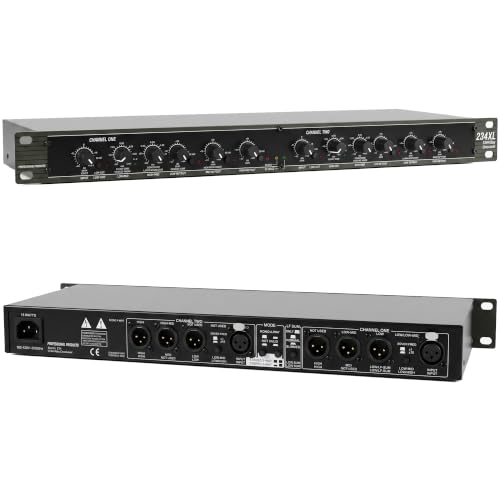
- Selectable stereo and mono operating modes
- Independent gain, phase, and 40 Hz low-cut controls
- Balanced XLR input and output connections
Best For: Professional PA and installed audio systems
Simple Subwoofer Filtering
Nippon HC-101 120 Hz Subwoofer Crossover

- 120 Hz low-pass filter
- 12 dB-per-octave slope
- Rated 200 watts RMS and 400 watts peak at 4 ohms
Best For: Compact single-subwoofer systems
Rack-Ready Control
Rolls SX95 Stereo Subwoofer Crossover

- 36Hz–200Hz crossover range
- Mono or stereo subwoofer output
- 16-gauge steel rack-mount chassis
Best For: Rack-based stereo or installed audio systems
Car Audio Flexibility
Pyle 2-Way Electronic Crossover

- Two inputs and four RCA outputs
- 6 or 18 dB/octave high-pass options
- Remote subwoofer control included
Best For: Configurable car audio systems
Passive Speaker Splitting

- Two passive crossover units
- 130W maximum power rating
- 12 dB/octave bass and treble slopes
Best For: DIY bookshelf and compact speaker builds
Compact Car Bass Filter
12V Low-Pass Subwoofer Crossover

- 120 Hz low-pass filtering for 12V systems
- Supports 4- and 8-ohm loads
- 200W RMS, 400W maximum handling
Best For: Single-subwoofer car-audio installations
PA System Signal Splitter
Professional 2/3-Way Stereo Crossover

- Selectable two-way, three-way, or four-way operation
- Balanced XLR inputs and outputs
- Individual band gain and phase controls
Best For: PA, DJ, studio, and venue audio systems
High-Power Passive Bass Divider
Adjustable 1500W Subwoofer Crossover

- Designed for systems up to 1500W
- Supports 4- to 8-ohm passive setups
- Selectable bass and heavy-bass modes
Best For: DIY passive subwoofer cabinets and home-audio upgrades
Flexible Control – Clarion MCD360 3-Way Electronic Crossover
Clarion Mobile Electronics Mcd360 3 Way 6 Channel Electronic Crossover with Subwoofer Control
Check Price On AmazonThe Clarion MCD360 is a versatile choice among audio crossovers for subwoofers when you want separate front, rear, and subwoofer signal control. It provides six-channel RCA inputs and outputs, plus dedicated subwoofer adjustment features for a car audio installation.
Best For: Car audio systems needing front/rear/subwoofer routing, subwoofer level adjustment, and flexible channel control.
Pros:
- Supports 3-way, 6-channel signal distribution with front, rear, and subwoofer RCA outputs.
- Includes subwoofer equalizer, boost, and level controls.
- Provides an included remote subwoofer level control.
- Uses gold-plated terminals and offers a compact shelf-mount form factor.
Cons:
- Designed for wired connections rather than wireless system integration.
- The supplied specifications identify a 5-volt input voltage and may require careful system-matching.
With its dedicated outputs and remote subwoofer adjustment, the MCD360 is a practical fit for drivers who want hands-on control over a multi-zone car audio setup.
High-Power Filtering – Sound Town XO-1S 180 Hz Subwoofer Crossover
Sound Town High-Power 1000W Replacement Low Frequency Filter, Crossover for PA/DJ Subwoofers (XO-1S)
Check Price On AmazonThe Sound Town XO-1S is a straightforward low-pass replacement crossover for PA and DJ subwoofers. As audio crossovers for subwoofers go, its 180 Hz cutoff and 18 dB-per-octave slope are aimed at directing low-frequency content toward a dedicated subwoofer system.
Best For: PA, DJ, and sound-reinforcement subwoofers requiring a high-power, mono low-pass filter.
Pros:
- Provides a 180 Hz low-pass filter for frequency distribution.
- Uses an 18 dB-per-octave slope.
- Rated for up to 1000 watts of input power.
- Designed as a replacement subwoofer crossover.
Cons:
- Offers mono operation rather than stereo crossover modes.
- The supplied notes describe a fixed 180 Hz filter rather than an adjustable frequency range.
- It is a dedicated low-frequency filter, not a full multi-band crossover.
The XO-1S makes sense when you need a simple replacement filter with a clearly specified cutoff and substantial power rating for a PA or DJ subwoofer.
Professional Versatility – 2/3-Way Stereo and 4-Way Mono Crossover
This professional crossover is built for systems that need more than a basic subwoofer filter. Its selectable 2/3-way stereo and 4-way mono modes make it one of the more adaptable audio crossovers for subwoofers, while balanced XLR connectivity supports professional signal routing.
Best For: Live sound, installed audio, recording, studio-monitor, and PA systems requiring configurable stereo or mono crossover operation.
Pros:
- Offers selectable 2/3-way stereo and 4-way mono crossover modes.
- Provides independent output gain, phase inversion, and 40 Hz low-cut controls per band.
- Uses balanced XLR inputs and outputs for professional signal transfer.
- Includes LED indicators for mode and signal monitoring.
Cons:
- Its 5.24-pound chassis and 22-by-11-by-2-inch package are less suited to ultra-compact setups.
- The supplied notes do not specify individual crossover frequency ranges.
For users managing a full PA or installed system, this model offers the broadest routing flexibility in the group, especially when phase, gain, and low-cut adjustments are important.
Simple Subwoofer Filtering – Nippon HC-101 120 Hz Subwoofer Crossover
The Nippon HC-101 is a compact, single-channel low-pass crossover for 4-ohm subwoofer applications. It keeps the design focused, making it a practical option among audio crossovers for subwoofers when a fixed 120 Hz filter and clearly stated power figures are all you need.
Best For: Single 4-ohm subwoofer systems requiring a compact 120 Hz low-pass crossover.
Pros:
- Provides a 120 Hz low-pass filter for subwoofer use.
- Uses a 12 dB-per-octave slope.
- Specified for 200 watts RMS and 400 watts peak at 4 ohms.
- Compact dimensions measure approximately 3 by 3.5 by 2 inches.
Cons:
- Its single-channel, mono design limits multi-speaker routing.
- The supplied notes describe a fixed-frequency filter without adjustment controls.
- The listed connectivity details are inconsistent, so system compatibility should be confirmed before purchase.
The HC-101 is best suited to a focused, single-subwoofer installation where its fixed 120 Hz cutoff, 4-ohm specification, and small footprint align with the rest of the system.
Rack-Ready Control – Rolls SX95 Stereo Subwoofer Crossover
The Rolls SX95 is a practical choice for audio crossovers for subwoofers when you want a rack-mountable stereo unit with RCA connectivity. It offers an adjustable 36Hz–200Hz crossover range, a 12 dB/octave roll-off, and selectable mono or stereo subwoofer output.
Best For: Home, studio, or installed audio setups that need a compact rack-space crossover with flexible subwoofer output options.
Pros:
- 36Hz–200Hz adjustable crossover range
- Stereo RCA inputs and outputs
- Mono or stereo subwoofer output selection
- 16-gauge steel chassis fits a standard 19-inch rack space
Cons:
- Uses a 12 dB/octave roll-off rather than a steeper slope
- Designed for rack installation, which may be unnecessary for small systems
Its broad frequency range and mono/stereo flexibility make the SX95 a versatile signal-management option, especially for systems already built around rack equipment.
Car Audio Flexibility – Pyle 2-Way Electronic Crossover
The Pyle PLXR2B is a feature-focused option among audio crossovers for subwoofers, providing two RCA inputs, four RCA outputs, and a remote subwoofer control. Its two-way design supports high-pass and low-pass filtering, with selectable 6 dB or 18 dB/octave high-pass slopes and an 18 dB/octave low-pass slope.
Best For: Car audio installations that need multiple RCA outputs, adjustable filter slopes, and a remote subwoofer control.
Pros:
- Two RCA inputs and four RCA outputs
- Selectable 6 dB or 18 dB/octave high-pass slope
- 18 dB/octave low-pass filter
- Includes power wire with 1A fuse and mounting screws
Cons:
- Requires an 11V–15V operating voltage
- Its compact 3.94-by-6.18-by-1.18-inch design is primarily suited to car-audio installation
With its multiple outputs and remote subwoofer control, the PLXR2B is aimed at users who want more routing and filter-slope options in a compact electronic crossover.
Passive Speaker Splitting – 130W 2-Way Crossover Pair
This two-piece passive crossover pair is a straightforward option for audio crossovers for subwoofers in bookshelf-speaker and compact speaker projects. It divides the signal at approximately 3500Hz and uses 12 dB/octave bass and treble slopes for separating low- and high-frequency signals.
Best For: DIY bookshelf speakers, compact car speakers, and basic wired speaker builds using 4–8 ohm drivers.
Pros:
- Supplied as a two-piece set
- Supports 4–8 ohm output impedance
- 130W maximum power rating
- Clearly marked IN, T, and W connection points
Cons:
- Fixed approximately 3500Hz crossover frequency
- Passive design provides no electronic adjustment or remote control
- Not waterproof
The pair is best viewed as a simple component-level solution rather than a dedicated adjustable subwoofer processor. Its labeled terminals and compact shelf-mount form make it approachable for basic speaker projects.
Compact Car Bass Filter – 12V Low-Pass Subwoofer Crossover
For a straightforward car-audio setup, this 12V unit is a practical choice among audio crossovers for subwoofers. It provides a mono, 120 Hz low-pass filter for one 4- or 8-ohm speaker or subwoofer and is rated for 200 watts RMS, with 400 watts maximum handling.
Best For: Single-subwoofer installations in 12V mobile stereo systems.
Pros:
- Designed for 12V car-audio systems.
- Supports 4- or 8-ohm speaker loads.
- Offers a 120 Hz low-pass filter with a 12 dB-per-octave slope at 4 ohms.
- Compact flush-mount design with metal and plastic construction.
Cons:
- Handles one speaker or subwoofer per crossover.
- Its 200-watt RMS rating may not suit very high-powered systems.
- Not waterproof.
This crossover keeps installation simple when you need basic low-frequency separation in a wired car system. Confirm the subwoofer’s impedance and power requirements before installation.
PA System Signal Splitter – Professional 2/3-Way Stereo Crossover
This rack-mount processor is a flexible option for audio crossovers for subwoofers in PA, DJ, studio, and venue systems. Its selectable two-way stereo, three-way stereo, and four-way mono modes let you route low, mid, and high frequency bands to separate amplifiers and speakers.
Best For: PA systems and rack-based setups using balanced XLR connections and multiple frequency bands.
Pros:
- Provides two-way stereo, three-way stereo, and four-way mono operation.
- Uses XLR balanced inputs and outputs.
- Offers separate output gain controls for each band.
- Includes phase-reverse switches and a 40 Hz, 12 dB/octave low-cut filter.
Cons:
- Requires 110V AC power rather than a 12V mobile-audio supply.
- Its rack-mount form factor may be excessive for simple home setups.
- More involved to configure than a single-band passive crossover.
With multiple routing modes and individual band controls, this unit is suited to systems where precise signal management matters. It is best paired with compatible amplifiers, speakers, and subwoofers in a rack-based installation.
High-Power Passive Bass Divider – Adjustable 1500W Subwoofer Crossover
For passive speaker cabinets and DIY upgrades, this network is a high-power option among audio crossovers for subwoofers. It is designed for 12-, 15-, and 18-inch bass speakers, supports 4- to 8-ohm systems, and provides a selectable bass or heavy-bass mode.
Best For: Passive home-audio, home-theater, party, and DIY subwoofer cabinet projects.
Pros:
- Rated for audio systems up to 1500 watts.
- Compatible with 4- to 8-ohm passive subwoofers and speaker cabinets.
- Supports 12-, 15-, and 18-inch bass speakers.
- Pre-wired terminals simplify installation without complex soldering.
Cons:
- It is a passive network, so it does not provide active electronic gain or routing controls.
- No warranty is listed in the supplied specifications.
- Frequency options are described as 250 Hz/270 Hz rather than continuously adjustable.
This is a practical choice when you need a simple, high-power divider inside a passive speaker build. Its pre-wired layout and impedance range make it approachable for DIY users, while the selectable bass modes offer some tuning flexibility.
How We Picked These Audio Crossovers for Subwoofers
We focused on the specifications that most directly affect compatibility and performance: crossover type, supported frequency range, filter slope, power handling, impedance, connection format, and installation requirements. The selection includes active electronic units, passive networks, low-pass filters, and multi-way processors because no single design suits every system.
We also considered how clearly each product serves its intended use. A compact car-audio crossover has different priorities from a high-power PA unit or a passive network fitted inside a speaker cabinet. Before buying, verify the manufacturer’s ratings and confirm that the product matches your amplifier and speaker wiring.
Quick Comparison
| Best suited for | Look for | Typical choice |
|---|---|---|
| Car audio | 12V power, RCA connections, adjustable filters | Electronic active crossover |
| Home stereo | Correct impedance and modest power handling | Passive low-pass network or stereo filter |
| PA and DJ systems | XLR I/O, high power, flexible routing | Active multi-way crossover |
| DIY speaker projects | Impedance, frequency point, and wattage | Passive crossover network |
Key Buying Factors for Audio Crossovers for Subwoofers
Active or Passive Design
Active crossovers sit before the amplifier and usually provide more precise adjustment, lower-power signal processing, and easier integration with separate amplifier channels. Passive crossovers sit between the amplifier and speaker, require no separate power supply, and are simpler for basic installations. They must be rated for the amplifier’s output and the subwoofer’s impedance.
Crossover Frequency and Slope
A low-pass setting sends bass to the subwoofer while reducing higher frequencies. Common starting points are around 80 to 120 Hz, but the best setting depends on the main speakers, enclosure, room, and listening position. A steeper slope can reduce overlap more aggressively, while a gentler slope may blend more gradually.
Power and Impedance
Check RMS power rather than relying only on maximum or peak figures. Passive networks should support the expected amplifier power and match the speaker’s nominal impedance, such as 4 or 8 ohms. Using the wrong load can cause poor response, overheating, or amplifier stress.
Connections and Controls
RCA inputs and outputs are common in car and home systems; XLR connections are more useful for balanced PA signal paths. Adjustable frequency, gain, phase, and subwoofer level controls can simplify tuning, but fixed filters may be adequate when the system already has suitable bass management.
Who Should Buy Which Audio Crossovers for Subwoofers?
Choose an active car-audio crossover if you need 12V operation, RCA routing, and adjustable high-pass or low-pass control. Choose an active PA crossover when you need XLR connectivity, high output capability, or two-, three-, or four-way signal distribution. Choose a passive low-pass filter for a straightforward home or DIY setup where the amplifier and subwoofer have compatible impedance and power ratings.
If you are replacing an existing unit, match its crossover frequency, filter type, connectors, and wiring before considering extra features. For the cleanest results, set the crossover conservatively, confirm polarity, adjust gain gradually, and use familiar recordings to check for gaps or excessive bass overlap.