Choosing among the best resin printers means balancing fine detail, print speed, build volume, setup, and the ongoing demands of working with liquid resin. The right model depends as much on your projects and workspace as on headline resolution.
This roundup compares 10 current options across entry-level, high-resolution, fast-printing, large-format, and bundled categories, so you can narrow the field before buying.
Best 10 Resin Printers Picks for 2026
Fast Precision Pick
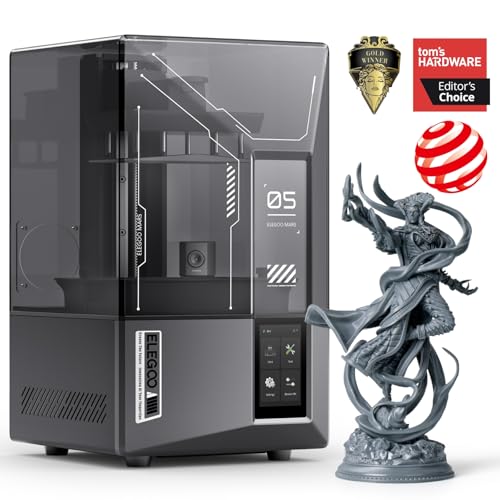
- 9K LCD with 18 μm XY resolution
- Up to 150 mm/h with tilt release
- AI camera and smart monitoring
Best For: Detailed, fast, monitored resin printing
Beginner-Friendly Detail

- 7-inch 10K LCD with 17 μm pixels
- Uniform LighTurbo light source
- Simple four-point leveling
Best For: Accessible high-detail printing for beginners
Complete Large-Format Bundle

- 16K printer with large build volume
- Up to 150 mm/h printing speed
- Includes 7.5 L wash and cure station
Best For: Larger projects with an integrated post-processing workflow
High-Speed Automation

- 14K detail with 16.8 × 24.8 μm XY resolution
- Up to 170 mm/h with high-speed resin
- Auto-fill and six detection systems
Best For: Fast, precise, repeat resin printing
Best Overall Detail

- 10-inch 12K LCD for intricate details
- Auto-leveling and self-check features
- Consistent COB and Fresnel light system
Best For: Detailed models and convenient resin printing
Best for Speed

- Up to 120 mm/h maximum print speed
- 10K screen with 17 μm XY pixels
- Five intelligent inspection features
Best For: Fast, detailed prints with automated monitoring
Best for Beginners

- Factory pre-leveled platform simplifies setup
- 9K LCD with 18 μm XY resolution
- USB, Wi-Fi, and Creality Cloud support
Best For: New users, miniatures, and compact desktop printing
Fast Detail Specialist

- Up to 150mm/h printing
- 16K LCD with 14×19μm XY resolution
- AI camera and heated resin tray
Best For: Detailed, frequent printing with automated monitoring
Easy-Setup Choice
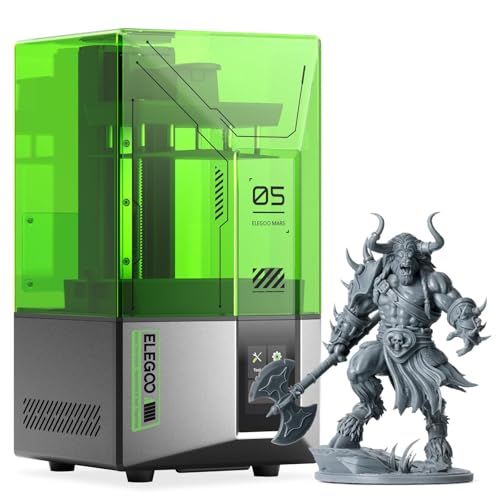
- One-click automatic leveling
- 4K mono LCD with COB light source
- Residue detection and self-checks
Best For: Beginners and hobbyists wanting simpler setup
Fast Precision Pick – ELEGOO Mars 5 Ultra
For resin printers that combine fine detail with speed, the ELEGOO Mars 5 Ultra pairs a 9K monochrome LCD and 18 μm XY resolution with tilt-release printing up to 150 mm/h. Its AI camera and smart sensors also add practical monitoring for everyday projects.
Best For: Makers who want detailed prints, fast production, and automated failure monitoring.
Pros:
- 9K resolution and 18 μm XY resolution support highly detailed models.
- Tilt-release technology enables printing speeds up to 150 mm/h.
- AI camera can detect errors, while sensors monitor residue, resin shortages, and leveling failures.
- Wi-Fi cluster printing supports control of multiple compatible printers.
Cons:
- AI detection results can vary with the environment, model, and resin type.
- The feature-rich design may be more than beginners need.
The Mars 5 Ultra is a strong all-around choice when productivity matters as much as surface detail. Its monitoring and connectivity features are especially useful for repeat printing or multiple-printer workflows.
Beginner-Friendly Detail – ANYCUBIC Photon Mono 4
The ANYCUBIC Photon Mono 4 is one of the more approachable resin printers for detailed everyday work. Its 7-inch 10K LCD, uniform LighTurbo illumination, and straightforward four-point leveling make it practical for newcomers and routine projects.
Best For: Beginners and hobbyists who want high-resolution prints with simple setup.
Pros:
- 10K resolution and 17 × 17 μm pixels capture fine model detail.
- LighTurbo lighting helps reduce layer lines and rasterization.
- Build volume measures 153.4 × 87 × 165 mm for varied projects.
- Four-point leveling does not need repeating after the initial setup, and printing can resume after power restoration.
Cons:
- The Anycubic app service is not supported.
- It lacks the larger build volume and advanced automation of higher-end options.
Choose the Photon Mono 4 if ease of use and precise detail are higher priorities than premium automation. Its repeatable leveling process and recovery feature help reduce common setup and interruption hassles.
Complete Large-Format Bundle – ELEGOO Saturn 4 Ultra
ELEGOO Saturn 4 Ultra 16K Resin 3D Printer and ELEGOO Mercury Plus V3.0 Wash and Cure Station
Check Price On AmazonThis ELEGOO bundle combines a Saturn 4 Ultra 16K resin printer with a Mercury Plus V3.0 wash and cure station. The printer offers a large 8.33 × 4.66 × 8.66-inch build area, smart tank heating, and speeds up to 150 mm/h, while the station adds a 7.5-liter cleaning and curing capacity.
Best For: Users who want a large-format resin printing setup with washing and curing included.
Pros:
- 16K resin printer targets highly detailed output.
- Large build volume accommodates bigger models or more pieces per batch.
- Smart tank heating maintains the resin at 30°C.
- Mercury Plus V3.0 provides 7.5-liter wash and cure capacity and supports multiple printer families.
Cons:
- The larger printer-and-station bundle requires more workspace.
- The supplied notes do not specify additional automated monitoring features.
This is a convenient choice for buyers building a complete post-processing workflow rather than purchasing accessories separately. Its large format and included wash-and-cure station suit substantial projects and higher-volume work.
High-Speed Automation – ANYCUBIC Photon Mono M7 Pro
Among resin printers designed for productivity, the ANYCUBIC Photon Mono M7 Pro stands out with 14K detail, speeds up to 170 mm/h using high-speed resin, and automated resin handling. Temperature control and multiple detection systems further simplify repeated printing.
Best For: Experienced makers and production-minded users who prioritize speed, precision, and automation.
Pros:
- 14K resolution with 16.8 × 24.8 μm XY resolution can reproduce very fine features.
- Prints up to 170 mm/h with high-speed resin and 130 mm/h with standard resin.
- Temperature-controlled vat and automatic resin filling support consistent operation.
- Six intelligent detection functions include residue, resin level, failed print, and build plate installation checks.
Cons:
- Its advanced feature set may be unnecessary for occasional hobby printing.
- Peak speed depends on using high-speed resin and the stated test conditions.
The M7 Pro is a compelling productivity-focused option for users willing to pay for automated safeguards and resin management. It balances fine resolution with unusually high claimed speed for efficient repeat workflows.
Best Overall Detail – ELEGOO Saturn 4 12K
For shoppers comparing resin printers, the ELEGOO Saturn 4 stands out with a 10-inch 12K monochrome LCD and a 19 × 24 μm XY resolution. Its auto-leveling, self-check features, and print-restart support make high-detail printing more approachable.
Best For: Detailed models and users who want a large, largely automated resin-printing setup.
Pros:
- 12K resolution supports highly detailed models.
- Self-check and automatic leveling simplify setup.
- COB lighting with a Fresnel lens provides consistent exposure.
- Quick-release plate, flip-up lid, and spill-conscious resin tray improve handling.
Cons:
- Its 29.7-pound weight makes it less convenient to move.
- The larger printer footprint may require substantial desk space.
The Saturn 4 is a strong choice when fine detail and convenience matter more than portability. Failure detection for foreign objects, resin shortages, and leveling issues adds useful protection during routine printing.
Best for Speed – ANYCUBIC Photon Mono 4 Ultra
The ANYCUBIC Photon Mono 4 Ultra is a compelling resin printer for makers who value speed without giving up fine detail. Its 10K monochrome screen, ACF film, and Intelligent Release Algorithm support fast printing with smooth release and consistent layer exposure.
Best For: Users seeking fast, high-resolution printing with extensive automated monitoring.
Pros:
- Print speeds can reach up to 120 mm/h.
- 10K resolution and 17 × 17 μm pixels support detailed models.
- Five intelligent inspections help identify operational and print issues.
- Eight-language interface and redesigned UI support easier operation.
Cons:
- Its 7-inch screen offers less display area than larger-format resin printers.
- It weighs only 8.8 pounds, but the supplied notes do not specify automatic leveling.
Choose the Photon Mono 4 Ultra if faster workflows and automated checks are priorities. Its light uniformity system and precision hardware are designed to help maintain dimensional consistency across printed layers.
Best for Beginners – Creality HALOT-X1 Neo
The Creality HALOT-X1 Neo is one of the more approachable resin printers for new users, thanks to its factory pre-leveled build platform and beginner tutorials. It also adds Wi-Fi, USB, Creality Cloud support, and AI-powered 2D-to-3D model generation for a flexible creative workflow.
Best For: Beginners, tabletop gamers, miniature creators, and DIY users who want a compact desktop printer.
Pros:
- Pre-leveled platform supports a plug-and-play setup.
- 9K resolution and 18 μm XY pixels capture fine model details.
- Files can be transferred by USB, 2.4GHz Wi-Fi, or Creality Cloud.
- AI 2D-to-3D generation can create models from images.
Cons:
- Its 153.36 × 77.76 × 160 mm build volume is geared toward smaller models.
- The AI-generated model workflow can take as long as 3.5 hours.
The HALOT-X1 Neo makes a practical entry point for resin printing, especially for users producing miniatures and figurines. Its compact design, pre-leveled platform, and broad slicing compatibility reduce setup friction while preserving high-resolution output.
Fast Detail Specialist – Saturn 4 Ultra 16K
For resin printers that prioritize both speed and fine detail, the ELEGOO Saturn 4 Ultra 16K combines tilt-release technology with a 16K mono LCD. Its automated monitoring and resin-temperature controls make it a strong option for demanding prints.
Best For: Detailed models, frequent printing, and users who want fast operation with automated safeguards.
Pros:
- Prints at speeds up to 150mm/h with fast and slow modes.
- 16K resolution, 14×19μm XY resolution, and 92% COB light uniformity support detailed prints.
- Smart sensors, power-loss recovery, and an AI camera help monitor print issues.
- Built-in heating maintains resin at approximately 25°C.
Cons:
- Its 40.7-pound weight and larger footprint may require a dedicated workspace.
- The advanced features may be more than casual users need.
The Saturn 4 Ultra 16K is a feature-rich choice when print speed, resolution, and automated oversight matter more than compact size.
Large-Format Workhorse – Photon Mono M7 Max
Among resin printers built for oversized projects, the ANYCUBIC Photon Mono M7 MAX stands out for its 298mm × 164mm × 300mm build volume. Its large vat, resin auto-fill, and temperature management are designed to simplify extended print jobs.
Best For: Full-size masks, cosplay props, game terrain, and other large models that would otherwise require assembly.
Pros:
- Large build volume supports full-size models and props.
- LightTurbo 3.0 provides over 90% light uniformity and a factory-calibrated light angle.
- Dynamic resin temperature control and automatic filling support more convenient printing.
- 1300ml resin vat and a one-hand flip-open cover suit large projects.
Cons:
- At 52.8 pounds, it is the heaviest and least portable option in this group.
- Its large dimensions require substantial workspace.
- Its maximum speed is 60mm/h, lower than the fastest printer listed here.
The Photon Mono M7 MAX is best selected for capacity: it minimizes splitting and assembly when your projects need a genuinely large print area.
Easy-Setup Choice – ELEGOO Mars 5
For shoppers seeking approachable resin printers, the ELEGOO Mars 5 emphasizes simple setup and dependable checks. One-click automatic leveling, self-checks, and residue detection reduce the routine work involved before printing.
Best For: Beginners and hobbyists who want a compact resin printer with automatic setup and safety features.
Pros:
- One-click automatic leveling simplifies initial setup.
- Smart mechanical sensing detects residue, resin shortages, and leveling failures.
- A one-click self-check helps verify components before printing.
- 4K mono LCD and COB lighting support detailed models.
Cons:
- It lacks the larger build capacity of the Photon Mono M7 MAX.
- It does not offer the 16K resolution or 150mm/h speed specified for the Saturn 4 Ultra.
The Mars 5 is a practical entry point for users who value straightforward operation, print checks, and a lighter, more compact machine.
How We Picked the Best Resin Printers
We organized this selection around the features that have the greatest effect on real-world resin printing: LCD resolution, XY pixel size, print speed, build volume, leveling design, connectivity, ventilation-related considerations, and included accessories. The list includes compact models for miniatures and display pieces, mid-size printers for general hobby use, and larger machines for bigger parts or batch production.
Marketing specifications are useful, but they do not tell the whole story. A high-resolution screen can improve detail, while dependable leveling, consistent exposure, software support, and a manageable workflow often matter more for successful prints. Bundled wash-and-cure equipment can also improve value by reducing the number of separate purchases.
Quick Comparison
Use the individual product sections above to compare each printer’s screen resolution, build area, speed, included equipment, and standout features. As a general guide, Mars models are compact and approachable; Saturn models provide more workspace; Photon Mono options cover a broad range of prices and capabilities; and the HALOT-X1 Neo and Photon Mono M7 MAX are aimed at shoppers who want specialized features or a larger format.
Key Buying Factors for Resin Printers
Resolution and Detail
Higher 10K, 12K, or 16K ratings can produce sharper edges and finer surface detail, especially on miniatures and small models. However, screen resolution should be considered alongside XY resolution, optics, exposure consistency, resin quality, and slicing settings.
Build Volume
Check the build dimensions rather than relying on the printer’s name. A compact printer may be ideal for miniatures and prototypes, while a Saturn-class or large-format machine is better for helmets, larger figures, multiple parts, or batch printing. More volume also means greater resin consumption and a larger footprint.
Speed and Reliability
Advertised speed is usually a maximum under specific conditions. Actual results depend on layer height, resin type, exposure settings, lift speeds, and model geometry. Features such as automatic leveling, a rigid build platform, reliable release behavior, and print monitoring can be more valuable than maximum speed alone.
Workflow and Safety
Resin printing requires gloves, suitable ventilation, careful handling, washing, curing, and responsible disposal of uncured resin. Confirm that you have room for the printer, wash-and-cure equipment, cleaning supplies, and sealed storage. Wi-Fi, USB support, failure detection, and compatible slicer software can make routine operation easier.
Who Should Buy Which Resin Printers?
First-time hobbyists: Choose a compact, easy-to-level model with straightforward controls and a reasonable accessory budget.
Miniature and detail-focused makers: Prioritize high resolution, stable exposure, and dependable dimensional consistency over maximum build size.
Families of parts or larger models: Consider a Saturn-class or large-format printer, provided your workspace can accommodate it and you are prepared for higher resin usage.
Speed-focused users: Look for a fast model with reliable leveling, suitable resins, and strong monitoring features rather than judging speed from the headline number alone.
Value shoppers: Compare the complete setup cost, including a wash-and-cure station, resin, replacement films, gloves, cleaning materials, and ventilation. The cheapest printer is not always the least expensive way to start.