Finding the right synthesizer for recording means balancing sound quality, workflow, portability, and connectivity. The best choice for your studio depends on whether you need hands-on sound design, quick songwriting, or a compact instrument that fits a mobile setup.
In this roundup, we focused on synthesizers for recording that make it easier to capture ideas fast, layer parts cleanly, and stay productive in a home studio or on the go.
Best 10 Synthesizers for Recording Picks for 2026
Analog Studio Mono

- Classic Moog sound with modern enhancements
- 32-key semi-weighted keyboard with aftertouch
- 64-step sequencer and 256 presets
Best For: Players recording bass, leads, and expressive mono parts
Portable Chord Writer

- 100 chord sets and 64 user patterns
- JUNO-60-inspired four-voice synth engine
- USB-C audio/MIDI plus sync and AIRA Link
Best For: Writing chord progressions and quick song sketches
Experimental Hybrid
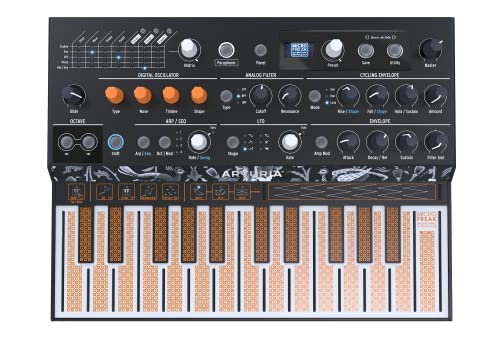
- 17 oscillator modes from multiple synthesis types
- Analog filter with poly-aftertouch touch plate
- Spice and Dice sequencing for evolving parts
Best For: Sound design, textures, and unconventional recorded synth lines
Classic Roland Module

- JD-800 sound modeled in a small tabletop unit
- 108 waveforms with original and new presets
- Two-part sequencer with motion recording and effects
Best For: Layered pads, digital textures, and studio sequencing
Portable Beatmaker Pick
Akai MPK Mini Play MK3 for Recording

- Built-in speaker plus onboard sounds for standalone sketching
- 25 keys, 8 pads, and 4 knobs for hands-on control
- Includes arpeggiator, note repeat, and software bundle
Best For: Beat makers and songwriters who want a portable controller with onboard sounds
Full-Size Synth Workhorse
Yamaha MX49 Music Production Synthesizer

- Class-compliant USB audio/MIDI for plug-and-play recording
- Motif engine with layer, zone, switch, and randomize controls
- 128-note polyphony for cleaner layered parts
Best For: Players who want a hardware synth for recording with simple USB connectivity
Modern Controller Choice
Arturia MiniLab 3 for Recording

- 25 velocity-sensitive keys in a compact layout
- 8 pads and 4 faders for beat and track control
- USB-C controller compatible with Ableton Live
Best For: Laptop-based producers who want a small, hands-on controller for recording workflows
Pocket Retro Synth
Stylophone Original Pocket Electronic Synthesizer

- Pocket-size stylus synth with an iconic retro sound
- Built-in speaker, headphone socket, and battery power
- Computer connection supports recording and sound manipulation
Best For: Beginners and mobile players who want a tiny synth for sketching recording ideas
Studio Workhorse
Yamaha MX49 Music Production Synthesizer

- Class-compliant USB audio/MIDI simplifies recording setup
- Motif sound engine supports layered and flexible sounds
- 128-note polyphony and multi-track USB capture for studio use
Best For: Home-studio users who want easy USB recording and versatile sounds
Portable FM Creator
M-VAVE Wireless Portable FM Synthesizer
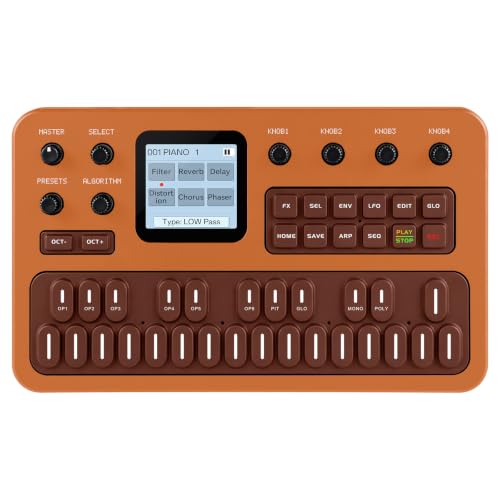
- Battery-powered with built-in speaker for mobile use
- 6 operators, 32 algorithms, and 128 presets
- Includes effects, arpeggiator, sequencer, and multiple MIDI options
Best For: Portable FM sound design and recording sketches on the go
Analog Studio Mono – Portable Analog Mono Synth
If you want synthesizers for recording with a classic analog character, the MOOG Messenger is built for dependable mono parts, bass lines, and leads. It pairs Moog’s familiar knob-per-function workflow with modern features like presets, sequencer automation, and flexible connectivity, making it easy to drop into a studio setup.
Best For: Producers and musicians who want a portable Moog monosynth for bass, leads, and hands-on studio sound design.
Pros:
- Two continuously variable-shape VCOs with sync, FM, and a sub-oscillator for strong low end
- Next-gen ladder filter with 4- or 2-pole low-pass, band-pass, and high-pass modes
- 32 full-size semi-weighted keys with velocity and aftertouch for expressive playing
- 64-step sequencer, arpeggiator, and 256 presets for recording-ready workflow
Cons:
- Monophonic design limits it to single-note lines rather than chords
- Larger and heavier than compact desktop options
- Best suited to players who specifically want an analog mono synth
The Messenger is a strong choice if you want Moog tone and tactile control in a modern studio instrument. It is especially appealing for parts that need weight, movement, and easy real-time shaping during recording.
Portable Chord Writer – Portable Chord Synth Machine
The Roland AIRA Compact J-6 is one of the more compact synthesizers for recording ideas quickly, especially if you want chords, patterns, and polished sounds in a travel-friendly format. Its JUNO-60-based engine, chord library, and built-in effects make it useful for songwriting and laying down harmonic backing parts.
Best For: Songwriters and producers who want a portable chord-based synth for fast idea capture and backing progressions.
Pros:
- 100 chord sets and 64 user patterns for quick song creation
- Authentic JUNO-60 synth engine with 64 presets
- Real-time filter and envelope controls for shaping sounds during playback
- USB-C audio and MIDI interface plus audio, MIDI, sync, and AIRA Link connectivity
Cons:
- Focuses on chord and pattern creation rather than deep synth editing
- Four-voice engine is limited compared with larger instruments
- Compact format may feel restrictive for players who want a full keyboard
The J-6 is a practical pick when you need a small, self-contained writing tool that can feed a recording session with chords, arpeggios, and ready-to-use tones. It’s more about fast musical sketching than complex sound design.
Experimental Hybrid – Experimental Hybrid Synth
If you want synthesizers for recording that can move from classic textures to strange new sounds, the Arturia MicroFreak stands out as a compact hybrid instrument. Its mix of digital oscillator modes, analog filtering, modulation tools, and sequencing features makes it a flexible option for sound design-heavy sessions.
Best For: Producers who want a compact experimental synth for unique timbres, modulation, and evolving recorded parts.
Pros:
- 17 oscillator modes, including physical modeling, wavetable, and other experimental engines
- Resonant analog filter for hybrid sound shaping
- Poly-aftertouch touch-plate keyboard for expressive control
- Spice and Dice sequencing plus randomization for evolving patterns
Cons:
- Touch-plate keyboard is very different from a traditional keybed
- Best suited to players comfortable with a more experimental workflow
- Compact design can be less immediate than larger performance synths
The MicroFreak is a strong studio wildcard when you need unusual tones, evolving sequences, and fast experimentation. It shines most when recording parts that benefit from character and motion rather than standard subtractive sounds.
Classic Roland Module – Compact JD-800 Sound Module
The Roland JD-08 is a compact option among synthesizers for recording if you want the character of the JD-800 in a small tabletop module. It offers a wide palette of original waveforms, layered structure, and detailed effects, which makes it useful for polished pads, textures, and synth parts in a studio workflow.
Best For: Producers who want a compact JD-800-style module for layered sounds, pads, and detailed sequencing.
Pros:
- Authentic JD-800 sound and behavior with advanced sound modeling
- 108 original waveforms plus original and new presets
- Two-part polyphonic sequencer with motion recording and 128 pattern memory
- Detailed multi-effects section including distortion, phaser, chorus, delay, and reverb
Cons:
- K-25M keyboard is sold separately
- Module format is less immediate than an all-in-one keyboard synth
- Best for players who want the JD-800 style rather than a broad modern synth engine
The JD-08 makes sense if you want a compact sound module with classic Roland digital character and deep patch potential. It is especially appealing for recording layered parts and sequenced ideas without needing a full-size instrument.
Portable Beatmaker Pick – Akai MPK Mini Play MK3 for Recording
If you want synthesizers for recording in a compact, travel-friendly format, the Akai Professional MPK Mini Play MK3 blends a mini keyboard controller with built-in sounds and USB MIDI control. It gives you a quick way to sketch melodies, drum patterns, and synth ideas without needing a full studio setup.
Best For: Beat makers, songwriters, and players who want a portable controller with onboard sounds for fast recording ideas.
Pros:
- Built-in speaker and 100 internal sounds let you create without an immediate computer connection.
- 25 velocity-sensitive mini keys, 8 MPC pads, and 4 knobs support hands-on recording and beat building.
- Includes arpeggiator, note repeat, and software extras like MPC Beats and AIR instruments.
- NKS integration adds control access to Native Instruments sound libraries and presets.
Cons:
- Mini keys may feel limiting if you prefer a larger keyboard for performance parts.
- Battery power requires batteries, which are not included.
For portable songwriting and quick recording sessions, this is a flexible all-in-one option that keeps the setup simple. It is especially appealing if you want onboard sounds for sketching ideas before moving into your DAW.
Full-Size Synth Workhorse – Yamaha MX49 Music Production Synthesizer
For synth-focused recording, the Yamaha MX49 Music Production Synthesizer gives you a straightforward 49-key layout with class-compliant USB audio/MIDI and a deep Motif-based sound engine. It is built for plug-and-play recording, letting you capture stereo audio and MIDI over a single USB cable.
Best For: Players who want a hardware synthesizer for recording with simple USB connectivity and full-size range.
Pros:
- Class-compliant USB audio/MIDI supports plug-and-play recording without driver installation.
- Motif sound engine offers layer, zone, switch, cycle, and randomize controls across up to 8 elements.
- 128-note polyphony helps keep parts clean in live playing and 16-track sequences.
- Single-cable stereo audio and 16-channel MIDI recording keeps the setup streamlined.
Cons:
- It is more of a production synth than an all-in-one controller with pads and performance extras.
- The supplied notes do not include bundled software or a large accessory package.
This is a practical choice if your priority is a reliable synth keyboard that records directly into your computer with minimal friction. It suits musicians who value sound engine depth and a more traditional 49-key feel.
Modern Controller Choice – Arturia MiniLab 3 for Recording
If you are shopping synthesizers for recording and want a compact controller to shape parts inside your DAW, the Arturia MiniLab 3 focuses on workflow. Its 25 velocity-sensitive keys, 8 pads, and 4 faders make it easy to control instruments, mute tracks, and trigger drums without reaching for the mouse.
Best For: Laptop-based producers and tablet or smartphone users who want a small, hands-on controller for recording workflows.
Pros:
- 25 velocity-sensitive keys give you a compact playing surface for recording ideas.
- 8 multi-color pads and 4 faders support beat programming and track control.
- USB-C connection keeps the setup modern and simple.
- Works with Ableton Live and is listed as compatible with laptops, PCs, tablets, and smartphones.
Cons:
- No onboard sounds, so it depends on connected software instruments for synthesis.
- Smaller key count may not suit players who want a wider performance range.
MiniLab 3 is best viewed as a streamlined recording controller rather than a standalone synth. If your production revolves around software instruments and fast hands-on control, it fits that role well.
Pocket Retro Synth – Stylophone Original Pocket Electronic Synthesizer
If you want one of the most portable synthesizers for recording ideas fast, the Stylophone is a fun, compact option with a distinctive analog-style sound. Its stylus-driven metal surface makes it easy to sketch melodies, and the headphone socket plus computer connection let you move from quick practice to simple home capture.
Best For: Beginners, mobile musicians, and anyone who wants a tiny retro synth for sketching parts and recording quirky sounds.
Pros:
- Iconic pocket-size synth with a warm, vintage, retro organ-like sound
- Easy stylus control over a touch-sensitive metal surface with 3 octaves
- Built-in speaker and headphone socket for private play or portable use
- Can connect to a computer via 3.5mm stereo cable for recording and sound manipulation
Cons:
- Very small format is better for simple lines than full keyboard-style performance
- Runs on 3 AA batteries, so it is not a plug-in studio centerpiece
For recording-friendly experimentation, the Stylophone stands out as a low-friction way to add characterful synth lines without taking up much space. It is less about deep programming and more about immediate, distinctive sounds that are easy to capture.
Studio Workhorse – Yamaha MX49 Music Production Synthesizer
The Yamaha MX49 is a practical choice if you need synthesizers for recording with real plug-and-play connectivity. Its class-compliant USB audio/MIDI support, Motif-based sound engine, and 128-note polyphony make it well suited for writing, layering, and capturing parts without fighting your setup.
Best For: Home-studio musicians, keyboard players, and producers who want a versatile synth-controller with easy USB recording.
Pros:
- Class-compliant USB audio/MIDI for direct computer connection without drivers
- Motif sound engine with layer, zone, switch, cycle, randomize, and control options
- 128-note polyphony helps prevent dropouts in live parts or full sequences
- Can record and play back stereo audio and 16 channels of MIDI over a single USB cable
Cons:
- More studio-focused than ultra-portable options
- Does not emphasize onboard speakers or battery operation
For recording workflows, the MX49 offers the kind of straightforward integration that makes it easy to move from playing to tracking. It is a solid middle ground between a performance keyboard and a production-ready synth controller.
Portable FM Creator – M-VAVE Wireless Portable FM Synthesizer
If you want a compact option among synthesizers for recording, the M-VAVE focuses on portable FM sound creation with plenty of built-in tools. With battery power, a speaker, multiple MIDI options, and onboard sequencing, it is designed for making and capturing ideas wherever inspiration hits.
Best For: Portable creators, FM sound fans, and players who want an all-in-one sketchpad with sequencing and MIDI flexibility.
Pros:
- Fully portable with battery operation and a built-in speaker
- 6 operators, 32 algorithms, and 128 factory presets for classic FM tones
- Includes 6 built-in effects plus arpeggiator and 16-step sequencer
- Three MIDI options: USB MIDI, wireless Bluetooth MIDI, and 3.5mm MIDI IN
Cons:
- Compact silicone-key layout may feel less traditional than a full-size keyboard
- Best suited to FM-focused workflows rather than general-purpose synth use
This is a versatile pocket synth for creating quick parts, dialing in FM textures, and syncing into a broader recording setup. If portability and hands-on sound design matter most, it offers a lot in a very small package.
How We Picked These Synthesizers for Recording
We looked for instruments that offer practical value for recording sessions: reliable sound generation, useful patch or preset libraries, performance-friendly controls, and connectivity that works with modern studio setups. Portability, power options, and recording workflow mattered too, especially for creators who move between rooms, rigs, or travel setups.
Quick Comparison: What Matters Most
Some synthesizers are better for direct inspiration and songwriting, while others are more useful as sound-design tools or MIDI controllers. If you want fast results, favor preset-rich or sequence-friendly models. If you want more original tones, look for deeper synthesis engines, onboard controls, and stronger editing options. For minimal setups, smaller units can still work well as Synthesizers for Recording if they connect cleanly to your interface or DAW.
Key Buying Factors for Synthesizers for Recording
Sound Character
Choose a synth whose core tone fits your music. Analog-style instruments often suit basses, leads, and warmth, while digital and hybrid designs can offer broader textures, modern effects, and more experimental sounds.
Recording Workflow
Look for features that speed up session work, such as easy preset access, sequencers, arpeggiators, chord modes, or hands-on knobs. These help you build parts quickly without interrupting creativity.
Connectivity
For recording, USB MIDI, standard MIDI, and audio outputs are important. If you plan to track directly into a DAW or interface, confirm whether the synth can send audio, MIDI, or both in the way you need.
Portability and Power
Battery power, built-in speakers, and compact dimensions are useful for mobile producers. Desktop and keyboard synths may offer a better playing experience, but they take up more space in a studio.
Keys, Controls, and Playability
If you perform or write parts by hand, check key size, velocity sensitivity, and control layout. Smaller controllers can be excellent for programming and sketching, but full-size keys may feel better for expressive recording.
Who Should Buy Which Synthesizers for Recording?
Producers who want a dedicated sound source should lean toward full-featured synths with strong tone and editing depth. Songwriters who prioritize speed may prefer compact portable units with patterns, chords, or built-in sounds. Beginners and DAW users may get more mileage from controller-style options that integrate easily into a recording setup.
If your goal is to build tracks efficiently, the best Synthesizers for Recording are the ones that match your workflow as closely as they match your sound preferences. Prioritize usability first, then choose the synth that inspires you to keep creating.