If you want bass that stays tight, fast, and controlled, sealed subwoofers are a smart place to start. They’re often the better choice for music listeners and home theater setups that need accuracy more than sheer boom.
In this roundup, we’ve focused on models that offer strong output, useful room-friendly sizing, and the kind of performance buyers can actually match to their space.
Best 10 Sealed Subwoofers Picks for 2026
Reference-Grade Bass

- 12-inch sealed design with strong, accurate output
- 325W RMS amp with 820+W peak power
- App control plus 50MHz DSP tuning
Best For: Compact home theater and music setups needing precise sealed bass
Budget Bass Starter
- 10-inch powered sub for small-to-mid rooms
- 50-watt RMS amp, up to 100 watts peak
- Easy integration with crossover and level inputs
Best For: Affordable added bass for simple home theater setups
Ultra-Compact Deep Bass

- Dual 8-inch drivers in a very small cabinet
- 800W RMS and 2,500+W peak power
- App-based DSP with EQ, crossover, and polarity control
Best For: Compact premium systems needing powerful sealed bass
Small-Room Sealed Pick

- Sealed 8-inch sub with quick, accurate bass response
- Compact 11-inch footprint for tight spaces
- High-pass filter and phase switch aid setup
Best For: Small rooms, desktops, and minimalist setups
Reference-Grade Compact Bass

- 550W RMS, 1,500W peak output
- 12-inch sealed design for controlled bass
- DSP smartphone app for tuning
Best For: Compact home theater and music setups needing accurate sealed bass
Deep-Extension Large Bass

- 15-inch sealed cabinet for control
- Rated down to 14 Hz with 475W RMS
- RCA and XLR inputs with tuning controls
Best For: Large home theater systems that need deep, physical bass
High-Power Smart Bass

- 13-inch driver with up to 4,000W output
- Advanced DSP with auto room EQ
- App control for setup and tuning
Best For: Premium systems needing high output and room-corrected sealed bass
Compact sealed subwoofer for small rooms

- 8-inch sealed cabinet fits small spaces
- 300W Class D amp with DSP app control
- Bass reaches down to 34Hz with iBX
Best For: Small rooms, apartments, and neat system integration
High-output sealed home theater subwoofer

- 12-inch sealed cabinet with 325W RMS
- DSP smartphone app for tuning and presets
- High-excursion driver for accurate bass
Best For: Home theater and music systems needing controlled, powerful bass
Compact desktop-friendly sealed subwoofer

- 8-inch sealed design for quick response
- 11-inch footprint fits desks and small rooms
- High-pass filter and phase switch aid setup
Best For: Desktop setups and small rooms that need compact, accurate bass
Reference-Grade Bass – SVS SB-1000 Pro 12-Inch
SVS SB-1000 Pro Subwoofer (Black Ash) | 12-in Driver, 325 Watt RMS, Sealed Cabinet
Check Price On AmazonIf you want sealed subwoofers that prioritize control, depth, and flexibility, the SVS SB-1000 Pro is built for serious home audio. Its 12-inch driver, 325-watt RMS amplifier, and app-based DSP tuning make it a strong fit for rooms where clean bass matters more than sheer size.
Best For: Home theater or music setups that need compact, accurate sealed bass with app control.
Pros:
- 12-inch high-excursion driver delivers strong output with finesse and accuracy.
- 325W RMS / 820+W peak Sledge amplifier provides substantial power and control.
- 50MHz DSP and smartphone app make tuning and preset management easy.
- Rigid sealed cabinet design helps keep resonance low in a compact footprint.
Cons:
- Wired connectivity may be less flexible than some wireless setups.
- At 13″ x 14.76″ x 13.5″, it is compact but not ultra-small.
The SB-1000 Pro stands out if you want the tighter response associated with sealed subwoofers and also want modern control features. It is a strong all-around pick for users who value precision, customization, and a room-friendly size.
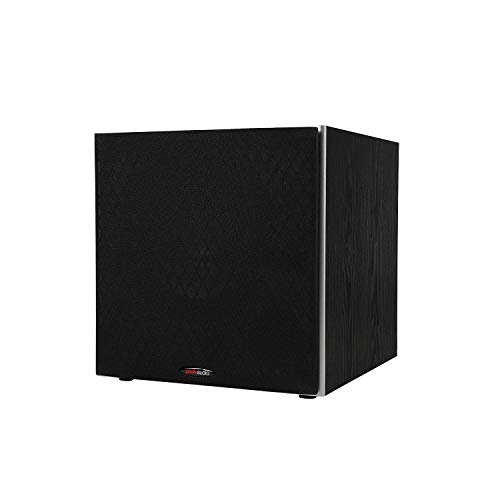
Budget Bass Starter – Polk PSW10 10-Inch
The Polk Audio PSW10 is a practical entry point if you are shopping sealed subwoofers-adjacent performance in a simple, affordable powered subwoofer. It uses a 10-inch Dynamic Balance woofer and a 50-watt RMS amp to add bass and punch to small-to-mid size rooms without complicating setup.
Best For: Budget-conscious buyers adding straightforward bass to a small or medium home theater.
Pros:
- 10-inch woofer with directed port is designed for accurate bass depth.
- 50-watt RMS amp, rated up to 100 watts, gives a basic powered boost.
- Continuously variable crossover helps it integrate with existing systems.
- Speaker-level and line-level inputs make hookup flexible.
Cons:
- It is a ported design, not a sealed subwoofer.
- Power and frequency response are modest compared with premium models.
This is a sensible choice if you want an inexpensive sub that is easy to connect and suitable for everyday movie and music use. It will not match the refinement or output of higher-end sealed subwoofers, but it covers the basics well.
Ultra-Compact Deep Bass – SVS 3000 Micro
For buyers who want sealed subwoofers performance in a very small cabinet, the SVS 3000 Micro is a standout. Its dual opposing 8-inch drivers, 800-watt RMS amplifier, and app-controlled DSP give it serious output and tuning flexibility in a compact design.
Best For: Small rooms and premium setups where compact size and powerful sealed bass are both priorities.
Pros:
- Active dual opposing 8-inch drivers deliver strong slam in a tiny footprint.
- 800W RMS and 2,500+W peak power provide substantial headroom.
- DSP app allows control over crossover, EQ, polarity, and room gain.
- Sealed cabinet with rigid bracing helps keep performance clean and controlled.
Cons:
- Premium feature set likely puts it above entry-level budgets.
- Wired subwoofer connectivity may not suit every installation style.
The 3000 Micro is ideal when space is tight but you still want the advantages of a sealed design and strong tuning tools. It is built for users who want high-end bass performance without giving up too much floor space.
Small-Room Sealed Pick – Kanto SUB8VMB 8-Inch
Kanto SUB8VMB Sealed Powered Subwoofer | 300W Peak Power | 8" Woofer | Matte Black
Check Price On AmazonThe Kanto SUB8VMB is aimed at buyers who want sealed subwoofers benefits in a compact, easy-to-place package. With an 8-inch woofer, 300-watt peak power, and a sealed enclosure, it focuses on quick, accurate bass that fits neatly into small rooms, desks, and minimalist setups.
Best For: Small apartments, desktop-friendly systems, and compact setups that need clean bass.
Pros:
- Sealed enclosure is designed for quicker response and low distortion.
- Compact 11-inch footprint fits under desks and in tight spaces.
- Adjustable high-pass filter and phase switch help system integration.
- Simple matte black finish blends easily with other gear.
Cons:
- 8-inch driver and 300W peak power are modest compared with larger subs.
- Best suited to smaller rooms rather than big home theater spaces.
This is a smart option if you want sealed bass behavior without a bulky cabinet. It is especially appealing for smaller living spaces, studios, or gaming setups where placement flexibility matters as much as sound.
Reference-Grade Compact Bass – SVS SB-2000 Pro 12"
If you want sealed subwoofers that deliver tight, controlled bass without giving up strong output, the SVS SB-2000 Pro is built for that role. Its 12-inch driver, 550 watts RMS, and app-based DSP tuning make it a practical fit for home theater or music systems where accuracy matters.
Best For: Listeners who want a compact sealed subwoofer with app control and strong, accurate bass.
Pros:
- 550 watts RMS and 1,500 watts peak power for serious output
- 12-inch high-excursion driver in a sealed design for controlled bass
- SVS DSP smartphone app adds convenient tuning and setup
- Compact cabinet for a sealed subwoofer in a smaller footprint
Cons:
- Wired connectivity only
- Piano gloss finish may not suit every room
- Not designed as a water-resistant model
The SB-2000 Pro is a strong all-around sealed subwoofer choice if you want clean low-end performance and modern control features. It stands out most for users who value precision and app-driven adjustment over the biggest possible cabinet size.
Deep-Extension Large Bass – Starke Sound SW15 15"
Among sealed subwoofers, the Starke Sound SW15 leans hard into deep extension and large-room impact. Its 15-inch glass-fiber driver, 475W RMS amplifier, and rated response down to 14 Hz make it a strong fit when you want low bass that stays controlled rather than loose or boomy.
Best For: Home theater owners who want a powerful sealed subwoofer with very deep low-end reach.
Pros:
- Sealed cabinet for tighter, more controlled bass
- 15-inch glass-fiber driver with 475W RMS amplification
- Frequency response reaches 14 Hz for deep effects
- Flexible RCA and balanced XLR connections with adjustable crossover and phase
Cons:
- Large 15-inch cabinet takes up more floor space
- Wired-only design
- Heavier build at 55 pounds
The SW15 is a good match if your priority is deep, controlled bass for movies and larger audio systems. Its connection options and tuning controls also make it easier to integrate into a serious home theater setup.
High-Power Smart Bass – SVS SB-3000 R|Evolution
If you are comparing sealed subwoofers in the premium tier, the SVS SB-3000 R|Evolution is built around control, power, and room correction. It pairs a high-excursion 13-inch driver with up to 4,000 watts of power and advanced DSP features, including auto room EQ and smartphone app control.
Best For: Buyers who want a premium sealed subwoofer with advanced DSP and high output.
Pros:
- 13-inch high-excursion driver for authoritative bass
- Up to 4,000 watts maximum output power
- Analog Devices DSP with auto room EQ for in-room optimization
- SVS control app simplifies setup and fine-tuning
Cons:
- More premium than entry-level options
- Wired connectivity via coaxial and optical protocols
- May be more subwoofer than smaller rooms need
The SB-3000 R|Evolution is the most feature-rich option here for users who want sealed bass with serious headroom and modern room optimization. It makes sense when performance and adjustment flexibility matter as much as output.
Compact sealed subwoofer for small rooms – KEF Kube 8 MIE
If you want sealed subwoofers that stay compact without giving up control, the KEF Kube 8 MIE is built for smaller spaces and clean integration. Its 8-inch driver, 300W Class D amp, and closed-box cabinet are aimed at tight, musical bass that works well with bookshelf speakers, floorstanders, or a soundbar.
Best For: Apartments, bedrooms, and smaller home theaters where space and bass control both matter.
Pros:
- Compact sealed cabinet is under 12 inches square for easy placement
- MUSIC INTEGRITY ENGINE DSP and iBX are designed for tight, musical bass down to 34Hz
- SmartConnect supports line-level, LFE, and speaker-level inputs for flexible setup
- Room EQ options help tune output for wall or corner placement
Cons:
- 8-inch size is better suited to smaller rooms than big home theaters
- Wireless use requires the optional KEF KW1 adapter kit
Overall, this KEF is a strong pick if you value sealed subwoofers for fast, controlled bass and want a model that blends neatly into a modest room. It focuses more on integration and accuracy than sheer size.
High-output sealed home theater subwoofer – SVS SB-1000 Pro
SVS SB-1000 Pro Subwoofer (Piano Gloss White) | 12-in Driver, 325 Watt RMS, Sealed Cabinet
Check Price On AmazonAmong sealed subwoofers, the SVS SB-1000 Pro stands out if you want serious output with precise control. It pairs a 12-inch high-excursion driver and a 325W RMS Sledge amplifier with DSP tuning, making it a practical choice for home entertainment systems that need deep, controlled bass.
Best For: Movies, music, and mixed-use systems where powerful bass and app-based control are priorities.
Pros:
- 325W RMS and 820+W peak power for strong output
- 12-inch high-excursion driver is built for finesse and accuracy at high levels
- Analog Devices DSP and smartphone app make tuning and presets easy
- Rigid sealed MDF cabinet helps keep resonance under control
Cons:
- Larger 12-inch design takes more space than compact sealed options
- May be more subwoofer than needed for very small rooms
This model is a good fit if you want sealed subwoofers with room-filling capability and modern control features. It leans toward powerful, accurate performance rather than a tiny footprint.
Compact desktop-friendly sealed subwoofer – Kanto SUB8VMW
Kanto SUB8VMW Sealed Powered Subwoofer | 300W Peak Power | 8" Woofer | Matte White
Check Price On AmazonIf you’re shopping sealed subwoofers for a small desk or apartment setup, the Kanto SUB8VMW keeps things simple and compact. Its 8-inch driver, 300W peak power, and sealed enclosure are designed for quick bass response and easy blending with other speakers.
Best For: Desktop systems, small apartments, and users who want straightforward sealed bass in a compact cabinet.
Pros:
- Sealed enclosure is tuned for fast response and low distortion
- Compact 11-inch footprint suits desks and tight spaces
- Adjustable high-pass filter and phase switch help with system integration
- Durable wood cabinet with vinyl finish is built for everyday use
Cons:
- 300W peak power is modest compared with larger home theater subwoofers
- Wired RCA connectivity may limit placement flexibility
The Kanto is a smart choice when you want sealed subwoofers that prioritize accuracy, size, and easy integration over maximum output. It should fit well wherever space is tight and cleaner bass matters more than big-room impact.
How We Picked These Sealed Subwoofers
We prioritized models with a strong reputation for clean low-end performance, practical cabinet sizes, and features that help with real-world setup. That includes amplifier power, driver size, DSP or app control, and overall fit for small, medium, and larger rooms.
We also looked for options that make sense for different buyers, from compact desktop-friendly bass to higher-output choices for movie nights and larger listening spaces.
Quick Comparison
Smaller 8-inch models are usually best when space is tight or when you want bass that blends easily with compact speakers. 10-inch and 12-inch designs tend to offer a more balanced mix of depth and output for most living rooms. Larger models and higher-powered sealed designs are better suited to people who want stronger home theater impact or more headroom at louder volumes.
Key Buying Factors for Sealed Subwoofers
Driver Size and Output
Driver size matters, but it is not the only factor. A well-designed 8-inch sub can outperform a poorly tuned larger unit in a small room. For bigger spaces, 10-inch and 12-inch models usually provide more effortless bass and less strain.
Amplifier Power and Control
More power can help a sub play louder with less distortion, but tuning matters just as much. Look for DSP, phase control, and adjustable crossover settings so you can integrate the sub cleanly with your speakers.
Room Size and Placement
Sealed Subwoofers are often easier to place than ported models because their smaller cabinets can fit closer to walls or inside tighter furniture layouts. Still, placement affects bass response, so leave room to experiment with position.
Music Versus Movies
If you listen mostly to music, prioritize speed, detail, and controlled bass. If you want more cinematic impact, choose a model with enough output and headroom to fill your room without sounding strained.
Who Should Buy Which Sealed Subwoofers?
Choose a compact sealed subwoofer if you need a small footprint for a desktop, office, or apartment system. Step up to a 12-inch model if you want a versatile choice for both music and movies in a typical living room. If you have a larger home theater or want more authority at higher volumes, consider the higher-powered options with advanced tuning features.
In short, the best Sealed Subwoofers are the ones that match your room, your speakers, and how you actually listen. That combination will matter more than chasing the biggest spec on the box.