The best compact portable radios make it easy to follow news, weather, sports, and music without relying on Wi-Fi or a smartphone. The models in this roundup include simple AM/FM designs, shortwave receivers, rechargeable options, and radios with NOAA alerts or Bluetooth.
Use the comparison and buying advice below to narrow your choices by power source, reception, portability, controls, and intended use.
Best 10 Compact Portable Radios Picks for 2026
Classic Everyday Pick

- Large fluorescent tuning dial
- AC or four-AA battery operation
- AM/FM with headphone jack
Best For: Simple home, camping, and outage listening
Most Feature-Rich Option
Rechargeable NOAA Shortwave Radio

- Four-band radio with NOAA alerts
- 1250mAh rechargeable battery and flashlight
- Bluetooth, TF card, and 5W speaker
Best For: Camping, emergency readiness, and media playback
Easy-Read Home Pick

- Large, simple analog tuning dial
- AC adapter or four-AA battery power
- Loud AM/FM speaker with headphone jack
Best For: Seniors, home listening, and outage kits
Best Pocket Shortwave Pick

- Pocket-sized and lightweight
- AM/FM/shortwave reception with DSP
- Simple controls and two-AA operation
Best For: Travel, pocket carry, and shortwave listening
Feature-Rich Home Radio

- FM presets and NOAA weather monitoring
- Bluetooth and microSD audio playback
- Rechargeable battery, alarms, and 8W sound
Best For: Home listeners wanting a versatile rechargeable radio
Ultra-Compact Pocket Pick

- Tiny 0.14-pound pocket-friendly design
- Simple AM/FM tuning with retractable antenna
- Speaker and included earphones
Best For: Portable everyday listening and emergency preparedness
Flexible Analog-Style Radio

- AM, FM, and shortwave reception
- Large speaker with high/low tone selection
- Wall power or four AA batteries
Best For: Home, yard, and emergency multi-band listening
Best Pocket Radio
PRUNUS J-166 Portable AM/FM Radio
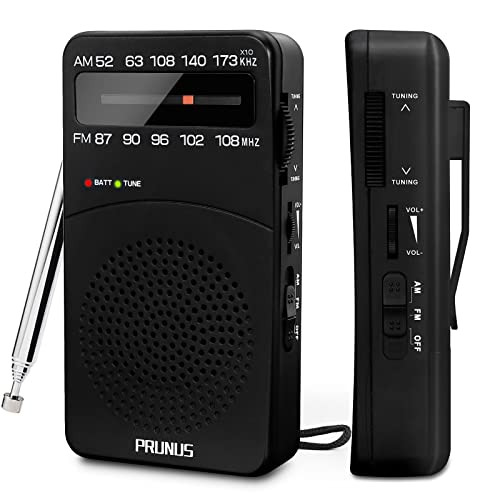
- Pocket-sized 4.2-ounce design
- Clip and lanyard for carrying
- AM/FM, speaker, and earphone output
Best For: Walks, emergency kits, and personal listening
Best Long-Running Radio
PowerBear Portable AM/FM Transistor Radio

- Lightweight 3.4-ounce construction
- Reported 800-plus-hour battery life
- 3.5mm headphone compatibility
Best For: Camping, outages, and emergency preparedness
Best Large-Speaker Radio
PRUNUS J03 AM/FM Portable Radio

- AC or four-AA battery operation
- Large speaker for fuller sound
- Carry handle and easy-read tuning scale
Best For: Home, kitchen, porch, and outdoor listening
Classic Everyday Pick – Panasonic RF-2400-K
Panasonic Portable AM/FM Radio, Battery Operated Analog Radio, AC Powered, Black (RF-2400-K)
Check Price On AmazonThe Panasonic RF-2400-K is a straightforward choice for shoppers seeking compact portable radios with dependable AM/FM listening. Its large tuning dial, fluorescent pointer, and AFC-assisted tuning make it practical for everyday use, while AC or AA-battery power adds flexibility at home or during outages.
Best For: Home use, emergency preparedness, camping, and listeners who prefer simple controls.
Pros:
- Large, easy-to-see dial with a fluorescent pointer.
- Supports both AC power and four AA batteries.
- Includes a 3.5mm headphone connection for private listening.
- Designed for simple AM/FM operation with stable AFC tuning.
Cons:
- Only supports AM and FM bands.
- Uses replaceable batteries rather than a rechargeable battery.
- Not water resistant.
This Panasonic is a sensible pick when ease of use matters more than extra features. It lacks Bluetooth, shortwave, and digital station presets, but its familiar controls and dual-power design suit dependable everyday listening.
Most Feature-Rich Option – Rechargeable NOAA Shortwave Radio
For shoppers wanting compact portable radios with more than basic AM/FM, this rechargeable model combines four-band reception, NOAA weather alerts, Bluetooth, and media playback. A 1250mAh battery, flashlight, back clip, and wrist strap make it especially versatile for travel and emergency use.
Best For: Camping, emergency kits, weather updates, and listeners who also want Bluetooth or TF-card playback.
Pros:
- Receives FM, AM, shortwave, and weather-band broadcasts.
- Built-in 1250mAh rechargeable battery provides a stated 10–12 hours of use.
- Includes NOAA weather alerts and a flashlight.
- Offers Bluetooth, TF-card MP3 playback, a 5W speaker, and headphone output.
Cons:
- More features may mean a steeper learning curve than an analog radio.
- Rechargeable operation depends on access to USB-C charging.
- Not all dimensions or water-resistance details are supplied.
This is the most versatile choice in the group for buyers who want a small radio that doubles as a speaker and emergency tool. Choose it over a basic model if shortwave, weather alerts, and rechargeable convenience are priorities.
Easy-Read Home Pick – DreamSky DS216
The DreamSky DS216 is one of the more approachable compact portable radios for listeners who want clear AM/FM reception and uncomplicated tuning. Its large analog dial, loud speaker, headphone jack, and AC-or-battery operation make it useful around the house or outdoors.
Best For: Seniors, bedside listening, kitchens, yard work, and basic emergency preparedness.
Pros:
- Large analog dial is simple to read and operate.
- Supports wall power with the included adapter or four AA batteries.
- Designed for clear, loud AM/FM audio.
- Includes a headphone jack for quieter listening.
Cons:
- Does not include shortwave, Bluetooth, or rechargeable power.
- Four AA batteries are required but not supplied.
- Not water resistant.
The DS216 is a practical fit for buyers who value familiar controls over advanced functions. Its larger dial and dual-power design are particularly useful for home listeners and anyone assembling a straightforward outage kit.
Best Pocket Shortwave Pick – XHDATA D220
The XHDATA D220 is a genuinely pocket-friendly option among compact portable radios, measuring 125 by 74 by 30 mm and weighing 125 g without batteries. It adds shortwave reception to AM/FM listening while keeping operation simple with three main controls and two AA batteries.
Best For: Pocket carry, travel, shortwave listening, and users who want simple physical controls.
Pros:
- Compact, lightweight design fits a pocket or handbag.
- Receives FM, AM, and shortwave broadcasts.
- DSP chip is designed to improve reception.
- Includes a built-in speaker and 3.5mm headphone jack.
Cons:
- Requires two AA batteries, which are not included.
- Uses a non-digital display without station presets.
- Not water resistant.
The D220 stands out when portability and shortwave access matter more than modern connectivity. Its limited controls are easy to understand, making it a good companion for casual listening, travel, and keeping up with broadcasts away from home.
Feature-Rich Home Radio – Mesqool Portable FM Radio
For shoppers seeking compact portable radios with more than basic station tuning, the Mesqool combines FM listening with Bluetooth, microSD playback, NOAA weather monitoring, and a rechargeable battery. Its color display, presets, alarms, and 8W speaker make it especially practical for everyday use around the home.
Best For: Home listeners who want a rechargeable FM radio with weather alerts, Bluetooth audio, alarms, and room-filling sound.
Pros:
- FM auto scan, up to 40 presets, and NOAA weather-band monitoring
- Bluetooth 5.0 and microSD playback work without Wi-Fi
- 8W speaker, six EQ modes, dual alarms, and sleep timer
- 3000mAh rechargeable battery with USB-C charging
Cons:
- Designed primarily for FM and weather-band listening rather than AM or shortwave
- microSD card is not included
- Larger and heavier than a basic pocket radio
The Mesqool is a versatile choice when a portable radio also needs to serve as a bedside clock, Bluetooth speaker, and weather-information backup. It is best suited to room-to-room use rather than ultra-light pocket carry.
Ultra-Compact Pocket Pick – PRUNUS J-777 AM/FM Radio
The PRUNUS J-777 is one of the most compact portable radios for simple AM/FM listening. It runs on two AAA batteries, uses straightforward physical controls, and includes both a built-in speaker and earphones for private listening while walking, camping, or keeping up with broadcasts during an outage.
Best For: Walkers, campers, seniors, and anyone who wants a lightweight, easy-to-operate AM/FM radio.
Pros:
- Very small and lightweight design at about 3.7 by 2.24 by 0.86 inches and 0.14 pounds
- AM/FM reception with retractable and internal antennas
- Simple volume, tuning, and power/band controls
- Includes earphones and a built-in speaker
Cons:
- AAA batteries are not included
- No USB interface, AUX input, or TF card support
- Not water resistant
This is a focused, no-frills pocket radio rather than a multimedia device. Choose it when low weight, battery operation, and easy controls matter more than rechargeable power or wireless connectivity.
Flexible Analog-Style Radio – DreamSky AM/FM/SW Radio
The DreamSky offers a practical middle ground among compact portable radios, combining AM, FM, and shortwave reception with a large speaker and easy analog-style controls. It can run from a wall adapter indoors or four AA batteries outdoors, while the backlit LCD shows the time and tuned station.
Best For: Home and outdoor listeners who want strong multi-band reception, loud sound, and both plug-in and battery operation.
Pros:
- Supports AM, FM, and shortwave bands
- Large speaker with selectable high and low tone
- Simple volume and tuning dials with a long-range antenna
- AC adapter or four AA batteries, plus earphone jack and backlit LCD
Cons:
- AA batteries are not included
- Not water resistant
- Less pocket-sized than the smallest personal radios
The DreamSky makes sense for buyers who value broad station coverage and flexible power options. Its larger speaker and dial-based controls favor kitchen, workshop, yard, or emergency use over discreet pocket carrying.
Best Pocket Radio – PRUNUS J-166 Portable AM/FM Radio
For shoppers seeking compact portable radios, the PRUNUS J-166 is a lightweight AM/FM option designed for easy carrying. Its pocket-friendly body includes a clip and lanyard, while the simple controls make tuning and volume adjustments straightforward.
Best For: Walks, emergency kits, bedside listening, and anyone who wants a lightweight radio with flexible carrying options.
Pros:
- Small 2.7 x 5 x 1.1-inch design weighs 4.2 ounces without batteries.
- Back clip and lanyard support hands-free or easy-carry use.
- AM/FM reception uses a telescopic antenna and DSP chip.
- Includes a speaker, 3.5mm earphone jack, and battery indicator.
Cons:
- Requires two AA batteries, which are not included.
- Not water resistant.
The J-166 stands out when portability is the priority. It is especially practical for personal listening and emergency preparedness, though its small speaker and battery-only operation may be less suitable for filling a larger room.
Best Long-Running Radio – PowerBear Portable AM/FM Transistor Radio
The PowerBear is one of the most practical compact portable radios for everyday carry and backup use. It provides basic AM/FM tuning in a lightweight body and runs on two AA batteries, making it convenient for camping, outages, and severe-weather preparedness.
Best For: Emergency kits, camping, power outages, and listeners who want extended battery life in a simple portable radio.
Pros:
- Compact 4.6 x 2.7 x 1.1-inch body weighs about 3.4 to 3.7 ounces.
- Designed for AM/FM listening indoors, outdoors, and during emergencies.
- Manufacturer notes over 800 hours on one set of two AA batteries.
- 3.5mm headphone compatibility enables private listening.
Cons:
- Two AA batteries are required and not included.
- Uses an analog display and basic manual controls.
If long runtime matters more than extra features, the PowerBear is a strong straightforward choice. Its small size and headphone support make it easy to keep ready, while its simple analog design may appeal to users who prefer uncomplicated operation.
Best Large-Speaker Radio – PRUNUS J03 AM/FM Portable Radio
The PRUNUS J03 takes a different approach to compact portable radios, pairing a carry handle with a larger speaker and dual power options. It can plug into an AC outlet indoors or run on four AA batteries outdoors, making it useful when you want louder room-filling audio than a pocket radio provides.
Best For: Home, kitchen, porch, and outdoor listening where a larger speaker, readable tuning scale, and AC flexibility are useful.
Pros:
- Supports AC power or four AA batteries for flexible placement.
- Large speaker is designed to provide crisp, full sound.
- Foldable handle makes the 20.8-ounce radio easier to carry.
- Large tuning scale, sizable knobs, DSP chip, and telescopic antenna simplify use.
Cons:
- Heavier and larger than pocket-style portable radios.
- Four AA batteries are required for battery operation and are not included.
- Not water resistant.
The J03 is best viewed as a portable tabletop radio rather than an ultra-pocketable model. Its AC compatibility and bigger speaker make it a practical choice for home or outdoor gatherings, while the added size and battery requirements reduce its convenience for lightweight travel.
How We Picked These Compact Portable Radios
We selected radios that balance practical portability with dependable everyday performance. Our comparison considers AM/FM coverage, shortwave support where available, tuning and volume controls, speaker clarity, power options, battery convenience, and features such as Bluetooth or NOAA weather alerts.
Because “portable” can mean anything from a pocket radio to a larger tabletop unit, we also looked at how easily each design fits different situations. A small personal radio may be ideal for walks or travel, while a larger speaker and AC operation can be more useful at home, on a porch, or during a power outage.
Quick Comparison
| Best For | Features to Prioritize | Recommended Radio Type |
|---|---|---|
| Everyday home listening | Clear speaker, AC power, simple tuning | Full-size AM/FM radio |
| Travel and personal use | Small design, lightweight build, earphone support | Pocket AM/FM radio |
| Weather and emergency updates | NOAA alerts, rechargeable or replaceable battery | Emergency-ready portable radio |
| Expanded station choices | Shortwave reception and sensitive tuning | AM/FM/shortwave receiver |
| Wireless audio | Bluetooth pairing and rechargeable power | Bluetooth portable radio |
Key Buying Factors for Compact Portable Radios
Reception and Bands
AM/FM support covers most local news, talk, music, and sports stations. Choose a shortwave model if you specifically want international or long-distance broadcasts. Reception depends on location, antenna design, interference, and station strength, so extra bands do not guarantee better local performance.
Power Options
Battery operation is essential for travel and outages, while AC power is convenient for regular home use. Radios that support both let you keep them plugged in and switch to batteries when needed. Check whether the model uses common AA or AAA batteries or a built-in rechargeable cell, and consider how easily you can replace or recharge it.
Size, Controls, and Display
Pocket radios save space but usually have smaller speakers and controls. Larger units are easier to tune and may provide fuller sound. Analog dials can be quick and dependable, while digital displays make it easier to identify an exact frequency. A strong tuning knob, readable markings, and a stable body matter more than extra features if simple operation is your priority.
Sound and Connectivity
For spoken broadcasts, voice clarity is often more important than bass. Look for a front-facing speaker, a headphone jack, or Bluetooth if you want private listening or wireless playback. Bluetooth can add versatility, but it should not replace good radio reception if broadcasts are your main reason for buying.
Who Should Buy Which Compact Portable Radios?
Choose a basic AM/FM model for uncomplicated home listening, dependable controls, and low-maintenance operation. Choose a pocket radio for walks, commuting, travel, or keeping a lightweight backup in a bag. Choose shortwave if you want access to more broadcast bands and are willing to spend more time tuning.
Choose a rechargeable or NOAA-equipped radio for camping, emergency kits, and weather awareness. Choose a Bluetooth model if you want one portable speaker that can handle both broadcasts and audio from a phone. Before ordering, confirm the dimensions, included power accessories, battery requirements, and whether the radio’s alert or charging features match your intended use.