Analog synthesizers reward hands-on control, immediate sound shaping, and the unmistakable warmth many players still chase in modern music production.
Whether you want a first synth, a compact sketchpad, or a flagship performance instrument, this roundup focuses on the best options for sound, workflow, and value.
Best 10 Analog Synthesizers Picks for 2026
Flagship Performance Pick
Subsequent 37 Analog Synthesizer

- 40 knobs and 74 switches for deep hands-on editing
- 2-note paraphonic mode with 37 semi-weighted keys
- 256 presets plus editor/librarian software
Best For: players who want a premium analog synth for detailed studio sound design
Portable Sound Design Pick
Stylophone GENX-2 Analogue Synthesizer

- Battery-powered with a built-in speaker
- LFO, resonant filter, envelope, and PWM controls
- CV/Gate outputs for modular and semi-modular gear
Best For: portable players who want expressive controls and external hardware connectivity
Portable Rhythm Pick
Volca Beats Analog Rhythm Machine

- 16-step sequencer for quick pattern programming
- Built-in speaker with optional battery power
- SYNC and MIDI support for rig integration
Best For: beatmakers who want a compact rhythm machine with simple sequencing
Pocket Classic Pick
Stylophone Original Pocket Synthesizer

- Iconic stylus-controlled interface
- Pocket-sized with battery power and built-in speaker
- Original analog sound with headphone and PC connectivity
Best For: beginners and collectors who want a tiny classic synth with instant playability
Editor’s Pick
MOOG Messenger Monophonic Analog Synthesizer

- Classic Moog mono sound with modern enhancements
- 32-key semi-weighted keyboard with aftertouch
- 64-step sequencer, arpeggiator, and 256 presets
Best For: Portable Moog-style mono synth playing, basses, leads, and performance sequencing
Hybrid Pick
Arturia MiniFreak 37-Key Polyphonic Synthesizer

- Hybrid digital-and-analog sound engine
- 6-voice polyphony for chords and layered parts
- Compact 37-key design with VST counterpart
Best For: Beginners and sound explorers who want a portable hybrid synth
Budget Bass Pick
Korg Volca Bass Analog Synthesizer

- Three oscillators for thick bass sounds
- 16-step sequencer with slide and Active Step
- Compact, battery-powered design with built-in speaker
Best For: Portable bass lines, acid grooves, and compact electronic setups
Hybrid Experimental Synth
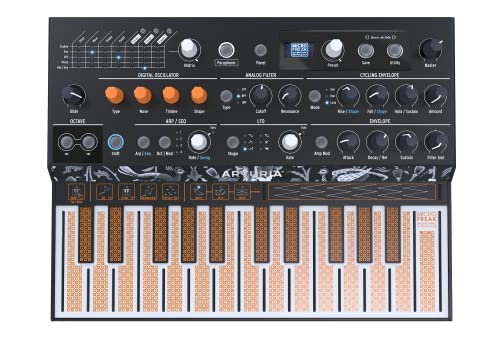
- 17 paraphonic oscillator modes
- Resonant analog filter and modulation matrix
- CV, USB, and MIDI connectivity
Best For: Advanced players who want a compact hybrid synth with deep sound design.
Modded Analog Bass Line
Behringer TD-3-MO-AM Bass Synth

- Pure analog VCO/VCF/VCA signal path
- 4-pole resonant low-pass filter
- 16-step sequencer with 250 user patterns
Best For: Players who want a sequencer-focused analog bass synth.
Portable Ribbon Analog
Korg monotron DUO Ribbon Synth

- Compact, lightweight portable design
- Simple interface for quick adjustments
- Analog sound profile with extra modulation
Best For: Portable, simple analog-style experimentation and sketching ideas.
Flagship Performance Pick – Subsequent 37 Analog Synthesizer
If you’re comparing analog synthesizers for deep sound design and hands-on control, the Moog Subsequent 37 stands out with a dense front panel and a very flexible signal path. It combines paraphonic playability, two oscillators, a sub oscillator, noise, and extensive modulation in a format built for serious programming.
Best For: Players who want a premium analog synth with extensive knobs, presets, and modulation for detailed studio work.
Pros:
- 40 knobs and 74 switches put sound-shaping controls within easy reach
- 2-note paraphonic keybed with 37 semi-weighted keys, velocity, and aftertouch
- 2 variable waveshape oscillators, sub oscillator, analog noise, and external input/filter feedback
- Includes 256 presets plus editor/librarian software for arranging and editing sounds
Cons:
- Large and relatively heavy compared with compact analog synths
- More complex than a simple beginner keyboard
- Built for depth, so it may be more instrument than some casual users need
This is a strong choice if you want a richly featured analog synthesizer that rewards real knob-twisting and modulation routing. The Subsequent 37 is clearly aimed at players who want expressive control and a broad palette rather than a stripped-down layout.
Portable Sound Design Pick – Stylophone GENX-2 Analogue Synthesizer
Among compact analog synthesizers, the Stylophone GENX-2 is geared toward fast idea capture and portable performance. Battery operation, a built-in speaker, and CV/Gate output make it easy to sketch sounds anywhere while still connecting into a wider hardware setup.
Best For: Musicians who want a portable analog synth with expressive controls and hardware connectivity.
Pros:
- Battery-powered with a built-in speaker for true grab-and-go use
- Flexible sound shaping with LFO, resonant low-pass filter, envelope, and PWM controls
- CV and Gate outputs can control modular and semi-modular gear
- Analogue delay and dual sub-octave switches add weight and character
Cons:
- Stylus-style keyboard may not suit players who prefer a traditional layout
- Smaller format offers less room than full-size synth keyboards
- Best suited to compact setups rather than large controller-style rigs
The GENX-2 is a practical pick if portability matters but you still want real synthesis controls instead of fixed presets. It blends retro stylophone playability with enough routing and tone-shaping to fit into modern gear setups.
Portable Rhythm Pick – Volca Beats Analog Rhythm Machine
Korg Volca Beats Analog Rythem Machine w/Electribe-style 16-step Sequencer and Real Analog Sounds
Check Price On AmazonIf your search for analog synthesizers is really about adding punchy rhythm to a setup, the Korg Volca Beats is a compact analog-digital hybrid made for quick programming. Its 16-step sequencer, built-in speaker, and battery power make it easy to build patterns anywhere.
Best For: Beginners and beatmakers who want a portable analog rhythm machine with simple sequencing.
Pros:
- Electribe-style 16-step sequencer keeps pattern creation straightforward
- Compact, portable design with built-in speaker and optional battery power
- SYNC In/Out and MIDI In support clocking and DAW control
- Eight memory patches help store custom sequences and patterns
Cons:
- It is a rhythm machine, not a full melodic synth
- Minimal parameters mean fewer deep sound-design options
- Some sounds rely on PCM rather than analog synthesis
The Volca Beats is a solid choice if you want immediate, compact beat-making with enough sync options to fit into a larger rig. It favors speed and portability over complex editing, which makes it easy to use but less flexible than a full-featured synth.
Pocket Classic Pick – Stylophone Original Pocket Synthesizer
For shoppers exploring analog synthesizers on a very small budget or form factor, the original Stylophone remains an easy entry point. Its touch-sensitive metal surface, stylus control, and built-in speaker deliver the classic retro sound in a pocket-sized instrument.
Best For: Beginners and collectors who want a tiny, battery-powered analog-style synth with instant playability.
Pros:
- Iconic stylus-controlled interface is simple to learn
- Compact, pocketable design with battery power and a built-in speaker
- Produces the original analog sound associated with the classic 1968 design
- Includes headphone socket and basic computer connectivity for recording
Cons:
- Very limited size and controls compared with larger analog synthesizers
- Not designed for complex sound programming
- Short warranty coverage compared with many larger instruments
The original Stylophone is best seen as a fun, ultra-portable instrument rather than a deep synthesis tool. If you want the classic stylus experience and a vintage character that is easy to carry and play, it does exactly that.
Editor’s Pick – MOOG Messenger Monophonic Analog Synthesizer
If you want an analog synthesizer that blends classic Moog character with modern workflow, the Messenger is built for exactly that job. Its mono voice, knob-per-function layout, and portable metal construction make it a practical choice for focused bass, lead, and sequence work in the studio or on stage.
Best For: Players who want a portable Moog monosynth with expressive controls, deep modulation, and performance-friendly sequencing.
Pros:
- Two continuously variable-shape VCOs with sync, FM, and a sub-oscillator for thicker low end
- Next-gen ladder filter with 4- or 2-pole low-pass, band-pass, and high-pass modes
- 32 semi-weighted full-size keys with velocity and aftertouch for expressive playing
- 64-step sequencer, arpeggiator, and 256 presets add useful performance flexibility
Cons:
- Monophonic design limits it to one note at a time
- More advanced modulation and patching may take time to explore fully
The Messenger stands out as a serious analog synthesizer for players who want Moog’s signature sound in a streamlined, portable format. It offers enough modern features to stay versatile while keeping the hands-on feel that many synth users want.
Hybrid Pick – Arturia MiniFreak 37-Key Polyphonic Synthesizer
Arturia MiniFreak 37 Key Polyphonic 6-Voice Hybrid Synthesizer Keyboard (Standard, 37 Key)
Check Price On AmazonThe Arturia MiniFreak is a strong choice if you want the flexibility of analog synthesizers without staying locked into a purely analog signal path. Its hybrid sound profile, 37 keys, and portable build make it approachable for beginners while still offering plenty of room to explore unusual sounds.
Best For: Players who want a compact hybrid synth for experimenting, learning, and making portable polyphonic parts.
Pros:
- Hybrid digital-and-analog sound opens up a wide range of tones
- 6-voice polyphony gives it more chordal flexibility than monophonic synths
- 37-key format keeps the instrument compact and portable
- Includes a VST counterpart for easier studio integration
Cons:
- Not a fully analog synth, so it may not fit purist buyers
- Smaller keyboard may feel limited for players who want a larger range
MiniFreak is best viewed as a creative hybrid instrument rather than a traditional analog workhorse. If your goal is to explore different sonic textures in a portable format, it is a very practical option among modern analog synthesizers.
Budget Bass Pick – Korg Volca Bass Analog Synthesizer
The Korg Volca Bass is a compact analog synthesizer built for thick bass lines, acid-style grooves, and easy hands-on sequencing. Its simple layout and battery-powered portability make it a practical pick when you want immediate results without a large footprint.
Best For: Producers who want a small, affordable bass-focused analog synth for groove building and portable use.
Pros:
- Three oscillators deliver a wide range of bass sounds
- 16-step sequencer with Active Step and slide functions supports groove creation
- Self-tuning helps reduce pitch drift, a common analog synth issue
- Battery power, built-in speaker, and compact size make it easy to use anywhere
Cons:
- Single VCF, VCA, LFO, and EG keep the architecture intentionally simple
- Best suited to bass parts rather than broader keyboard duties
If your priority is bass-heavy sequencing in a portable format, the Volca Bass delivers a focused experience. It is one of the more approachable analog synthesizers for fast groove creation and compact setups.
Hybrid Experimental Synth – Arturia MicroFreak Keyboard
If you’re comparing analog synthesizers but want something more adventurous, the Arturia MicroFreak stands out as a compact hybrid instrument with a lot of sound-design depth. It combines digital oscillator engines with a resonant analog filter, so you can move from physical modeling and wavetable textures to more classic subtractive-style shaping in one small keyboard.
Best For: Players who want an experimental hybrid synth with deep modulation, poly-aftertouch, and DAW/CV connectivity.
Pros:
- 17 paraphonic oscillator modes, including Arturia, Mutable Instruments, and Noise Engineering designs
- Resonant analog filter for hybrid sound shaping
- 25-key printed circuit board keyboard with individual pressure/aftertouch tracking
- CV, USB, and MIDI connectivity for modular or studio use
Cons:
- Compact control layout may feel unconventional if you prefer a traditional keyboard
- Best suited to advanced users rather than absolute beginners
The MicroFreak is a strong choice if you want an analog synthesizers roundup pick that prioritizes experimentation over familiar layout. Its sequencer, randomization tools, and wide oscillator range make it especially useful for evolving patches and unusual textures.
Modded Analog Bass Line – Behringer TD-3-MO-AM Bass Synth
The Behringer TD-3-MO-AM is a focused choice for anyone shopping analog synthesizers specifically for bass lines. It uses a pure analog signal path built around VCO, VCF, and VCA designs, plus a resonant 4-pole low-pass filter and a 16-step sequencer for classic pattern work.
Best For: Musicians who want an affordable, hands-on analog bass synth with sequencer-driven workflow.
Pros:
- Pure analog signal path based on classic VCO, VCF, and VCA designs
- 4-pole low-pass resonant filter with cutoff, resonance, envelope, decay, and accent controls
- 16-step sequencer with 7 tracks and 250 user patterns
- Compact desktop-friendly footprint
Cons:
- Primarily focused on bass-line duties rather than broad synth duties
- Limited control set compared with larger synths
As an analog bass specialist, the TD-3-MO-AM makes the most sense if you want punchy sequencing and hands-on filter shaping. It’s a practical pick for users who care more about immediate bass programming than a wide-ranging sound palette.
Portable Ribbon Analog – Korg monotron DUO Ribbon Synth
The Korg monotron DUO is a tiny, lightweight option for exploring analog synthesizers without a large footprint. Its analog sound profile and ribbon-style approach make it easy to carry and simple to use when you want quick sound-shaping and modulation in a very compact format.
Best For: Portable, simple analog-style experimentation and quick sketching of sound ideas.
Pros:
- Compact and lightweight design for easy transport
- Simple, intuitive interface for quick adjustments
- Provides extra modulation options for more dynamic sounds
- Analog sound profile in a very small form factor
Cons:
- Limited size means less hands-on control than larger synths
- Best for basic exploration rather than deep programming
If you want an analog synthesizer that’s easy to carry and fast to experiment with, the monotron DUO is a straightforward pick. Its simplicity is the point: it’s made for quick ideas, portable use, and low-friction sound exploration.
How We Picked the Best Analog Synthesizers
We prioritized sound quality, build, playability, sequencer and MIDI/CV integration, and how well each instrument fits a real-world use case. For Analog Synthesizers, the best choice is not always the most complex one; it is the one that matches your workflow and the kind of tones you actually want to make.
Quick Comparison
Think of this group in four buckets: portable pocket synths for experimentation, bass-focused instruments for low-end lines, performance-oriented monosynths for expressive lead work, and hybrid or semi-modular-style options for broader sound design. If you want instant character, choose a compact model. If you want a main studio instrument, look for stronger keyboard control, patchability, and deeper modulation.
Key Buying Factors for Analog Synthesizers
Sound Engine and Voice Count
Monophonic synths are ideal for basses, leads, and acid-style sequences. Paraphonic and polyphonic designs give you more chordal and harmonic flexibility, which matters if you want richer arrangements.
Controls, Sequencing, and Connectivity
Dedicated knobs, sliders, and ribbon controls make a big difference in live use and sound design. Also consider MIDI, CV/Gate, and onboard sequencing if you plan to integrate the synth with pedals, drum machines, or a DAW.
Size, Portability, and Power
Small Analog Synthesizers are great for travel and desk setups, but they may trade away key range or performance controls. Larger instruments usually offer a more complete playing experience and better studio ergonomics.
Filters, Modulation, and Character
A strong filter and flexible modulation section are often what separate an inspiring instrument from a basic one. If you want classic analog tone, prioritize instruments known for punchy bass, smooth sweeps, and responsive envelopes.
Who Should Buy Which Analog Synthesizers?
Beginners and portable-music fans should look at compact, easy-to-grab models. Beatmakers and bass producers will get the most from focused low-end synths and groove tools. Keyboard players and performers should lean toward fuller instruments with more expressive control, while experimenters may prefer hybrid or unconventional designs that expand beyond traditional subtractive synthesis.
In short, the best Analog Synthesizers are the ones that fit your space, your style, and your workflow. Match the instrument to your main job—bass, leads, portability, or performance—and you will get far more long-term value from your purchase.