The right XLR cable can help a high-end AV receiver deliver clean, balanced connections to amplifiers, powered speakers, subwoofers, and other components. The best choice depends less on marketing claims than on connector compatibility, cable length, shielding, construction, and system layout.
We selected 10 options spanning short audiophile interconnects, longer home-theater runs, budget-friendly pairs, and RCA-to-XLR designs for systems that require a different connection type.
Best 10 Xlr Cables for High End Av Receivers Picks for 2026
Flagship Audiophile Pick
Blue Truth Ultra XLR Stereo Pair

- 10-foot stereo pair for flexible routing
- Silver-coated conductors with Teflon insulation
- Neutrik connectors and 100% foil shielding
Best For: High-end balanced receivers, DACs, preamps, and amplifiers
Best Value Pair
Cable Matters Premium XLR 2-Pack

- Includes two 6-foot XLR cables
- 21 AWG oxygen-free copper conductors
- Braided shielding and strain-relieved connectors
Best For: Affordable stereo and replacement connections
Best for Long Stereo Runs
TODN J-Series Balanced XLR Pair

- 10-foot left/right stereo pair
- 20 AWG OCC copper with dual shielding
- Locking gold-plated connectors and braided jacket
Best For: Longer balanced stereo runs in hi-fi systems
Best Short Premium Cable

- 3.3-foot length for compact installations
- 5N OFC conductor with full copper shielding
- Rhodium-plated pure-copper connectors
Best For: Short, premium receiver-to-amplifier connections
Premium Audiophile Pick
Ultimate 6-Foot XLR Cable Pair

- 8.5pF/ft ultra-low capacitance
- Dual 18AWG, 99.99% OFC conductors
- Handcrafted tweed finish with Amphenol connectors
Best For: High-end systems where premium construction and presentation matter
Long-Run Value Pick
- 10-foot cables for flexible placement
- 22AWG, 99.99% OFC core
- Dual-layer shielding and locking connectors
Best For: Longer indoor receiver, amplifier, or rack connections
Compact Premium Pick

- 0.5-meter pair for tidy rack layouts
- Solid PSC+ conductors
- Triple-balanced geometry and shielding
Best For: Short connections between nearby XLR-equipped components
Best RCA-to-XLR Value

- 10-foot dual RCA-to-XLR male configuration
- 4N OFC wire with layered shielding
- Bending protection and organized paired design
Best For: RCA-equipped sources connecting to XLR inputs
Best Audiophile Pair
WORLDS BEST CABLES Ultimate XLR Pair

- Matched 2-foot left/right cable pair
- 18AWG ultra-pure OFC conductors
- Premium Amphenol male-to-female connectors
Best For: Short, polished connections in high-end audio racks
Best Shielded Pair
SVS SoundPath Balanced XLR Cable

- 6.56-foot pair for flexible equipment placement
- Five-layer shielding for RFI resistance
- Gold-plated contacts and high-purity conductors
Best For: Interference-conscious home and professional audio setups
Flagship Audiophile Pick – Blue Truth Ultra XLR Stereo Pair
For listeners seeking xlr cables for high end av receivers, the Blue Truth Ultra is a premium 10-foot stereo pair built for balanced home audio and theater connections. Its silver-coated conductors, Teflon insulation, and full foil shielding are designed for detailed, low-noise transmission.
Best For: Balanced audiophile systems using receivers, DACs, preamps, amplifiers, or disc and streaming sources.
Pros:
- 10-foot stereo pair provides flexible installation length
- Pure silver-coated conductors and Teflon insulation
- 100% foil shielding supports noise rejection
- Neutrik silver-plated male-to-female XLR connectors
Cons:
- Premium construction may be more than basic setups require
- Only a stereo pair is included
The Blue Truth Ultra is the strongest fit here for a high-end balanced system when build materials, shielding, and long-run flexibility are priorities.
Best Value Pair – Cable Matters Premium XLR 2-Pack
The Cable Matters 2-pack is a practical choice when you need dependable xlr cables for high end av receivers without paying for boutique construction. These 6-foot male-to-female cables use 21 AWG oxygen-free copper, balanced wiring, and copper braided shielding.
Best For: Value-focused receiver, preamp, speaker, mixer, and studio setups that need two standard 3-pin XLR connections.
Pros:
- Two cables provide convenient stereo or replacement coverage
- 21 AWG OFC conductors support clear balanced audio
- Copper braided shielding helps reduce interference
- Metal connectors include molded strain relief
Cons:
- Six-foot length may not suit larger installations
- Positioned as a versatile professional cable rather than a specialized audiophile model
With two cables in the box and durable everyday construction, this pair is a sensible option for straightforward balanced connections around an AV system.
Best for Long Stereo Runs – TODN J-Series Balanced XLR Pair
The TODN J-Series combines a 10-foot length with dual-channel labeling, making it a useful option for xlr cables for high end av receivers in stereo systems. Its 20 AWG OCC copper conductors, dual shielding, locking connectors, and braided jacket emphasize secure routing and interference reduction.
Best For: Hi-fi stereo systems, home audio, mixers, amplifiers, and other balanced setups needing clearly identified left and right cables.
Pros:
- 10-foot pair supports longer equipment layouts
- 20 AWG OCC copper conductors and dual shielding
- White and red channel markings simplify stereo setup
- Locking, gold-plated connectors and tangle-resistant braided jacket
Cons:
- Longer length can be excessive for compact racks
- Product notes specify a pair intended for stereo channels, limiting it to that configuration
The TODN pair is particularly convenient when channel identification and secure, well-shielded 10-foot runs matter as much as the underlying conductor design.
Best Short Premium Cable – Viborg VA801 Hi-End XLR
For compact equipment racks, the Viborg VA801 offers a 3.3-foot male-to-female connection with 5N oxygen-free copper and full pure-copper shielding. It is a focused choice among xlr cables for high end av receivers when short routing, connector quality, and protection from interference are important.
Best For: Short connections between AV receivers, amplifiers, mixers, audio interfaces, and other nearby professional audio equipment.
Pros:
- Compact 3.3-foot length helps manage short rack connections
- 5N OFC conductor supports clean signal transmission
- 100% pure-copper shielding helps resist EMI and hum
- Rhodium-plated pure-copper connectors and braided sleeve
Cons:
- Only one cable is included
- Short length may not work for widely spaced components
- Its premium connector and shielding design may exceed basic needs
The VA801 makes the most sense for a tidy, short-run installation where one premium XLR interconnect is needed and excess cable would be inconvenient.
Premium Audiophile Pick – Ultimate 6-Foot XLR Cable Pair
For listeners comparing xlr cables for high end av receivers, this handcrafted pair emphasizes low capacitance, heavy-gauge conductors, and premium connectors. Each 6-foot cable uses two 18AWG, 99.99% OFC conductors, braided shielding, and customized Amphenol XLR connectors for balanced connections between receivers, DACs, amplifiers, and preamps.
Best For: Audiophiles building a high-end stereo or home-theater system who want a polished, premium-looking cable pair.
Pros:
- Ultra-low 8.5pF/ft capacitance and two 18AWG OFC conductors.
- Premium Amphenol connectors with silver-plated machined contacts.
- Hand-applied tweed jacket, embroidered labeling, and reusable presentation packaging.
Cons:
- Its luxury construction may be more than a basic receiver connection requires.
- At 6 feet, it may not suit especially short or long installations.
This is the most presentation-focused option in the group, combining substantial construction with carefully specified conductors and connectors. It is a strong choice when finish and premium assembly matter alongside balanced signal connectivity.
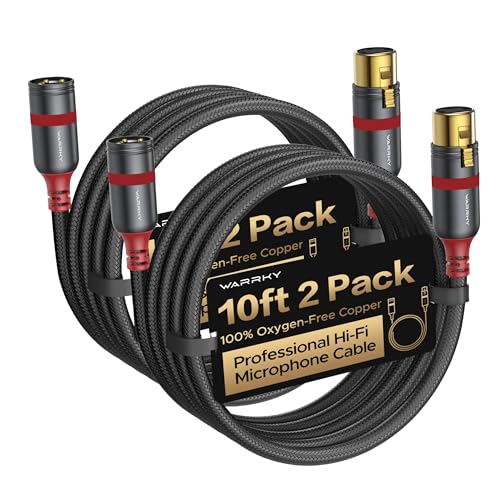
Long-Run Value Pick – Warrky 10-Foot XLR 2-Pack
These 10-foot cables are a practical option for xlr cables for high end av receivers when you need extra reach and a two-cable set. The male-to-female XLRs use 22AWG OFC conductors, aluminum housings, locking clips, and dual-layer shielding for receiver, amplifier, mixer, speaker, and other balanced-audio connections.
Best For: Longer indoor runs, equipment racks, and buyers who need two durable XLR cables at once.
Pros:
- 10-foot length provides useful flexibility around racks and room setups.
- Six-layer construction includes foil and 96-braid copper-mesh shielding.
- Aluminum housings, gold-plated connectors, locking clips, and strain relief support frequent use.
Cons:
- The 10-foot length can leave extra cable in compact setups.
- The supplied specifications identify it as an indoor-use cable.
Warrky focuses on practical durability and interference resistance rather than decorative finishing. For installations that need reach, shielding, and a pair of balanced cables, it offers a well-equipped configuration.
Compact Premium Pick – AudioQuest Red River XLR Pair
The AudioQuest Red River pair suits buyers seeking compact xlr cables for high end av receivers and other line-level components. At 0.5 meter per cable, it is designed for short connections between XLR-equipped AV receivers, streamers, preamps, monoblocks, and stereo amplifiers, with solid conductors, PSC+ metal, and triple-balanced geometry.
Best For: Short, tidy connections between nearby rack-mounted components and XLR-equipped home-audio electronics.
Pros:
- Compact 0.5-meter pair helps reduce excess cable in close equipment layouts.
- Uses solid PSC+ conductors and separate ground-reference geometry.
- Shielding and selected insulation are designed to minimize interference and distortion.
Cons:
- The short length limits placement flexibility.
- Its configuration is less suitable for widely separated components.
Red River is the most space-conscious choice here, aimed at clean, short interconnects rather than long routing. Choose it when your receiver and source or amplifier sit close together and you want a specified premium cable design.
Best RCA-to-XLR Value – JOLGOO Dual RCA-to-XLR Cable
For shoppers seeking xlr cables for high end av receivers with RCA source connections, the JOLGOO is a practical 10-foot option. Its dual RCA-to-XLR male configuration is designed for connecting compatible audio equipment, while 4N OFC wire and layered shielding support reliable signal transmission.
Best For: Connecting an AV receiver, amplifier, or stereo system with RCA outputs to equipment using XLR inputs.
Pros:
- 10-foot dual-cable design provides useful reach for home audio installations.
- 4N OFC wire, high-density shielding, and aluminum-foil shielding help protect signal integrity.
- Gold-plated and nickel-plated terminals with non-magnetic plugs are built for stable connections.
- Connector-bending protection and a paired cable design make routing and organization easier.
Cons:
- Uses male RCA and male XLR connectors, so it may not suit systems requiring female or balanced XLR connections.
- The 10-foot length may be excessive for compact equipment racks.
The JOLGOO is a sensible choice when you need a longer RCA-to-XLR connection rather than a conventional XLR-to-XLR interconnect. Confirm the connector genders and your receiver’s input/output layout before ordering.
Best Audiophile Pair – WORLDS BEST CABLES Ultimate XLR Pair
For high-end systems that need short, carefully assembled xlr cables for high end av receivers, the WORLDS BEST CABLES Ultimate pair emphasizes premium construction. The 2-foot male-to-female cables use low-capacitance, 18AWG ultra-pure OFC conductors and premium Amphenol connectors.
Best For: Short left-and-right-channel connections between compatible AV receivers, DACs, amplifiers, preamps, and other balanced audio equipment.
Pros:
- Sold as a matched pair for left and right channels.
- Ultra-low 8.5pF/ft capacitance and two 18AWG OFC conductors are designed for demanding audio setups.
- Premium Amphenol connectors feature silver-plated contacts and a satin nickel-finished shell.
- Braided tweed jacket, embroidered labeling, and reusable packaging provide a polished presentation.
Cons:
- At 2 feet, the cables may be too short for widely spaced components.
- The premium construction and presentation may be unnecessary for basic installations.
This pair is well suited to a tidy, high-end rack where components are close together and male-to-female XLR connections are required. Measure the route carefully because the short length leaves little room for repositioning.
Best Shielded Pair – SVS SoundPath Balanced XLR Cable
The SVS SoundPath pair is a strong contender for xlr cables for high end av receivers when interference rejection and connection security are priorities. These 6.56-foot male-to-male cables use three high-purity conductors and a five-layer shielding system for home or professional audio setups.
Best For: Connecting compatible balanced XLR equipment, including AV receivers, speakers, and other home or professional audio components.
Pros:
- 6.56-foot length offers flexible placement for many equipment layouts.
- Five-layer shielding includes a directionally connected outer shield and braided cotton jacket to resist RFI.
- 24K gold-plated electrical contacts support secure, conductive connections.
- Sold as a pair for convenient stereo or dual-channel setups.
Cons:
- Male-to-male connectors may not work with equipment requiring female XLR ends.
- Its 6.56-foot length may be longer than needed for closely stacked components.
Choose the SVS SoundPath when you want a balanced XLR pair with useful reach and extensive shielding. Verify that both connected devices accept male XLR plugs before purchasing.
How We Picked the Best Xlr Cables for High End Av Receivers
We focused on cables that suit serious home audio and home-theater systems, prioritizing balanced male-to-female XLR connections, reliable strain relief, shielding, conductor quality, and useful length options. We also considered whether each cable is sold as a pair, since stereo systems and many AV receiver connections require two cables.
Our selections include conventional XLR-to-XLR interconnects, premium audiophile-oriented designs, longer cables for equipment racks, and one RCA-to-XLR option. Cable construction matters, but compatibility and installation practicality matter more than extravagant claims about audible upgrades.
Quick Comparison
| Best For | What to Look For |
|---|---|
| High-end stereo components | Shielded, balanced XLR-to-XLR pair with secure connectors |
| Home-theater equipment racks | Six- to 10-foot cables for flexible component placement |
| Short interconnects | Two- to three-foot pair that reduces cable clutter |
| Budget-conscious systems | Reliable construction and correct connector gender |
| Mixed RCA/XLR equipment | Purpose-built RCA-to-XLR cable, with attention to signal compatibility |
Key Buying Factors for XLR Cables for High-End AV Receivers
Connector Type and Signal Path
Confirm that your receiver and connected component use balanced XLR inputs and outputs. Standard interconnects typically use male XLR on one end and female XLR on the other. Do not assume an XLR socket automatically means a fully balanced signal path; consult the manuals for your receiver, amplifier, DAC, or subwoofer.
Length and Cable Management
Choose the shortest practical length without forcing sharp bends or putting tension on the connectors. Short cables work well between stacked components, while six- or 10-foot options are more practical for separated amplifiers, powered subwoofers, or large equipment cabinets.
Shielding and Construction
Good shielding helps reduce hum and interference, particularly near power cables, wireless equipment, and switching supplies. Flexible jackets, strong strain relief, and snug connector tolerances are useful everyday features. Gold-plated contacts can resist corrosion, but they are not a substitute for sound mechanical construction.
Pairing and Compatibility
Check whether the listing includes one cable or a stereo pair. Also verify wire routing and connector gender before ordering. RCA-to-XLR cables can solve connection problems, but they may not provide the same balanced operation as a true XLR-to-XLR connection.
Who Should Buy Which Xlr Cables for High End Av Receivers?
Choose a premium audiophile pair if your system is already carefully assembled and you want refined construction, distinctive materials, or a polished finish. For most receivers and power amplifiers, a well-built mainstream balanced cable offers the most practical value. Longer 10-foot pairs suit equipment racks with generous separation, while compact pairs are ideal for close-set components.
If you are connecting an AV receiver to balanced subwoofers or amplifiers, prioritize the correct XLR configuration, adequate length, and effective shielding over branding. For mixed-output systems, select the RCA-to-XLR model only after confirming the receiving equipment’s input requirements. In every case, buy the cable that fits the connection and installation first; price and specialty materials should come second.